


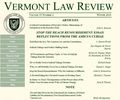
VTLREV_coverAs we noted here (when we posted our article), the latest issue of the Vermont Law Review deals with the U.S. Supreme Court’s “judicial takings” case, Stop the Beach Renourishment, Inc. v. Florida Dep’t of Environmental Protection, 130 S.Ct. 2592 (June 17, 2010). 

In eight essays, the authors of several of the many amicus briefs add their post-opinion thoughts. Authors include Ilya Shapiro (Cato Institute), Professor John D. Echeverria (Vermont Law), and Julia Wyman (Marine Affairs Institute). The groundwork is laid in the first article, by Professor L. Kevin Wroth:

If hard cases make bad law, bizarre cases may make no law at all. The recent Supreme Court decision, Stop the Beach Renourishment, Inc. v. Florida Department of Environmental Protection is a case in point. In the Essays that follow, the Vermont Law Review has brought together the reflections of seven lawyers, or teams of lawyers, for amici curiae
Continue Reading Vermont Law Review: Essay Reflections From The Amicus Curiae In The Judicial Takings Case

For anyone not watching the game, here’s your Sunday fix of items that do not involve football:

  • The Institute for Justice — the good people who represented Mrs. Kelo in Kelo v. City of New London, 545 U.S. 469 (2005) — have posted this short video entitled “Kelo v. City of New London: Judicial Abdication in Action.” Money quote: “What does Fort Trumbull look like today? Today, the Fort Trumbull neighborhood is a barren wasteland.”
  • The New York Times (itself the corporate beneficiary of eminent domain), posts the story “Blighted Area? These Business Owners Beg to Differ,” about the latest case of alleged “blight” and redevelopment in New York City, this time from East Harlem. Unless there is something here that we’re missing, New York’s law of blight and public use are so skewed in favor of the condemnor as recently reaffirmed in the


Continue Reading Super Bowl Sunday Links

The last chapter in the Ninth Circuit’s rent control saga has not been written. In Guggenheim v. City of Goleta, No. 06-56306 (Dec. 22, 2010), a sharply divided en banc Ninth Circuit concluded that Goleta’s mobile home rent control ordinance was not a taking under the three-factor regulatory taking test of Penn Central Transportation Co. v. New York City, 438 U.S. 104 (1978). Our resource page on the case is here (includes all opinions and merits and amicus briefs).

Mark Alpert (one of the attorneys for the property owners) reports on his blog California Property Rights Journal:

We are happy to announce that Dan Guggenheim has made the decision to file a cert petition. We are thrilled that Dan has been able to retain former Solicitor General Ted Olson and his appellate team at Gibson, Dunn to lead the effort along with myself and Rob Coldren at HKC.

With a panel

Continue Reading Cert Petition Coming In Ninth Circuit Rent Control Takings Case (Guggenheim)

In a case with “a lengthy procedural history spanning the past three decades and involving litigation in various federal courts,” in Innovair Aviation Ltd. v. United States, No. 2010-5025 (Jan. 25, 2010), the United States Court of Appeals for the Federal Circuit held that the Court of Federal Claims had no subject matter jurisdiction to consider Innovair’s takings claim because “Congress provided a comprehensive administrative and judicial system in the district courts to review the in rem forfeiture of property seized pursuant to 21 U.S.C. § 881.”  Slip op. at 18.

The case involves the government’s seizure of modified DC-3 airplanes sold to Air Columbia and allegations of drug smuggling, FAA regulations and the right to market turboprop conversion kits, and substitute res bonds. Relying on Vereda LTDA v. United States, 271 F.3d 1367 (Fed. Cir. 2001), the court concluded that a Tucker Act remedy was not available

Continue Reading Federal Circuit: Tucker Act Not Available When Congress Provides Other Relief

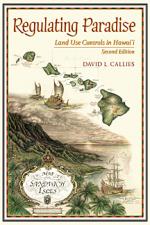
Regulatingparadise For those of you who do not yet have your copy of University of Hawaii lawprof David L. Callies‘ recent book Regulating Paradise – Land Use Controls In Hawaii, here’s your chance to get it signed by the author himself.

This Saturday, January 29, 2011 from 2:00 to 3:00 p.m., Professor Callies will be selling and signing at the Barnes & Noble at Ala Moana Center.

As we wrote in our initial review of the book, it’s a must-have for every dirt lawyer’s bookshelf. It is the one essential book if you want to understand Hawaii land use law, so it also belongs on the shelf of every Hawaii landowner, government regulator, environmentalist, and politician. At $22, it is a real bargain. Continue Reading Book Signing: Regulating Paradise – Land Use Controls In Hawaii (2d ed. 2010)

In California Trailer Parks War: Owners Vs. Renters, Time magazine takes a look at the mobile home rent control issues behind the recent Ninth Circuit en banc opinion in Guggenheim v. City of Goleta (our resource page on the case is here). Be sure to take the article’s implicit conclusion (the mobile home owners are getting reamed by the Simon Legree park owners) with a grain of salt – the author’s bias shines through pretty clearly:

  • The rent control ordinances are keeping mobile home park owners from “enjoy[ing] explosive upticks in value” experienced by other California land owners. It’s only fair, after all, that such profiteers not be allowed to make beneficial use of their land.
  • The mobile home park owners employ “lawyers as foot soldiers” in their war on the tenant featured in the article, whom we are told “take peaceful walks with his wife and


Continue Reading Time On Guggenheim – California Rent Control In The (Biased) Spotlight

To all of you who attended the first day of the Hawaii Land Use Conference today, thank you. As promised, here are the items I discussed during my two sessions:

  • United States v. Milner, 583 F.3d 1174 (9th Cir. 2009) – the case in which the Ninth Circuit affirmed a finding of common law trespass for the building of a wall on fast land, because the shoreline eventually eroded up to it. Both parties had “vested rights” to an ambulatory littoral boundary. The U.S. Supreme Court denied review, as noted here.


Continue Reading Cases And Links From Today’s Hawaii Land Use Conference Sessions On Coastal Issues And Water Law

11.LULHI This Thursday (January 13, 2011) I’ll be leading two sessions at the fifth Hawaii Land Use Law conference at the Ala Moana Hotel in Honolulu. This conference takes place biannually, so this is your last chance until 2013 to get updated on the hottest topics, by a stellar faculty.

My sessions will cover Coastal Issues (which includes shoreline boundary, takings, and the U.S. Supreme Court’s Stop the Beach Renourishment case), and Water Issues (which will cover instream flow standards, public trust and private rights, and the Maui Water cases). The conference continues on Friday. Download the brochure here for a complete agenda.

The planning chairs, U. Hawaii Law Professor David Callies (U. Hawaii Law) and Ben Kudo (Imanaka, Kudo and Fujimoto), have assembled a talented and interesting faculty. The keynote speaker will be Professor Gideon Kanner, who will present “Taking a Critical Look at 30 Years of the Supreme Court’s

Continue Reading There’s Still Time To Register And Attend The Fifth Hawaii Land Use Conference

In Navajo Nation v. United States, No. 2010-5036 (Jan. 10, 2011), the U.S. Court of Federal Claims concluded that the Nation’s claim that a development moratorium resulted in a taking was barred by the six year statute of limitations.

The Nation asserted that a 1934 federal statute created a property interest in an area known as the “Bennett Freeze area,” and that the federal government took that right when it precluded the Nation from any development within the area. The facts and legal background of the case are somewhat convoluted, and you can read the opinion if you are interested, but here’s the essence of the court’s analysis:

Here, the Navajo Nation’s takings claim, if any, accrued when the United States precluded it from developing land within the Bennett Freeze area without Hopi Tribe ap-proval. This was the only governmental action that served to restrict any right the Nation

Continue Reading Federal Circuit: Takings Claims By Navajo Nation Barred By Statute Of Limitations

What we’re reading today:


Continue Reading Friday Round-Up: Takings Ripeness, Defining “Hawaiian” Cultural Practices, Penn Central, and Judicial Takings