Cutting_edge_2010

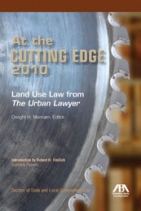
The ABA has announced the forthcoming publication of a new book by the State and Local Government Law Section: At the Cutting Edge 2010: Land Use Law from The Urban Lawyer, edited by my colleague Dwight H. Merriam, and which is “[a]n essential resource for practitioners, planning professionals and students, this book provides information and insight into timely issues impacting land use law.”

It’s not available just yet, but is scheduled for publication on December 31, and is available for pre-order here (the usual discounts for ABA/Section members, and for law student members, apply).

I contributed a chapter, Recent Developments in Challenging the Right to Take in Eminent Domain. I received my advance copy today, and it’s a handy little volume that has the latest developments in the law relating to (among other subjects):

  • Cellular telecommunications facilities
  • Exactions and impact fees
  • Trends in green buildings laws
  • Ethical


Continue Reading New Book: At The Cutting Edge 2010: Land Use Law From The Urban Lawyer

11.LULHI On January 13 and 14, 2011, I’ll be leading two sessions in the fifth Hawaii Land Use Law conference. This one only comes around every two years, so this is your chance to get updated on the hottest topics by a stellar faculty.

My sessions will cover Coastal Issues (which includes shoreline boundary, takings, and the U.S. Supreme Court’s Stop the Beach Renourishment case), and Water Issues (which will cover instream flow standards, public trust and private rights, and the Maui Water cases).

The keynote speaker will be Professor Gideon Kanner, who will present “Taking a Critical Look at 30 Years of the Supreme Court’s Takings Jurisprudence.” That alone will be worth the admission price.

Also of note: the seminar includes 3.25 Hawaii MCPE ethics credits, so you can fulfill your 2011 requirements in one sitting (you can attend the ethics portion for only $195). Members of the HSBA

Continue Reading January 13-14, 2011: Fifth Hawaii Land Use Conference

This just in: the en banc Ninth Circuit, in an opinion by Judge Kleinfeld (the dissenter from the panel opinion) has concluded that the City of Goleta’s mobile home rent control ordinance is not a regulatory taking. In Guggenheim v. City of Goleta, No. 06-56306 (Dec. 22, 2010), the majority “assumed without deciding” that the case was ripe under Williamson County, but that the property owners did not establish a regulatory taking under Penn Central. We covered the en banc oral arguments here, and our resource page on the case is here.

There’s a lot of opinion to churn through, but the core of the majority opinion is based on the notion that the Guggenheims did not have “investment-backed expectations.” Imposing what can only be called a bizarre economic and appraisal theory, the majority concluded:

Whatever unfairness to the mobile home park owner might have

Continue Reading En Banc 9th Circuit Decides Guggenheim: Mobile Home Rent Control Ordinance Is Not A Regulatory Taking

We’re going to wrap up 2010 with a post on our favorite topic, inverse condemnation. While the Ninth Circuit ended the year badly by making hash of both Penn Central and Palazzolo in a rent control case, other federal courts of appeals aren’t so predictably off-key. The Federal Circuit, which hears appeals from the U.S. Court of Federal Claims (the court with jurisdiction to hear most claims against the federal government for just compensation), is one in which a property owner has a decent shot at getting a court that understands the issues. 

The Federal Circuit has a “bright-line rule” that the six year statute of limitations begins to run on a physical takings claim in a rail-to-trail case when a property owner’s state law reversionary interest is blocked. Caldwell v. United States, 391 F.3d 1226 (Fed. Cir. 2005) and Barclay v. United States, 443 F.3d 1368

Continue Reading Federal Circuit: Physical Taking Is Complete When Statute Of Limitations Begins To Run

The Vermont Law Review has published an article authored by me and my Damon Key colleagues (and fellow law bloggers) Mark M. Murakami and Tred Eyerly. The article is an essay with our thoughts about the U.S. Supreme Court’s decision in Stop the Beach Renourishment, Inc. v. Florida Dep’t of Environmental Protection, No. 08-11 (June 17, 2010).

That’s the “judicial takings” case involving accretion rights and Florida’s “renourished” beaches. Disclosure: we filed an amicus brief supporting the property owners in the case. We argue in the article that despite eight Justices concluding the Florida Supreme Court’s decision in the case was not a judicial taking, the doctrine remains viable. The article suggests a roadmap for how future cases can be analyzed.

Download the pdf here, or get it below.

Of Woodchucks and Prune Yards: A View of Judicial Takings From the Trenches, 35 Vt. L. Rev.

Continue Reading New Article – Of Woodchucks and Prune Yards: A View of Judicial Takings From the Trenches

Aliaba

Thursday-Saturday, February 17-19, 2011, come join us for the 28th annual presentation of the advanced-level ALI-ABA Course of Study, Eminent Domain and Land Valuation Litigation, and the sixth annual presentation of the basic-level ALI-ABA Course of Study, Condemnation 101: Making the Complex Simple in Eminent Domain, both at the Hyatt Regency in Coral Gables (Miami), Florida. Both courses also are offered via live webcast, available either in their entirety or in segments.

Update: Register online between December 12 and December 31, 2010, and you can get a 30% tuition break. Simply enter coupon code DECS30 when you check out to receive your discount (this includes ALI-ABA’s, live and online courses, telephone seminars, webcasts and on-demand CLE, coursebooks, DVDs, mp3s, subscriptions to periodicals, books, and all online content, including forms). This offer may not be combined with other ALI-ABA discounts, group rates or bundled products. This discount is only available for new

Continue Reading Mark Your Calendars – Feb. 17-19, 2011: Annual ALI-ABA Condemnation Law Programs

The court has posted the recording of yesterday’s oral argument in Leone v. County of Maui, No. 29696, a case that we’ve been following closely involving federal regulatory takings claims, Williamson County ripeness, and the practical effect of the Hawaii Supreme Court’s decision in GATRI v. Blane, 88 Haw. 108, 962 P.2d 367 (1998) regarding zoning and planning for land in the Special Management Area.

We live blogged the argument, and now you can listen and follow along. Be warned, the file is an 84 mb mp3, so be prepared for a long download. Still not scared off? Download it here.

Briefs in the case are posted here.Continue Reading Oral Argument Recording In HAWICA Takings And Ripeness Case

We’ve been meaning to post links to these items for a while:

Continue Reading Monday Round Up

As we have noted previously, we love creative lawyering. But sometimes … well, just check this case out for an unusual approach to “takings” claims.

In McCarthy v. City of Cleveland, No. 09-4149 (Nov. 9, 2010), the U.S. Court of Appeals for the Sixth Circuit dismissed a claim that the city’s red light and traffic camera ordinance effected a taking of property because it imposed liability on the owner of the vehicle. The plaintiffs leased their cars and received traffic citations which they did not contest.

The plaintiffs filed federal takings claim in Ohio state court (as required by Williamson County), but the city (as allowed by International College of Surgeons) removed the case to federal district court. Long story short: the district court dismissed, the Sixth Circuit affirmed:

These two examples, in which the Supreme Court found a per se taking of funds, explain

Continue Reading Sixth Circuit: Red Light Camera Ordinance Not A Taking

In CRV Enterprises, Inc. v. United States, No. 2009-5100 (Nov. 17, 2010), the U.S. Court of Appeals for the Federal Circuit concluded that the EPA’s installation of a “log boom” in the Old Mormon Slough in Stockton, California as part of the remediation of a Superfund site was not a physical taking of CRV’s riparian and littoral access rights:

Here, there has been no physical invasion of the plaintiffs’ land. The log boom is anchored to the bottom of the Slough. Plaintiffs do not contend that they own the bed of the Slough. Nor do the plaintiffs claim that they own the water itself. In fact, plaintiffs admit they do “not assert that [they] owned the [Slough], the waters within it, or the Slough’s bed.” Appellant’s Reply Br. 8. Riparian and littoral rights do not convey ownership to the water but only rights to use the water.

Continue Reading Federal Circuit: No Physical Taking, No Regulatory Taking