A couple of days ago, we posted “Final Briefs In Hawaii Beach Takings Case: Is ‘Future’ Accretion A Present Property Interest?” with what we thought was a complete set of the merits and amicus briefs filed in Maunalua Bay Beach Ohana 28 v. State of Hawaii, No. 28175 (cert. application filed Apr. 22, 2010).

Turns out we missed one set, the amicus brief of Hawaii’s Thousand Friends which urges the Hawaii Supreme Court not to accept the application for a writ of certiorari filed by the property owners, and the property owners’ brief responding to HTF’s brief.

Here they are:

[Our usual disclosure: we filed an amicus brief in the Intermediate Court of Appeals supporting the property owners, and recently filed an amicus brief in the Supreme Court].

Unless there is another

Continue Reading Final (Final) Briefs In Hawaii Beach Taking Case: Is “Future” Accretion A Present Property Interest?

Here are the latest filings in Maunalua Bay Beach Ohana 28 v. State of Hawaii, No. 28175 (cert. application filed Apr. 22, 2010). In that case, the property owners are asking the Hawaii Supreme Court to review the decision of the Intermediate Court of Appeals in Maunalua Bay Beach Ohana 28 v. State of Hawaii, 122 Haw. 34, 222 P.3d 441 (Haw. Ct. App. 2009), which held that “Act 73” (codifed here and here) was a taking. [Disclosure: we filed an amicus brief in the ICA supporting the property owners, and recently filed an amicus brief in the Supreme Court – see below].

In Act 73, the legislature declared that title to shoreline land naturally accreted cannot be registered by anyone except the State, and that only the State could quiet title to accreted land. The ICA held that the Act was a taking of accreted land

Continue Reading Final Briefs In In Hawaii Beach Taking Case: Is “Future” Accretion A Present Property Interest?

This just in: the Ninth Circuit has issued an opinion in Adam Bros. Farming, Inc. v. County of Santa Barbara, No. 09-55315 (May 14, 2010).

Adam Bros. Farming, Inc. and Iceberg Holdings, L.L.C. (collectively “Adam Bros.”) appeal from the district court’s dismissal of their joint complaint. Adam Bros. sued the County of Santa Barbara and several of its employees (collectively “the county”) in federal court, alleging that the county had, through a false wetland delineation, temporarily taken its land without providing just compensation in violation of the Fifth Amendment. The district court granted the county’s motion to dismiss and concluded that Adam Bros.’s claim was not ripe because Adam Bros. failed to demonstrate that it had sought and was denied just compensation under state law. Because we conclude that Adam Bros.’s claim is barred by the application of res judicata, we affirm the district court’s judgment.

More to follow after a chance to digest the opinion.
Continue Reading New Ninth Circuit Ripeness And Res Judicata Regulatory Takings Case

Orange-fruit-2When the state purposely destroys healthy citrus trees as part of a program to address citrus canker, it must pay the owners of the trees just compensation.

In Dep’t of Agriculture & Consumer Services v. Borgoff, No. 4D08-4474 (May 12, 2010), the Florida District Court of Appeal (Fourth District) affirmed an $11 million class action jury verdict ordering the Department of Agriculture to pay for the more than 100,000 non-commercial trees it cut down and destroyed in Broward County. The Department’s eradication program destroyed any citrus tree within 1,900 feet of any tree found with citrus canker. The court concluded this was a taking: 

Cutting down and destroying healthy noncommercial trees of private citizens could hardly be more definitively a taking. Government has regulatory power for the very purpose of safeguarding the rights of citizens, not for destroying them.

Slip op. at 6 (footnote omitted) (emphasis added). The court

Continue Reading Florida Court Of Appeal: State Must Pay When It Destroys Healthy Orange Trees

SCOTUSblog has listed Sharp v. United States, No. 09-820 as a “petition to watch” for the Court’s conference today.

May 17, 2010 Update: cert. denied.

In that case, the property owners are asking the U.S. Supreme Court to review the Ninth Circuit’s decision in United States v.  Milner, 583 F.3d 1174 (9th Cir. 2009), which held that a littoral owner was liable for trespass in waters held by the federal government for the benefit of the Lummi Nation, and for violation of the Rivers and Harbors Act formaintaining a “shore defense structure.” The structure was built onprivate fast (dry) land, but the shoreline eventually eroded up to it.

In the opinion, detailed in this post, the Ninth Circuit held that “both the tideland owner and the upland owner have a right to anambulatory boundary, and each has a vested right in the potential

Continue Reading Petition To Watch: Is A Littoral Owner Trespassing When The Shoreline Erodes?

Vanderbilt lawprof James Ely (if you haven’t read his book The Guardian of Every Other Right: A Constitutional History of Property Rights (1998), you really should) writes on the topic du jour, the nomination of SG Elena Kagan to the Supreme Court in Stevens, Kagan and property rights.

Most of the article focuses on Justice Stevens’ record in property cases:

However, in at least one important area of constitutional law – the rights of property owners – Justice Stevens’ record fell woefully short of protecting the interests of average citizens. In fact, Justice Stevens consistently dismissed property rights claims and voted to strengthen government control over the lives of individuals.

He concludes with this:

Hopefully Elena Kagan, Mr. Obama’s nominee to replace Justice Stevens, holds a more balanced view of the importance of property rights in the American constitutional order. As in many other fields of law, however

Continue Reading Ely On “Stevens, Kagan and Property Rights”

Yesterday, I had the pleasure of speaking to members of the Western Manufactured Housing Communities Association about some of the legal issues facing their businesses, and property owners in general. Here are the links I mentioned:

  • Guggenheim v. City of Goleta, 582 F.3d 996 (9th Cir. 2009) (en banc review ordered Mar. 12, 2010). This is the very important case regarding the city’s mobile home rent control ordinance, which the Ninth Circuit panel concluded worked a facial taking of property under Penn Central. We have the briefs which have been filed for en banc review, and will be posting them in the upcoming days. Most definitely a case to watch.
  • A recent opinion from the California Court of Appeal in another rent control


Continue Reading Links From WMA Presentation – Regulatory Takings, Rent Control, And Guggenheim

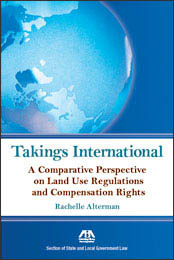
5330205_big My ABA State & Local Government Law colleague Andy Gowder has posted on his blog Grounded, a report and summary of the recent Miami panel discussion of Takings International: A Comparative Perspective on Land Use Regulations and Compensation Rights (Mar. 2010; $95 regular price; $75 for SLG members). 

Takings International is a comparative study of how 13 jurisdictions worldwide treat what we in the U.S. call “regulatory takings.” Visit this page for the Table of Contents and a pdf of Chapter I (scroll to the bottom of the page). Our book review is here.

I concur with Andy’s assessment that it was a fascinating and informative session (and I disclaim any bias resulting from the fact I served as moderator).

The panelists highlighted the issues discussed in the book, and Andy reports:

Professor Alterman began her remarks by pointing out that though no other country comes close to

Continue Reading “Takings International” Panel Report

Yesterday, we filed this motion for leave to file brief amicus curiae and a copy of the proposed brief in support of the application for writ of certiorari which asks the Hawaii Supreme Court to review the decision of the Intermediate Court of Appeals in Maunalua Bay Beach Ohana 28 v. State of Hawaii, 122 Haw. 34, 222 P.3d 441 (Haw. Ct. App. 2009).

In Maunalua Bay, the ICA held that “Act 73” (codifed here and here) was a taking. In the Act, the legislature declared that title to shoreline land naturally accreted cannot be registered by anyone except the State, and that only the State could quiet title to accreted land.

The ICA, however, held that the Act was a taking only of existing accreted land, but was not a taking of what the ICA called “future accretions.” The court held that because “future” accretion might

Continue Reading Amicus Brief In Hawaii Beach Taking Case: “Future” Accretion Is A Present Property Interest

The property owners have filed an application for a writ of certiorari asking the Hawaii Supreme Court to review the decision of the Intermediate Court of Appeals in Maunalua Bay Beach Ohana 28 v. State of Hawaii, 122 Haw. 34, 222 P.3d 441 (Haw. Ct. App. 2009).

Disclosure: we filed an amicus brief supporting the property owners in the ICA, available here, and will be submitting a motion for leave to file an amicus brief urging the Supreme Court to accept the application for cert.

In its opinion, the ICA held that “Act 73” (codifed here and here) was a taking. In the Act, the legislature declared that title to shoreline land naturally accreted cannot be registered by anyone except the State, and that only the State could quiet title to accreted land. The ICA held that the Act was a taking of existing accreted land, but

Continue Reading Cert Application In Hawaii Beach Taking Case: Legislative Reassignment To The State Of The Right To Future Accretion Is A Taking