


At its upcoming April 30, 2010 conference, the U.S. Supreme Court is considering the cert petition in a case we’ve been following since it was decided by the Court of Federal Claims. In Palmyra Pacific Seafoods, L.L.C. v. United States, No. 09-766 (cert. petition filed Dec. 28, 2009), the Court is presented with the following Questions Presented:

1.  Are private contracts property protected by the Takings Clause of the Fifth Amendment to the Constitution?

2.  Assuming that private contracts are property protected by the Takings Clause, is the federal government liable for regulatory as well as appropriative takings of private contracts?

The CFC and the Federal Circuit both rejected the claim that the Secretary of the Interior’s designation of the waters surrounding Palmyra and Kingman Reef as National Wildlife Refuges and attendant commercial fishing ban was a taking of Palmyra Pacific Seafood’s exclusive licenses to operate commercial fish processing
Continue Reading Was Ban On Palmyra Commercial Fishing A Taking Of The Right To Operate Seafood Processing Facilities?

A fascinating case is now pending in Hawaii’s Intermediate Court of Appeals involving the nature of “Torrens” title and, in a broader sense, the nature of property rights themselves. 

Hawaii has had a dual system of land registration. One is your run-of-the-mill system of registering deeds (what we creatively call “Regular System”). The other is “Land Court” registration, a statutory Torrens scheme of title registration where the State guarantees indefeasible title to the rights and interests reflected in the register. Land Court registration insures that interests which are not reflected on title do not exist. Indeed, persons who are wrongfully deprived of land or their interest through registration or the act or omission of the registrar are entitled to be paid by an indemnity fund, and the State’s guarantee operates against all claims, including claims by the State itself. 

As background (for those of you who, like me, weren’t paying

Continue Reading Land Court, Schmand Court: State Disregards Torrens Title, Claiming Unstated, Preexisting Rights

What we’re reading today:

  • Curbing abuse of eminent domain – A Denver Post editorial on a new Colorado statute designed to limit the power of the government to declare farmland “blighted” (“The new law says land that has been classified by the county assessor as agricultural land cannot be condemned for urban renewal. However, it makes an exception for agricultural land that is an enclave within cities and has had development around it for at least three years. We will have to see how the law shakes out in the coming years, but that seems to be an awfully big exception. That’s exactly the kind of land that usually needs the most protection from government.”).


Continue Reading Sunday Eminent Domain Round-Up

To paraphrase comedian Jeff Foxworthy, if you understand the title of this post…you might be a regulatory takings lawyer.

And when you hear the terms “RookerFeldman” and “San Remo,” you know you are knee deep in the often-bizarre procedural maze where a regulatory takings claim in federal court may be too early (ripeness), too late (preclusion and full faith and credit), or completely barred (RookerFeldman).

The RookerFeldman doctrine posits that federal district courts do not have jurisdiction to review the decisions of state supreme courts, where it is alleged that the state court’s judgment itself violates the plaintiff’s federal rights. San Remo Hotel, L.P. v. City and County of San Francisco, 545 U.S. 323 (2005) is the Supreme Court’s most recent “ripeness” decision, affirming that property owners do not have to bring their federal takings claims

Continue Reading 8th Circuit: Rooker-Feldman Not Applicable, But Federal Claims Precluded Under San Remo

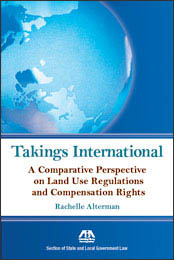
5330205_big I’ve finally had a chance to peruse the recently-published book Takings International: A Comparative Perspective on Land Use Regulations and Compensation Rights (ABA Section of State and Local Government Law 2010; $95 regular price; $75 for SLG members).

Takings International is about how 13 jurisdictions worldwide treat what we in the U.S. call “regulatory takings.” For those of us who have a keen interest in this area of law, this book is a goldmine of information about how the rest of the world deals with the issue. For those who may not be quite as interested, it is still a fascinating survey of how others treats the modern regulatory state’s impact on private property.

The book is headlined by Professor Rachelle Alterman (Technion-Israel Institute of Technology), and contains chapters authored by other experts on regulatory takings. It is divided up into several sections. In Part I, Professor Alterman provides an


Continue Reading Book Review: Takings International: A Comparative Perspective on Land Use Regulations and Compensation Rights

When one lawyer writes that another is “my friend and colleague,” watch out: what follows may not be exactly friendly or collegial. For legal academics, the rule is even more pronounced when the friend-and-colleague’s name shows up in the title of an article.

In that vein, we bring you the latest chapter in the ongoing debate about “background principles” in regulatory takings analysis. In Background Principles, Takings, and Libertarian Property: A Response to Professor Huffman (posted on SSRN here), lawprofs Michael C. Blumm and J.B. Ruhl respond to Professor James Huffman’s critique of their work.

A short refresher. The “background principles” issue was spawned by Lucas v. South Carolina Coastal Commission, 505 U.S. 1003 (1995), the case in which the Court held that a regulation takes property when it deprives a property owner of “economically beneficial or productive use of land,” even if the government’s reasons for enacting

Continue Reading Be Careful Of Lawprofs Bearing Praise: Another Chapter In The “Background Principles” Debate

More on the closely-followed case rent control regulatory takings decision from the Ninth Circuit, Guggenheim v. City of Goleta, No. 06-56306 (Sep. 28, 2009), which is currently being reheard en banc by the Ninth Circuit.

Earlier, we posted a link to Professor Richard Epstein’s short article, Takings Law Made Hard, in which he opines that “[j]udged by the normal canons of judicial review, the likely outcome is that the [Supreme] Court will do to … Guggenheim what it did to Judge Kozinski [in Hall v. City of Santa Barbara, 813 F.2d 198 (1987)]: reverse and enter judgment for the defendant.” 

Responding to Professor Epstein, Pacific Legal Foundation’s RS Radford has posted Takings victories made harder, pointing out the “technical deficiencies” in Epstein’s article that undermine his conclusions. Radford writes:

Whatever Prof. Epstein’s reasons may have been for rushing into print to condemn the Guggenheim decision, his

Continue Reading Making Regulatory Takings Harder

In granting a special zoning exemption to Shelter House, Iowa City allowed it to build a homeless shelter on land next to Mr. and Mrs. Dahlen’s mobile home park. After losing their challenge to the zoning exemption, the Dahlens filed suit in federal court alleging the exemption violated their due process rights.

That claim was abandoned when the Dahlens amended their complaint to allege that they owned a portion of the Shelter House property by adverse possession, and the city’s approval of a site plan for the homeless shelter was an uncompensated taking of their property. The District Court dismissed the amended complaint because it was not ripe under Williamson County Regional Planning Comm’n v. Hamilton Bank of Johnson City, 473 U.S. 172 (1985).

In Dahlen v. Shelter House, No. 09-1909 (8th Cir. Mar. 24, 2010), the U.S. Court of Appeals for the Eighth Circuit agreed. The Dahlens

Continue Reading 8th Circuit: Federal Takings Lawsuit Not Ripe

Calling the case “tempestuous,” the New Jersey Law Journal (via law.com) summarizes this week’s New Jersey Supreme Court oral arguments in Klumpp v. Borough of Avalon,No. A-49-09 (certification granted Nov. 10, 2009). See Michael Booth, Town’s Taking of Beachfront Property Without Compensation Tested at Court (Mar. 24, 2010).

In Klummp v. Borough of Avalon, A-49-09, a trial judge found and an appeals court agreed that an inverse condemnation of beach property resulted from Avalon’s passing of shore-protection regulations after a 1962 Nor’easter leveled the house once standing there.

The borough built sand dunes and vacated access roads to the property, but Edward and Nancy Klummp kept paying taxes — albeit for miniscule amounts. No condemnation case was filed nor was notice given of a taking.

Not until 1997, when they sought permits to rebuild, did Avalon assert the Klummps were no longer the owners, which led them to

Continue Reading NJ Law Journal’s Summary Of The Klumpp Oral Arguments (The “Bizarre Condemnation”)