The Federalist Societyhas posted a podcast of my Pacific Legal Foundation colleague Jim Burling discussing Stop the Beach Renourishment, Inc. v. Florida Dep’t of Environmental Protection, No. 08-11 (cert. granted. June 15, 2009):

If that doesn’t work for you, go here to download the mp3.

The Stop the Beach Renourishment case, which has been argued and is currently awaiting dispositionby the Supreme Court, asks whether a state court is constrained by theTakings and Due Process clauses from rewriting the common law rules ofproperty. [Disclosure: we filed an amicus brief in the case supporting the property owners.]

Our summary of the oral arguments as well as links to the briefs are available on our resource page. A recent article summarizing the key amici arguments is posted here.

Also, a distant heads-up: the State and Local Government Law and the Real Property Sections will be presenting a major CLE

Continue Reading Post-Argument Podcast On Florida Judicial Takings Case
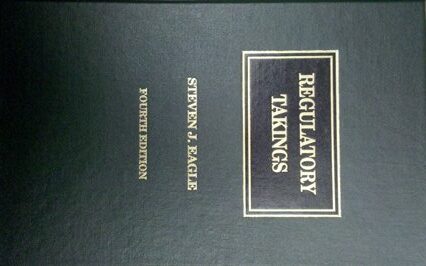
Eagle_reg_takings_cover I just received my copy of the latest edition of Professor Steven J. Eagle‘s definitive treatise Regulatory Takings (Lexis/Nexis, 4th ed. Dec. 2009).

Like the earlier editions, this is a must-have for every land use and property law attorney’s back bookshelf.

Chapters include “Property Rights and Their Sources,” “The Ascendancyof Land Use Regulation,” “Analytical Issues in Regulatory TakingsLitigation,” and “Regulatory Takings Remedies.”

The book is available here (oddly, the Lexis-Nexis web site only has the 3d edition for purchase, but I expect that to be remedied shortly).

From the preface to the fourth edition:

Thisbook is about “regulatory takings,” which is a relatively new term, but not an entirely new idea. The underlying concept is stated simply — government may “regulate” private property, but not to the extent that it constitutes a “taking,” under the United States Constitution, or a state constitution. Owners need not be compensated for losses

Continue Reading Eagle On Regulatory Takings (4th ed. 2009)

Recently, the owners of vacation cabins located on leased land in a state park on the island of Kauai filed a cert petition which asks the U.S. Supreme Court to review an unpublished decision of the Hawaii Intermediate Court of Appeals which held that the State did not run afoul of the Takings Clause when it required the owners to surrender their cabins at the end of the lease.

The trial court determined that the lessees had no property interest when their leases expired. The Hawaii Supreme Court declined review of the ICA’s disposition.

The lessees’ petition is available here, and presents the following question:

QUESTION PRESENTED

The State of Hawaii owns land in Kokee State Park on the island of Kauai. Petitioners, have leasehold estates in parcels on the land and own private cabins thereon. Each Petitioner, or his or her predecessor in interest, bought, built or inherited

Continue Reading New SCOTUS Cert Petition From Kauai: Is Surrender Clause In State Lease A Taking?

Statelocalcover_1_2010_small The most recent edition of State & Local Law News has an article summarizing the arguments in Stop the Beach Renourishment, Inc. v. Florida Dep’t of Environmental Protection, No. 08-11 (cert. granted. June 15, 2009). 

That case, which has been argued and is currently awaiting disposition by the Supreme Court, asks whether a state court is constrained by the Takings and Due Process clauses from rewriting the common law rules of property. [Disclosure: we filed an amicus brief in the case supporting the property owners.]

In Drawing a Line in the Sand: Stop the Beach Renourishment, Inc. v. Florida Dep’t of Envtl. Protection, six authors of amici briefs in the case — including me — summarized their arguments. I focused on the “background principles” issue, and the notion that certain common law aspects of property are beyond the reach of state court redefinition:

The “judicial takings” question in

Continue Reading New Article On Florida Beach Judicial Takings Case

Both parties have asked the Hawaii Intermediate Court of Appeals to take another look at its opinion in Maunalua Bay Beach Ohana 28 v. State of Hawaii, No. 28175 (Dec. 30, 2009).

In that case, the court held (1) the Hawaii Legislature took existing littoral accretion when it assigned ownership of the accretion from beachfront owners to the State; and (2) the Legislature did not take “future accretion.” We summarized the opinion here. [Disclosure: we filed an amicus briefsupporting the property owners, available here.]

The State of Hawaii asserts the opinion should not have addressed the claim that land which had accreted prior to 1985 was taken. The State’s Motion for Clarification is here.

The property owners assert the ICA’s conclusion that “future accretion” is not a property interest should be reexamined. The ICA relied on three federal cases from the Ninth Circuit, Western Pac. Ry.

Continue Reading Motions For Reconsideration In ICA Accretion Taking Appeal

PICT0319 This post deals with the practical impacts of the Hawaii Intermediate Court of Appeals’ recent decision in Maunalua Bay Beach Ohana 28 v. State of Hawaii,No. 28175 (Dec. 30, 2009). [Disclosure: we filed an amicus brief supporting the property owners,available here.]

First, some background for those who have not been following our recent posts on the November 2009 oral arguments, and the decision.

In 2003, the Hawaii Legislature adopted Act 73 (codifed here and here),which declared that title to shoreline land naturally accretedcannot be registered by anyone except the State, and that only theState could quiet title to accreted lands. Most critically, the Actdeclared that all accretion not registered was State property.

A three judge ICA panel held that Act 73 took accreted land in existence when the Act was adopted. The ICA agreed with the trial court that the Act rewrote the common law

Continue Reading Balkanizing The Beach: The Practical Consequences Of Maunaula Bay Beach Ohana 28

Waves Can the legislature adopt a law mandating that from here forward, upon an owner’s death, all of her property escheats to the State? Yes, according to the Hawaii Intermediate Court of Appeals. Because the property is not “vested” in future heirs and “may never materialize,” the State is free to take it.

That’s the basic rationale the 3-judge ICA panel adopted in Maunalua Bay Beach Ohana 28 v. State of Hawaii, No. 28175 (Dec. 30, 2009), where the issue was not the right of descent and devise, but whether littoral property owners are entitled tocontinue to own accreted lands. In that case, the court held the legislature was not constrained by the takings clauses of the federal and state constitutions from simply assigning ownership of land which has not yet accreted from littoral property owners to the State. [Disclosure: we filed an amicus brief supporting the property owners, available


Continue Reading Hawaii Court Of Appeals: Legislative Grab Of The Right To Beachfront Accretion Is Not A Taking

This just in: the Hawaii Intermediate Court of Appeals has issued an opinion in Maunalua Bay Beach Ohana 28 v. State of Hawaii, No. 28175, a case we recently analyzed here.

We conclude that (1) Plaintiffs and the class they represent had no vested property rights to future accretions to their oceanfront land and, therefore, Act 73 did not effect an uncompensated taking of future accretions; and (2) Act 73 effectuated a permanent taking of littoral owners’ ownership right to existing accretions to the owners’ oceanfront properties that had not been registered or recorded or made the subject of a then-pending quiet-title lawsuit or petition to register the accretions.

Accordingly, we vacate that part of the PSJ order which concluded that Act 73 took from oceanfront owners their property rights in all future accretion that was not proven to be the restored portion of previously eroded land. We

Continue Reading HAWICA: No “Vested Right” To Beachfront Accretion

WavesWith all that has been going on lately (SCOTUS arguments in the judicial takings case, New York’s courts issuing two big eminent domain decisions, etc.), we haven’t had the opportunity to summarize the oral argument in a very important Hawaii case.

Last month, the Hawaii Intermediate Court of Appeals heard arguments in the case about the taking of beachfront property, Maunalua Bay Beach Ohana 28 v. State of Hawaii, No. 28175.[Disclosure: we filed an amicus brief supporting the property owners, available here.]

Since there’s no official written transcript of Hawaii state courtappellate arguments, only an audio recording, we’re going toexperiment with a different approach than we’ve taken before, and embedsnippets of the recording into our written commentary, rather than attempt to transcribe the recording.

This is a rather long post, so if you’d rather just listen to our analysis along with the snippets, stop reading now


Continue Reading Taking Accretion By Legal Erosion: Summary Of The Oral Arguments In The Hawaii Beach Takings Case (Podcast)