Courtesy of the New York Times is the backstory of Stop the Beach Renourishment, Inc. v. Florida Dep’t of Environmental Protection, No. 08-11 (cert. granted. June 15, 2009). This, of course, is the “judicial takings” case that was argued in the Supreme Court last December, and is now awaiting disposition (our summary page contains links to the briefs — including the amicus brief we filed — and other case materials).

And when the Times goes back, it really goes back:

The sands found Destin first. They started off eons ago, from the Appalachian Mountains, washing their way down the rivers that flow into the Gulf of Mexico. Winnowed to pure, hardy quartz, the sediment moved with the gulf’s currents and gathered into the necklace of narrow barrier islands that buffer Florida’s Panhandle. Time and tides refined the sand into a soft, sun-bleached powder. By the 1830s, when a Yankee

Continue Reading Behind The Music: Stop The Beach Renourishment And Judicial Takings

Technology permitting, we are live blogging today’s oral arguments in Klumpp v. Borough of Avalon,No. A-49-09 (certification granted Nov. 10, 2009).

That’s the case in which the New Jersey Supreme Court is reviewing the decision from the AppellateDivision which held that the government can assert inverse condemnationin order to take property without compensation. (If that leaves you scratching your head, you are not alone — the New Jersey Law Journal called the decision “a bizarre condemnation.” More about the case here, including links to the Appellate Division’s per curiam opinion and the merits and amici briefs.

The court’s web site states the issue simply:

May a municipality occupy a property and obtain title through inverse condemnation without initiating condemnation proceedings under the Eminent Domain Act, N.J.S.A. 20:3-1 to -50?

Arguments are set to begin at 11:00 a.m., Monday, March 22, 2010 in Trenton. Although we are

Continue Reading Live Blog Of New Jersey Supreme Court Oral Argument In Klumpp v. Borough of Avalon (The “Bizarre Condemnation”)

The latest skirmish in California’s mobile home rent control wars, this time from the California Court of Appeal, Fourth District, in two cases out of San Diego county, MHC Financing Ltd. P’ship v. City of Santee, No. D053345 (Mar. 15, 2010).

The cases present a convoluted series of facts and procedural twists which we are not going to rehash, but recommend that you read yourself. It’s a long opinion (50 pages), but it’s worth delving into the details. The court held:

  • First, the property owner “sustained no legally remediable injury” from the retroactive application of a mobile home rent control ordinance which the city adopted to correct errors in an earlier-adopted mobile home rent control ordinance (the erroneous ordinance was based on the original version of a proposed initiative ordinance, and not the modified initiative ordinance which was certified by petition) (slip op. at 15-19).
  • Damages are not an


Continue Reading California Court Of Appeal: Takings Claims Brought Too Early, Too Late, And No Damages For Violations Of The Right To Petition (Inter Alia)

This just in: the U.S. Court of Appeals for the Ninth Circuit will be hearing Guggenheim v. City of Goleta, No. 06-56306 (Sep. 28, 2009) en banc.

The panel opinion in Guggenheim held that the city’s mobile home rent control ordinance was a regulatory taking, an issue the court had never considered before:

Daniel Guggenheim and others bring a facial challenge the the City of Goleta’s mobile home rent control ordinance. Guggenheim argues that the ordinance, which effects a transfer of nearly 90 percent of the property value from the mobile home park owners to mobile home tenants, constitutes a regulatory taking under Penn Central Transportation Co. v. New York City, 438 U.S. 104 (1978). We have fielded such challenges before, but have never reached the merits of the takings claim.

Slip op. at 13808-09. What review by the full Ninth Circuit probably portends is that whatever

Continue Reading Ninth Circuit To Hear Rent Control Takings Case En Banc

The New Jersey Supreme Court has scheduled oral arguments in Klumpp v. Borough of Avalon,No. A-49-09 (certification granted Nov. 10, 2009), to review the decision from New Jersey’s AppellateDivision which held that the government can assert inverse condemnationin order to take property without compensation. (If that leaves you scratching your head, you are not alone — the New Jersey Law Journal called the decision “a bizarre condemnation.”

Arguments are set to begin at 11:00 a.m., Monday, March 22, 2010 in Trenton. We won’t be there, but through the miracle of technology, we look forward to following along via the court’s live webcast site (why don’t all appellate courts do this?). We may even live blog it, as we have done with other appellate oral arguments.

More about the case here, including links to the Appellate Division’s per curiam opinion and the merits and amici briefs.Continue Reading Oral Arguments Scheduled In New Jersey’s “Bizarre Condemnation”

Barista’s note: we posted a version of this story before, on the 30th anniversary of the date the Court issued the opinion (December 4, 2009), but thought we would reprint a more detailed view, recently published in our firm’s newsletter, complete with photos.

Damon Key Celebrates Thirtieth Anniversary of Landmark U.S. Supreme Court Victory

What do you call a court opinion that has been cited by 627 othercourts, expressly followed in 42 cases, distinguished in 24 others, andhas been cited 1,041 times in law reviews and 147 times in legaltreatises?

We call it a landmark.

In 1979, the U.S. Supreme Courtissued its decision in Kaiser Aetna v. United States, a truly landmarkcase, argued and won by Damon Key attorneys Charlie Bocken and DianeHastert.

DDH_RCB_hawaii_kai Onbehalf of the developer of Hawaii Kai, Charlie and Diane took on thefederal government and overturned over a century of seemingly adverseprecedent. Kaiser Aetna was the

Continue Reading More On The Thirtieth Anniversary Of Kaiser Aetna

Remember Klumpp v. Borough of Avalon, No. A-2963-07 (per curiam), the decision from New Jersey’s Appellate Division which held that the government can assert inverse condemnation in order to take property without compensation? 

As noted in this order dated November 19, 2009, the New Jersey Supreme Court has granted the property owners’ petition (available here). We called the decision “kafkaesque,” since we couldn’t quite figure how the appellate court reached the conclusion which it did. The New Jersey Law Journal called the decision “a bizarre condemnation.”

Why the perjorative labels?

The appellate division held that the government can assert inverse condemnation. Yes, you read that right: inverse condemnation is a cause of action which the government may assert to allow it to take property without compensation.

Confused? You are not alone. Here’s our recipe for straightening yourself out:

Start here, our summary of

Continue Reading Latest Briefs In New Jersey’s “Bizarre Condemnation”

Aliaba We just wrapped up the annual three-day Festival of Eminent Domain Law, otherwise known as the American Law Institute | American Bar Association’s two CLE conferences, “Eminent Domain and Land Valuation Litigation,”and “Condemnation 101: How To Prepare and Present an Eminent DomainCase.” 

Dana Berliner, Matt Fellerhoff and I spoke about about “Winning Arguments in Challenging the Right toTake and Public Use” in the Land Valuation course, and in the 101course, I presented a session on “Voir Dire: Selecting a Jury in a Post-Kelo Era in a Down Economy” with William Blake and Susan MacPherson.

The depth of talent teaching and attending these courses is unbelievable, so I always learn more at these conferences than I impart. Among the other presenters were our fellow law bloggers Gideon Kanner, Anthony Della Pelle and Edward McKirdy. Internet marketing strategist Jayne Navarre also presented an interesting session on using

Continue Reading ALI-ABA Annual Eminent Domain Conference Wrap-Up

There is still time to register for the two ALI-ABA eminent domain conferences, “Eminent Domain and Land Valuation Litigation,” and “Condemnation101: How To Prepare and Present an Eminent Domain Case,” being heldconcurrently at the Westin Kierland Resort in Scottsdale, Arizona.

Thefirst course is designed for attorneys with some condemnationexperience, while the second is an introduction or refresher to thebasic concepts and techniques in a condemnation case. These are greatprograms, and registration discounts are available.

Moreinformation about “Eminent Domain and Land Valuation Litigation” isavailable here, and about “Condemnation 101” here.

Along with Dana Berliner and Matt Fellerhoff, I’ll be speaking about “Winning Arguments in Challenging the Right to Take and Public Use” in the Land Valuation course, and in the 101 course, I will be speaking with William Blake and Susan MacPherson about “Selecting a Jury in a Post-Kelo Era.”

If you attend, please stop by and Continue Reading Off To The ALI-ABA Eminent Domain Conferences

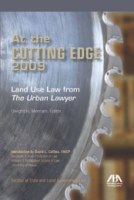
Cutting_edge_2009 One of the benefits of doing your own blog is that every now and then you are allowed to engage in a little shameless self-promotion (what’s this “every now and then?”).

Well, here goes.

The ABA has announced the forthcoming publication of a new book by the State and Local Government Law Section: At the Cutting Edge 2009: Land Use Law from The Urban Lawyer, edited by my colleague Dwight H. Merriam, and which features “[a] compilation of the most recent Section of State and Local Government Law committee reports from The Urban Lawyer.”

What this means is that it contains topical and timely articles about the hottest topics in land use law, including exactions and impact fees, green building laws, ethics in land use, regulatory takings, citizen participation in public hearings, and public use and pretext in eminent domain (the piece I authored).

Here’s the Table

Continue Reading New Book: At the Cutting Edge 2009: Land Use Law from The Urban Lawyer