


Remember after Knick when we predicted that the Supreme Court’s opening back up the federal courthouse doors wasn’t the end of the procedural gamesmanship, but merely the opening of a new chapter? That it was time to dust off your old Federal Courts hornbook, because things like the Eleventh Amendment, Rooker/Feldman, abstention, and similar, were going to spring up as the way to avoid the merits of takings claims? That’s we’re going to be experiencing Williamson County, Phase 2?

Here’s more proof (as if you needed it).

In EEE Minerals, LLC v. North Dakota, No. 22-2159 (Aug. 30, 2023), the U.S. Court of Appeals for the Eighth Circuit held that a takings claim against the State of North Dakota was barred from being litigated in federal court because the State can’t be sued in federal court – even if the right to just compensation

Continue Reading CA8: 11th Amendment Trumps The Fifth Amendment – Just Because Just Compensation Is A “Self-Executing” Federal Remedy Doesn’t Mean You Get To Come To *Federal* Court

Check out this press release, reprinted on the Wine Industry Advisor (“Renowned International Winemaker Files Lawsuit Against Napa County over Denial of Water Rights“), noting that “winemaker of some of the world’s most sought-after wines” has sued the County in federal court for a regulatory taking, because it denied well permits after Woodbridge refused to agree to a “strict limit on the water that could be drawn annually from each well, a restriction that does not apply to existing wells[.]”

Want to follow along? Here’s the complaint, and here’s the docket report. Here’s a report on the case from Courthouse News (“Heralded winemaker sues Napa County over water wells“).

We may have to do a “site visit” soon, just to be sure these reports are accurate. Just think if this involved our favorite label, Eminent Domaine!Continue Reading Wine And Takings > Wine And Cheese

Here’s a follow up to the issue resolved by the Supreme Court in Tyler v. Hennepin County. Recall that in that case, the core question was whether state law exclusively defined the “property” which Ms. Tyler claimed – the monies remaining after the foreclosure and sale of her home to satisfy her outstanding property tax obligation. The Supreme Court unanimously held no, that a state’s law of property is “one important source,” but “cannot be the only source” of what constitutes private property for purposes of the U.S. Constitution.

In Freed v. Thomas, No. 21-1248 (Sep. 6, 2023), the U.S. Court of Appeals followed up on that question. The court addressed the measure of just compensation in these home equity takings. To do so, the court focused on what “property” was taken – was it the home, or was it the excess proceeds after foreclosure and sale?

The

Continue Reading CA6: In Home Equity Theft Taking, Just Compensation Is The Excess The Government Kept, Not The Value Of The Foreclosed Home

Why is it, you ask, that the ALI-CLE Eminent Domain & Land Valuation Litigation Conference (scheduled next February 1-3, 2024, in New Orleans) is an event that seems to be growing in popularity and attendance. In recent years, we have standing room only in the Conference halls, and have sold out the hotel block. After all, this is a pretty niche area of law. So what gives?

When we were in Austin earlier this year, we thought it might be nice to try and answer that question. We asked Conference participants why they come, year-after-year (and in Austin, despite massive travel disruptions). Yes, it is the various venues (Nashville, Austin, Scottsdale, Palm Springs, to name a few recent locations), and yes, it is the excellent and useful programming.

But as we suspected it is more than that. As the above video notes

Continue Reading ALI-CLE’s Eminent Domain & Land Valuation Litigation Conference (Feb 1-3, 2024, New Orleans): Why Attend? Here’s Why.

Here’s the cert petition, recently filed, which asks the Supreme Court to review the California courts’ decision that the state’s “unclaimed property” statute  — by which the State is able to grab billions of dollars of private property on the theory that the owners abandoned it. The statute requires the State to try and locate the owners, but the petition alleges the procedures do not provide adequate notice to the owners, and that the State doesn’t really try all that hard to tell them.

Here are the Questions Presented:

1. Whether the Controller’s actions under color of the California Unclaimed Property Law, Cal. Civ. Proc. Code §§ 1300, et seq. (“UPL”), violate the Due Process Clause of the Fourteenth Amendment because they deprive owners of their property without affording constitutionally adequate notice.

2. Whether the Controller’s actions under color of the California UPL violate the Takings Clause of the

Continue Reading New Cert Petition: California’s Escheat Procedures Cheat Due Process (And Take Property To Boot)

Here’s the Order by which the Arizona Supreme Court agreed to review a case we’ve been following.

The main issue is whether the Arizona condominium statute, which allows the condo association upon termination of the condominium regime, to sell individually-owned units is a taking under the Arizona Constitution.

Here are the questions presented:

FURTHER ORDERED: GRANTING IN PART the petition and cross-petitions as to these rephrased questions:

1. Either on its face or as applied in this case, does A.R.S. § 33-1228 authorize the taking of private property for private use in violation of Article 2, § 17 of the Arizona Constitution?

2. If any common elements or units in a condominium are to be sold pursuant to a condominium termination agreement, does A.R.S. § 33-1228 require all the common elements and units to be part of that sale?

3. If a contract incorporates an unconstitutional statute by reference, are

Continue Reading Arizona Supreme Court To Decide Whether Condo Law Which Permits Association To Force Sale Of A Privately-Owned Unit Is A Taking

Screenshot 2023-08-26 at 10-33-05 Brigham-Kanner Property Rights Conference

Heads-up: the registration page for the 20th Brigham-Kanner Property Rights Conference, October 26-27, 2023, at the William and Mary Law School in Williamsburg, Virginia, is now up.

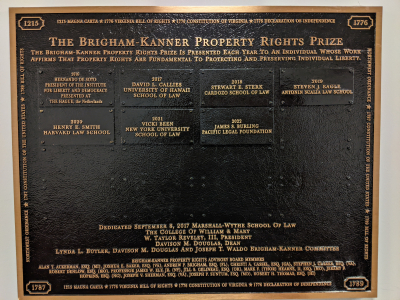
Early registration is a good thing because space is limited, especially at the Wren Building banquet on the 26th, at which the 2023 B-K Property Rights Prize will be presented to Prof. Gregory Alexander.

So please don’t miss out.

2022 BK plaque
The Property Rights Hall of Fame (second plaque)

If you are not already familiar with the Conference, it is (in our opinion) the best one-day event on property and property rights theory and practice. Expressly designed to bring together the legal academy and the practicing dirt law bar, the conference is where we discuss the burning property and property rights issues of the day. Here’s the 2023 Program:

  • Property and Propriety (or a Well-Ordered Society): A Tribute to Gregory S.


Continue Reading Register Now For The 20th Brigham-Kanner Property Rights Conference, Oct. 26-27, 2023

The buried lede in the U.S. Court of Appeals for the D.C. Circuit’s opinion in Valancourt Books, LLC v. Garland, No. 21-5205 (Aug. 29, 2023) is that the government doesn’t have that big of a role in copyrights, at least in the bare minimum of copyright protections.

We’re no copyright experts (that’s an understatement), but we knew the basics here: in order to have a copyright and all the rights that entails, the owner need do nothing more than fix the work in a tangible medium. No formalities are necessary, including publication. As the court put it, “[c]opyright thus accrues automatically upon creation of an original work in a tangible medium, and creators need not take any further action such as publication or registration to gain the protection.” Slip op. at 4.

You may register your copyright to obtain certain other benefits — for example, registration is prima facie

Continue Reading DC Circuit: US Copyright Office’s Requirement To Turn Over Copies Is A Taking

Here’s the latest in a case we’ve been following.

In this cert petition, the property owner is asking the U.S. Supreme Court to review an unpublished decision of the Ninth Circuit which rejected both Lucas and Penn Central takings claims.

Here are the Questions Presented:

1. Should this Court overrule in its entirety, or reconsider parts of, Penn Central Transportation Co. v. City of New York, 438 U.S. 104 (1978)?

2. Does the “economic impact” of a regulation on the subject property have to approach total loss of use and value to weigh in favor of a taking under Penn Central, as the District Court and Ninth Circuit held below?

3. Can a property owner ever have “distinct investment-backed expectations” for the beneficial use of property, for purposes of alleging a Penn Central taking, if restrictive downzoning is adopted before development of the property is undertaken?

Continue Reading New Cert Petition: Overrule Penn Central!

A fairly short one from the U.S. Court of Appeals for the Fifth Circuit.

In Sheffield v. Buckingham, No. 22-40350 (July 31, 2023), the court affirmed the district court’s declining to issue a preliminary injunction enjoining State of Texas officials from enforcing the Open Beaches Act.

The presumptive public/private boundary on beaches in Texas is the mean high tide line, although the public may obtain an easement to access the beach landward of the MHTL through prescription or dedication. But as the Texas Supreme Court held, abrupt shifts in the topography of a beach caused by hurricanes and tropical storms does not automatically “roll” the line landward under the state’s Open Beaches Act. 

After the Texas court issued that ruling, the legislature amended the statute to permit the State to “suspend action on conducting a line of vegetation determination for a period of up to three years from

Continue Reading The Downside Of Seeking Injunctive Relief In Takings Cases