In Masloka v. Public Utility District No. 1, No. 101241-1 (Aug. 3, 2023), the Washington Supreme Court held that a takings claim did not automatically transfer to a new property owner when the property was sold.

Your first reaction might be like ours, “what about Palazzolo!?” Didn’t that case say that transfer of property after an alleged taking does not wipe out the transferee’s right to assert a takings claim:

Were we to accept the State’s rule, the postenactment transfer of title would absolve the State of its obligation to defend any action restricting land use, no matter how extreme or unreasonable. A State would be allowed, in effect, to put an expiration date on the Takings Clause. This ought not to be the rule. Future generations, too, have a right to challenge unreasonable limitations on the use and value of land.

Palazzolo, 533 U.S. at 607.

So
Continue Reading Washington: “The right to inverse condemnation belongs to the property owner at the time of the taking; the right does not pass to a subsequent purchaser unless expressly conveyed.”

Screenshot 2023-06-16 at 07-52-47 How Did Property Rights Fare at the Supreme Court What Happened in the 2022 Term and What's Next ALI CLE

Tomorrow, Wednesday, August 9, 2023 at 1:00 – 2:00 p.m. (Eastern Time), please join us for ALI-CLE’s web program, “How Did Property Rights Fare at the Supreme Court? What Happened in the 2022 Term and What’s Next.”

Here’s the course description:

This has been a blockbuster U.S. Supreme Court term for property law, with the Court deciding three major property cases: Tyler v. Hennepin County (government’s keeping the excess value when seizing and selling a home to satisfy a property tax debt is a taking), Wilkins v. United States (is the federal Quiet Title Act’s statute of limitations a jurisdictional bar?), and Sackett v. EPA (the scope of Clean Water Act wetlands jurisdiction). To gain a better understanding these opinions, the current state of takings and property law, and what these cases mean for your practice, join a distinguished panel of experts for this one-hour webcast. The faculty

Continue Reading Still Time To Join Us Wed Aug 9: ALI-CLE’s “How Did Property Rights Fare at the Supreme Court? What Happened in the 2022 Term and What’s Next”

We recently attended the American Bar Association’s Annual Meeting in Denver to speak at the Section of State and Local Government Law’s program, “The 100th Anniversary of Pennsylvania Coal v. Mahon: How the Takings Clause Became the Primary Check on Government Power When SCOTUS Abandoned Review Under the Due Process and Contracts Clauses During the New Deal.

But the real highlight of the Meeting was the Jefferson Fordham Awards which, as we noted earlier, were presented to property rights icon Michael Berger, who the Section recognized with the Daniel J. Curtin, Jr. Lifetime Achievement Award.

Also noteworthy: the presentation of the Anita P. Miller Advocacy Award to land use law giant, Professor John R. Nolon, and the Up and Comer Award to a former William and Mary student (and now colleague) of ours, Makenna X. Johnson. 

Professor Frank Schnidman introduced Michael Berger

Continue Reading Recognizing A Property Rights Icon: “Mentors, A Path to Fairness, and the Joy of Taking”

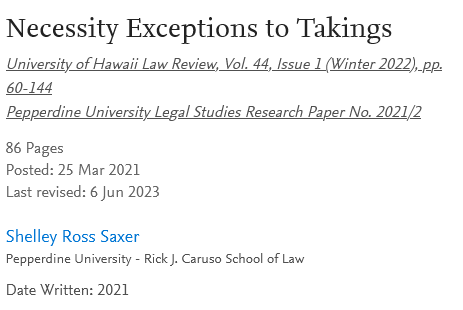
Screenshot 2023-07-31 at 08-01-31 Necessity Exceptions to Takings

Worth checking out: a new article from Pepperdine Law School’s Shelley Ross Saxer, published in the University of Hawaii Law Review, “Necessity Exceptions to Takings,” 44 U. Haw. L. Rev. 60 (2022). [Disclosure: as noted in the author’s note, we reviewed an earlier draft of the piece and provided some thoughts.]

Here’s the Abstract:

The doctrine of necessity has strong roots in the common law of tort and property going back hundreds of years. In the United States the doctrine has been applied in various situations to negate judicial review of constitutional challenges to government action, most recently in some of the wildfire and flood claims resulting from disasters. But now, the states’ responses to the COVID-19 pandemic have brought one of these necessity doctrines—the public health necessity relying on Jacobson v. Massachusetts—to the forefront as courts across the country review constitutional challenges to state public

Continue Reading New Article – “Necessity Exceptions to Takings” (Shelley Ross Saxer)

Here’s what we’re reading today:


Continue Reading Tuesday Property Round-Up (International Edition)

The city told an owner whose three parcels were outside of the city’s jurisdiction that if it wanted the city’s permission to replat into 74 parcels, it would need city water and sewer service to each of the proposed lots.

So the owner asked to connect to the city’s water and sewer system (deliberately overbuilt to account for future users, apparently), and in response, the city told the developer that it would have to do two things. First, it would have to contribute to the cost of building the system by purchasing water/sewer chits (our term). When the system was built, the city anticipated future connections and created a chit system by which future connections would help pay for the cost of construction. Second, in order to purchase these chits, the buyer’s property must be included within the city’s jurisdiction. And that meant a voluntary annexation. Annexation does not come

Continue Reading Tex App: Nollan/Dolan Challenge To Annexation Fees Not Ripe: You Have To Apply For Annexation To Find Out What The Fee Will Be

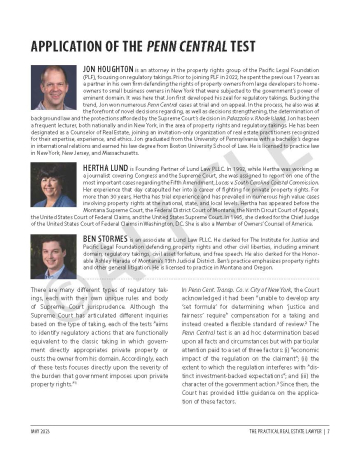
PC PREL

Here’s a recently-published article (ALI-CLE’s The Practical Real Estate Lawyer) on a subject that we know you will want to read about: Jon Houghton, Hertha Lund, and Ben Stormes, Application of the Penn Central Test, 7 Prac. Real Estate Lawyer 7 (May 2023).

Check it out. It’s short, practical (naturally), and worth your time.

Jon Houghton, Hertha Lund, and Ben Stormes, Application of the Penn Central Test, Prac. Real Estate Lawyer…

Continue Reading New Article: Application of the Penn Central Test

PXL_20221211_185826126
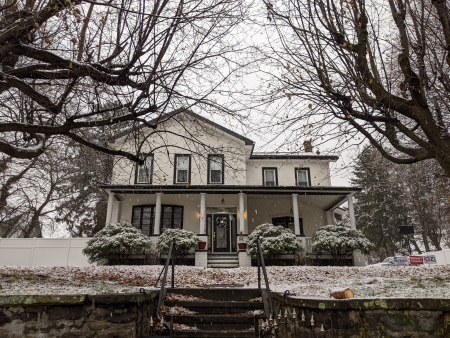
The Mahon Property

Join us on Friday, August 4, 2023 (10:30-11:30am, MT) in Denver at the ABA Annual Meeting for our CLE session on “The 100th Anniversary of Pennsylvania Coal v. Mahon: How the Takings Clause Became the Primary Check on Government Power When SCOTUS Abandoned Review Under the Due Process and Contracts Clauses During the New Deal.”

The program description:

The Takings Clause and 100 years of the Pennsylvania Coal v. Mahon doctrine have become the primary check on governmental power that the Due Process and Contracts Clause used to serve, before the Supreme Court finally and formally abandoned judicial review under those doctrines during the New Deal. Mahon transcended its primary relevance as to compensation for the taking of private property to become the fundamental means by which the Rule of Law determines of the individual’s relation with the government.

This session will survey the evolution

Continue Reading Aug 4, 2023: “The 100th Anniversary of Pennsylvania Coal v. Mahon: How the Takings Clause Became the Primary Check on Government Power” (ABA Annual Meeting, Denver)

 A short one from the Florida District Court of Appeals (First District).

In D’Arcy v. Florida Gaming Control Comm’n, No. 1D21-3606 (May 24, 2023), the court held that the voters of Florida adopted Amendment 13 to the Florida Constitution that outlawed betting on greyhound racing (indeed betting all dog racing), it did not effect a Penn Central taking of the property of the owner of a greyhound racing business.

The trial court granted the state summary judgment, and the appeal court affirmed. The court also pointed out that the Amendment didn’t ban dog racing outright, merely betting on dog racing. Slip op. at 3. The court focused on a single Penn Central factor, the “expectations” question and held that “given then heavily regulated field of gambling, D’Arcy did not have a reasonable expectation that the investment in dog racing could not be severely impacted by regulation.” Id.

It is

Continue Reading Don’t Release The Hounds! No Taking When Florida Voters Outlawed Dog Race Gambling

As you can tell from the date of the opinion, we’ve been meaning to post the South Carolina Supreme Court’s ruling in Braden’s Folly, LLC v. City of Folly Beach, No. 2022-000020 (Apr. 5, 2023) for a while. Something else always intervened, but it remains a decision worth reviewing.

The city adopted an ordinance that erased lot lines for certain contiguous properties under common ownership, merging two distinct parcels into one and prohibiting their separate sale. The ordinance recognized nonconforming uses. Braden’s properties are covered by the ordinance.

When Braden’s Folly acquired the Lots in 1999, there was a small house on Lot A, and Lot B was undeveloped because it was either underwater or part of the active beach. Following a beach renourishment in 2005, Lot B became developable because it had been transformed into mostly sandy beach. Therefore, between 2006 and 2007, Braden’s Folly received building permits

Continue Reading SC: No Penn Central Taking For City Ordinance Merging Contiguous-But-Separate Parcels