Check this out, a recently-filed cert petition in a case we’ve been following, filed by our friends and colleagues at the Institute for Justice. This one involves an issue we’ve been on top of also, most recently in these two cases (see here and here).

That is, what does the Supreme Court’s description of the Takings Clause as “self-executing” actually mean? Do you need statutory authorization in order to bring a takings or just compensation claim, or can you sue directly under the Constitution?

In Devillier v. Texas, No. 21-40750 (Nov. 12, 2022), the Fifth Circuit’s cryptic opinion concluded that “the Fifth Amendment Takings Clause as applied to the states through the Fourteenth Amendment does not provide a right to action for takings against a state[.]” Slip op. at 1-2. Here’s the entirety of the decision (minus footnotes):

The State of Texas appeals the district court’s decision

Continue Reading New Cert Petition: Do You Need Statutory Authorization To Sue For A Taking?

There’s a lot to digest in the 36-page Order of the U.S. District Court for the Southern District of Florida in case that mostly concerns the validity of an exaction a small property owner was required to pony up in order to tear down and replace an old home on its land.

Megladon bought the residentially-zoned property in 2016 to tear down the existing building and build a new one. Simple enough, right? It demolished the old house, and applied to the Village to build a new one. But the Village also needed a road, and began making noise about a “possible road dedication.” And sure enough, eventually the Village notified Megladon that “a certificate of occupancy will not be issued until dedication of the right-of-way is complete.” Slip op. at 4. There’s a dispute over exactly whose law requires such a dedication — Village or County? — but

Continue Reading Exactions, Takings, And Ripeness…Oh My! When Planning Officials Say “No,” That’s Enough (Even If They Might Have Said “Yes” Some Other Way)

Mortons

A quick one from the Indiana Supreme Court (thanks to our Pacific Legal Foundation colleague Sam Spiegelman for the heads-up on this one).

In Town of Linden v. Birge, No. 22S-PL-352 (Mar. 7, 2023), the court held that intermittent government-induced flooding of property is treated as a permanent invasion and a per se taking if the flooding is inevitably recurring.

A Town owned and maintained drain fell into disrepair, “resulting in frequent flooding of the Town” so replacement and upgrade was in order. The Town did so and formed an improvement district to fund it. The Birge property was assessed $7k, and after some back-and-forth about the location and placement of a manhole cover on the Birge property, the upgrade project went forward. But “[a]fter completion of the project in late 2012, low-lying portions of the Birges’ Property flooded after any heavy rainfall, encumbering the Birges’ farming enterprise. So

Continue Reading When It Rains, It Floods: Intermittent Flooding, Inevitably Recurring, Is Treated As A Permanent Invasion

Screenshot 2023-03-03 at 08-06-54 Robert Thomas inversecondemnation.com on Twitter

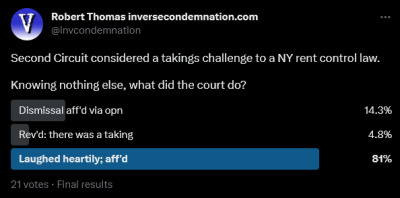
Let’s say you know nothing else about an appeal except it is being decided by the U.S. Court of Appeals for the Second Circuit, and the case is a constitutional challenge to rent control. What’s your best guess about the outcome (the district court dismissed for failure to state a claim)?

When the Second Circuit issued its summary order in just such a case last week — a challenge to the “Housing Stability and Tenant Protection Act of 2019” — we decided to undertake a little unscientific poll to see whether others out in the Twitterverse predicted as we did.

Looks like so. Yes, the sampling size was small, and the respondents were only those who voluntarily offered their thoughts. But 95% accurately predicted that the property owners would lose, as the Second Circuit indeed held in an appellate court’s version of “laughing heartily” at an appellant’s arguments:

Continue Reading One Guess What The Second Circuit Did With A Takings Challenge To Rent Control

Today’s post is by our Pacific Legal Foundation colleague Kady Valois, writing about a recent Federal Circuit Rails-to-Trails takings case, Behrens v. United States, No. 22-1277 (Feb. 13, 2023).

+++++++++++++++++++++++++++++++++++++++++

How The West Was Won: Easements!

by Kady Valois

There’s a saying that the west was won by pioneers, settlers, and adventurers.

And while that may be somewhat accurate, what’s clearer still is that the west — at least the west we know today — was built and developed because of railroads. We owe a lot to railroads because this nation was built by the coal engines that carried steel, food, and people to areas never previously explored by Americans. Many of these railroads were built on easements or rights-of-way on private property, subject to the fee owner’s reversionary interest: should the easement ever not be used for railway purposes, the property is supposed to revert

Continue Reading Guest Post – Kady Valois, “How The West Was Won: Easements!”

20151208_064159

Here’s the merits brief, filed yesterday in the above-depicted Court by our law firm colleagues, headed by Counsel of Record Christina Martin in Tyler v. Hennepin County, No. 22-166, a case and an issue we’ve been following closely. This is the one, where, as recounted in the petition:

Hennepin County confiscated 93-year-old Geraldine Tyler’s former home as payment for approximately $15,000 in property taxes, penalties, interest, and costs. The County sold the home for $40,000, and, consistent with a Minnesota forfeiture statute, kept all proceeds, including the $25,000 that exceeded Tyler’s debt as a windfall for the public. In all states, municipalities may take real property and sell it to collect payment for property tax debts. Most states allow the government to keep only as much as it is owed; any surplus proceeds after collecting the debt belong to the former owner. But in Minnesota

Continue Reading Property Owner’s SCOTUS Merits Brief: “Under no circumstances can government have an unbounded ability to confiscate entire properties of any size for even the most minimal tax debts.”

Screenshot 2023-02-23 at 11-13-54 Toward Principled Background Principles in Takings Law

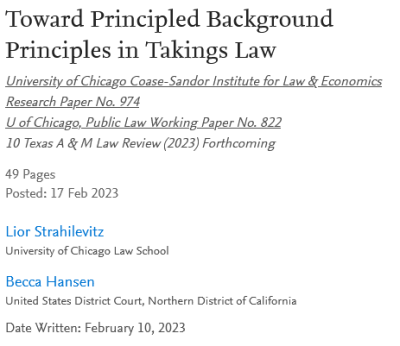
Check this out, a new article co-authored by a federal judge’s law clerk and lawprof Lior Strahilevitz (Chicago). With the title, “Toward Principled Background Principles in Takings Law” are we going to read it? You bet. (Unlike a lot of new scholarship that we post here, we read this one immediately.)

Here’s the Abstract:

Blunders made by lawyers, judges, and scholars have caused the Supreme Court’s recent opinion in Cedar Point Nursery v. Hassid to be deeply misunderstood. In Cedar Point, the Court re-wrote takings law by treating temporary and part-time entries onto private property as per se takings. Prior to Cedar Point these sorts of government-authorized physical entries would have been evaluated under a balancing framework that almost invariably enabled the government to prevail. As it happens, there were two well-established rules of black letter law that California’s lawyers and amici mistakenly failed to invoke in defending

Continue Reading New Article: “Toward Principled Background Principles in Takings Law” (Strahilevitz & Hansen)

IRWA header

The International Right of Way Association‘s Real Estate Law Committee produces twice-a-year reports “which contain summaries of eminent domain decisions and legislation within the United States.”

And what is really nice is that they make the report available.

Here’s the latest.

We’re posting it here because we’re one of the co-authors. Hat tip to our co-authors Brad Kuhn, Jillian Friess Leivas, and Ajay Gajaria.

The report is short, and doesn’t contain a lot of fluff. Just what you wanted.Continue Reading IRWA’s Summary Of Major Eminent Domain Cases & Legislation (June-Dec 2022)

Here’s the latest SCOTUS cert petition, filed by our law firm colleagues Dave Breemer and Deborah LaFetra. Because this is one of ours, we won’t be commenting, but leave it to you to digest it yourself.

Here’s the Question Presented:

Frank and Rachel Revere and David and Judith Kagan (Owners) own a duplex in Los Angeles, California, as tenants in common. The Reveres live in one unit. In 2019, the Reveres applied to the City to displace a month-to-month tenant in the other unit, so they could move in their own family members. The City denied the request, concluding the tenant was protected from eviction for a family move-in under Los Angeles’ Rent Stabilization Ordinance. The Owners sued, alleging the City’s decision forced them to suffer a physical taking of their property.

The question presented is:

Whether a law that bars termination of a tenancy, and compels the occupation

Continue Reading New Takings Cert Petition: Yee v. Escondido And Physical Occupations

Shaka
We thought this fellow has “authority over all fish.”

By statute (the Magnuson-Stevens Act), the feds claim the sovereign right to exclusive fishery management and “authority over all fish” in the U.S. Exclusive Economic Zone, a zone “extending 200 nautical miles from the baseline[.]”

The question facing the U.S. Court of Appeals for the Federal Circuit in Fisherman’s Finest, Inc. v. United States, No. 21-2326 (Feb. 8, 2023) was whether having licensed via regulation quota-based access to, and commercial fishing in, the EEZ in the Bering Sea, the ability of licensees to continue to fish at previous levels was a compensable property right.

The regs are quite complex — see pages 4-6 of the slip opinion for the court’s summary of the regulatory-speak requirements and limitations — and dictate the type and amount of fish which may be caught, and the type of vessel that may be employed in

Continue Reading CAFED: Commercial Fishing In The U.S. Exclusive Economic Zone Is A Govt-Granted Privilege, Not A Property Right