Screenshot 2023-02-13 at 15-12-42 The Illusory Promise of General Property Law

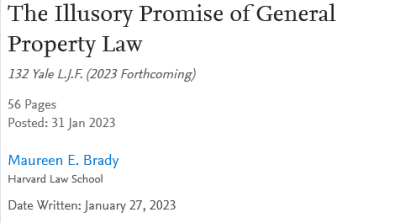
Check this out, a new piece by lawprof Molly Brady, “The Illusory Promise of General Property Law,” 132 Yale. L.J.F. (2023 forthcoming).

If the title alone isn’t enough to grab you, here’s the abstract:

In The Fourth Amendment and General Law, Danielle D’Onfro and Daniel Epps endorse an approach to the Fourth Amendment that defines the scope of protection largely by reference to “general property law”—uniform principles of trespass, abandonment, and so forth—discerned from and informed by the customs and rules of multiple jurisdictions. While their approach attractively reasons from useful common-law and private-law concepts, the specific general-law model they outline has both unresolved internal puzzles and unaddressed external effects.

In this Response, I probe this vision of “general law,” which has the potential to be more open-ended and unconstrained than the general law as it has previously been understood. Even if it did more closely resemble traditional general law, a court’s resort to making general law in a particular context is typically justified by some federal interest or power meriting the application of uniform rules. The authors do not satisfactorily explain that need here, especially given traditional deference to positive state law—and the desirability of some variation reflecting local conditions and expertise—in matters involving property questions in other areas of constitutional law. Further, in justifying reliance on the general law, the authors over-sell its determinacy and stability vis-à-vis existing Fourth Amendment law, which assesses whether an individual’s “reasonable expectations of privacy” have been violated. Given the vagaries of some common-law standards and the breadth of the sources of general law, courts will still be faced with unclear choices within and among them. The general-law approach does not offer guidance on resolving these conflicts and uncertainties, dooming it to the same indeterminacy.

To illustrate with specific examples, I turn to a doctrinal area where the pitfalls of general law—and specifically, general property law—can already be observed: in recent decisions under the Takings Clause of the Fifth Amendment. Decisions interpreting the Takings Clause traditionally “emphasiz[ed] the role of nonconstitutional state property law in defining both what counts as constitutional property and in measuring whether a taking has occurred.” The presumption of deference to state-specific property principles was grounded in a belief that property is an inherently local matter and that different states might opt to recognize and regulate property interests differently. However, two Supreme Court decisions within the last five years—Murr v. Wisconsin and Cedar Point Nursery v. Hassid—have unsettled that longstanding tradition with troubling effects. Takings law also teaches that decisions by courts in federal constitutional cases can influence the direction of nonconstitutional state private law, even though that result is not compelled.

There is an approach that would carry some of the benefits of the general-law model while leaving most of the development of property law to the states. In articles covering the Due Process and Takings clauses, Thomas Merrill has advocated for a “patterning definition” of constitutional property—a set of federal criteria that are met (or not) by the characteristics an interest has under nonconstitutional state law. The idea behind patterning is to provide a baseline, uniform constitutional standard across the states—one of the key purported advantages of the general-law model over the positive-law one—without having courts make a confusing national law of property specific for federal purposes. While private law can helpfully frame and elucidate Fourth Amendment problems, the general-law model offers limited promise for the development of Fourth Amendment doctrine while posing unwarranted risks for the viability of variable state property law.

Get it from SSRN here

.
Continue Reading New Article: Maureeen Brady, “The Illusory Promise of General Property Law”
“But we had to eat.”

So begins the Washington Supreme Court’s opinion in Washington Food Industry Ass’n v. City of Seattle, No. 99771-3 (Feb. 9, 2023), wherein the court held that a takings challenge to Seattle’s ordinance requiring Co-19 combat pay for food delivery workers may proceed. 

There’s a lot in the opinion about the crisis and the early days of the response. And about the various claims brought by the WFIA challenging the city’s ordinance, including a statutory claim under Washington law (this is a prohibited tax or fee on groceries), equal protection, takings, contracts clause, section 1983, a “police power” claim, and a privileges and immunities claim.

The opinion is long (39 pages, plus concurring opinions and dissents, adding up to 67 pages), so here’s your scorecard:

I. The chapter 82.84 RCW claim is dismissed; we affirm.
II. The equal protection claim is dismissed; we reverse.
III.

Continue Reading Seattle’s Hazard Pay For Food Delivery Gig Workers Might Be A Penn Central Taking

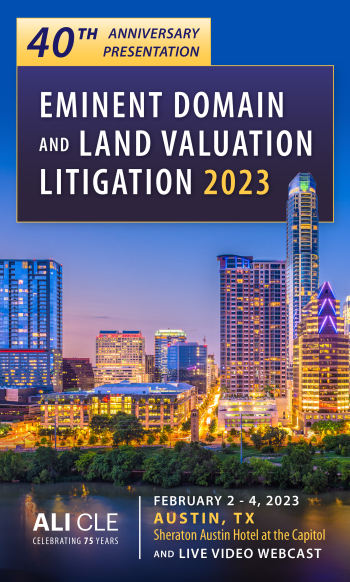
40th ALI-CLE

We were eagerly anticipating 40th American Law Institute-CLE Eminent Domain and Land Valuation Litigation Conference. The 2022 Conference in Scottsdale was one of the first meetings where everyone was back in-person (and was a smashing success), but that conference was early in the game so not everyone could or would attend. But in the past year most of us got back to some semblance of “normal,” and the turnout promised to be good.

We had record registrations: with over 300 attendees, faculty, and staff signed up, things were shaping up.

Plus, we were headed to Austin, Texas. The last time we held the Conference there in 2016, we loved it so much it has been in-demand for a return visit. And this year is the debut Conference for some new planning co-chairs for both the main tracks as well as the “Condemnation 101” tracks, so the buzz for the

Continue Reading Ice Ice Baby: A Report From The 40th ALI-CLE Eminent Domain & Land Valuation Litigation Conference, Feb 1-4, 2023, Austin

Here’s the latest in a case we’ve been following since its inception.

The U.S. Court of Appeals for the Second Circuit has affirmed the Eastern District of New York’s 12(b)(6) dismissal of a complaint alleging that New York (state)’s sweeping amendments to its Rent Stabilization (rent control) statute effected physical and regulatory takings.

First, this can’t be a surprise to anyone who has been paying attention to how courts treat rent control. Putting aside for a moment the legal theories and the various challenges, rent control has become so ossified — such a political third-rail and sacred cow — that courts are very reluctant to do anything to upset the system, and will approve most any ratcheting-up of the restrictions. Any challenger, whatever the logic of their legal theory, has to recognize that they start off in a very deep hole.

That said, let’s take a look at

Continue Reading CA2, Pellucidly:* You Let ‘Em In, Property Owners, So New York Can Tell You To Keep ‘Em (Part I)

Screenshot 2023-02-07 at 09-17-30 Emerging Issues in Property Rights

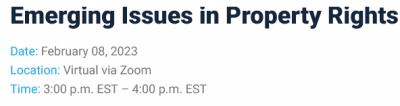
Join our Pacific Legal Foundation colleagues Jon Houghton, Daniel Woislaw, Kady Valois, and Sam Spiegelman (moderating) tomorrow, Wednesday, February 8, 2023, at 3:00 – 4:00 p.m. ET for a free webinar, “Emerging Issues in Property Rights.”

Here’s the agenda:

Protecting private property rights has been at the heart of PLF’s work since our founding in 1973. Our view, and that of the American Founders, is that property rights are foundational to all other constitutional rights.

Our relentless defense of property rights has secured many precedented victories, including 12 property rights wins at the U.S. Supreme Court—and counting.

Unfortunately, even today, the need for property rights champions remains critical.

Government officials too often relegate property rights to second-class status among Americans’ constitutional rights—cloaking their assaults in erroneous assertions of environmental protection or cleverly constructed land use restrictions.

To learn more about property rights’ legal landscape in

Continue Reading “Emerging Issues In Property Rights” – Wednesday, February 8, 2023, 3-4pm ET (Free!)

You remember, don’t you? In the early days of the Co-19 epidemic, government and public health authorities were scrambling to do something … sometimes anything! … to respond.

Dare County, North Carolina might have been one of those local governments that went maybe just a bit too far in the precaution vs effectiveness departments: it banned nonresident property owners from entering the county (and apparently didn’t ban anyone else from coming and going, only outsiders).

Dare County announced the restrictions on March 16 and implemented them over three phases. Phase one, which took effect immediately, declared a state of emergency and prohibited mass gatherings. Phase two, which took effect one day later, prohibited non-resident visitors from entering the county. Phase three, which took effect four days after the restrictions were announced, prohibited non-resident property owners from entering the county. In effect, Dare County told non-resident property owners: “If you

Continue Reading CA4: Being Blocked From Accessing Your Beach House For 45 Days Isn’t A Physical Taking (Or Any Kind Of Taking)

If your first reaction to the Texas Court of Appeals (First District)’s decision in City of Houston v. The Commons of Lake Houston, Ltd., No. 01-21-00369-DV (Jan. 12, 2023) is scratching your head, then please come join us in bewilderment.

After all, the court held that a takings claim failed because the city is immune from inverse condemnation. Say what? We thought that the self-executing nature of the just compensation requirement of the U.S. Constitution (and the Texas Constitution) means that claims of sovereign immunity don’t hold water in inverse cases.

The Commons wants to develop “The Crossing,” one of those big master-planned communities. The usual development activities entailed: master plan, subdivision plats, city approvals for infrastructure, and even some actual site work. “By April 2018, The Commons had invested millions of dollars in planning and infrastructure for The Crossing.” Slip op. at 2.

But in

Continue Reading An Ordinance Isn’t A Taking Because It’s A Valid Exercise Of Police Power?: What The Heck Is Going On In The Texas Court Of Appeals (First District)?

We’re not suggesting you read the entire majority and dissenting opinions from the U.S. Court of Appeals for the Eleventh Circuit in Landcastle Acquisition Corp. v. Renasant Bank, No. 20-13735 (Jan. 12, 2023). After all, together they comprise 126 pages (yikes!). And the case isn’t our usual fare, but “arises out of the insolvency of the Crescent Bank and Trust Company (“Crescent”) and the conduct of its customer-lawyer Nathan Hardwick[.]” Slip op. at 1.

So what gives, inversecondemnation?  

We’re posting it because of the back-and-forth between the majority and the dissenting judge (Pryor, C.J., which begins on page 80 of the slip copy) on a takings question that cropped up.

We say “cropped up” because, as the majority argues, the dissent’s takings discussion “strays so far afield from the narrow” issue presented in the case that it proves to be a “false alarm.” Slip op. at 51. Thus

Continue Reading CA11: Majority’s Response To Dissent’s Claim That After Butch Cassidy Defaults, FDIC’s Receivership Is A Taking: “Oh my goodness”

Today’s post is by our Pacific Legal Foundation colleague Kady Valois, writing about last week’s opinion by the Florida District Court of Appeal (Second District) in Lake Lincoln, LLC v. County of Manatee, No. 2D21-2826 (Jan. 13, 2023),

+++++++++++++++++++++++++++++++++++++++++

Divide and Conquer (Or Not): Florida’s Test
For The Regulatory Takings Larger Parcel

by Kady Valois

It is highly likely that anyone who follows this blog, at least as religiously as I do, groaned when the Supreme Court issued its decision in Murr v. Wisconsin, 137 S.Ct. 1933 (2017). After all, what could be more accessible and pro- private property than creating a balancing test within a balancing test and expanding the “parcel as a whole analysis” to encompass not only the regulated property but also any other property owned by the plaintiff (in the case of the Murr family, a parcel abutting the property they asserted was

Continue Reading Guest Post – Kady Valois, “Divide (Or Not) and Conquer: Florida’s Test For The Regulatory Takings Larger Parcel”

We really want you there…

One (nearly) last reminder that there’s still time to register for your space at the 40th ALI-CLE Eminent Domain & Land Valuation Litigation Conference, February 1-4, 2023, in Austin. In the past several years, we have sold out due to the conference room capacity and the conference hotel block. But there’s still space, although we are nearly full. So register now – don’t delay any further! 

Here’s the brochure with the complete agenda, schedule, and faculty listing. But to tempt you, here are some of the highlights of the program:

  • Everything Old is New Again: Why Today’s Practitioners Need to Understand the Original Meaning of the Takings and Just Compensation Clauses
  • When the SWAT Team Comes (No) Knocking: Police Power Takings
  • Private Utility Takeovers – Lessons From a 67 Day Trial

  • “Contraband”: How Property Rights Helped Pave the Way for Civil Rights

  • Valuation


Continue Reading (Nearly) Last Call: There’s Still Time To Join Us For The 40th ALI-CLE Eminent Domain & Land Valuation Litigation Conference, Feb 1-4, Austin