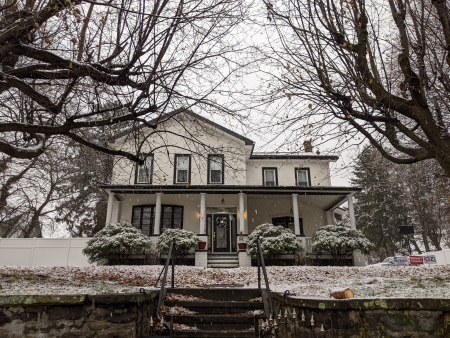
Chop_park
Saturday in the park…I think it was the Fourth of July

Here’s the latest on a case we’ve been following, about the blocking off of a neighborhood in Seattle and making it a no-go zone for those whom the takeoverers wanted to keep out.

Yes, the CHOP/CHAZ case is still a thing. [And before we go on a disclosure: our law firm is participating as amicus curiae in the case.]

Business owners in the zone sued the City in federal court, alleging that the government actively aided or facilitated the takeover, or at minimum did nothing to end it. Claims asserted include Due Process, Takings, and state and local law claims. The takings claim was based on two theories: first, that the City facilitated a physical invasion by third parties of plaintiffs’ properties; second, that the City action or inaction resulted in a loss of access by plaintiffs and their
Continue Reading Federal Court: Seattle Facilitating Downtown Takeover Takings Claim Is Going To Trial

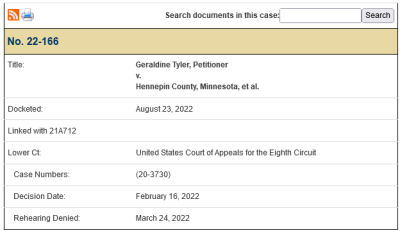
Screenshot 2023-01-13 at 14-15-26 Search - Supreme Court of the United States

Here at inversecondemnation.com, we were all set to call it a week and take a break from posting until Monday.

But SCOTUS had other ideas.

In this Order issued today, it agreed to review Tyler v. Hennepin County, No. 22-166, a case and an issue we’ve been following closely.

The Questions Presented by the petition:

Hennepin County confiscated 93-year-old Geraldine Tyler’s former home as payment for approximately $15,000 in property taxes, penalties, interest, and costs. The County sold the home for $40,000, and, consistent with a Minnesota forfeiture statute, kept all proceeds, including the $25,000 that exceeded Tyler’s debt as a windfall for the public. In all states, municipalities may take real property and sell it to collect payment for property tax debts. Most states allow the government to keep only as much as it is owed; any surplus proceeds after collecting the debt belong

Continue Reading Lucky Friday The Thirteenth: SCOTUS Grants New Takings And Excessive Fines Case

When we first read the U.S. Court of Appeals’ opinion in PEM Entities, LLC v. County of Franklin, No. 21-1317 (Jan. 5, 2023), our reaction was one of skepticism. After all, at first blush, the court seemed to have concluded that in order to possess a property right protected by the Takings Clause, the owner needs first to prove it is a “vested” under state law.

That struck us as waaaay wrong. Yes, vesting under state law gets you a separate property interest, but failure to vest under state law does not mean you don’t otherwise possess Takings Clause “private property.” So what gives, Fourth Circuit?

Well, it turns out that despite us being ready to render a hearty j’accuse at the court, the outcome was a product of the claims made by the property owner (as they often are).

The opinion is short enough that it makes

Continue Reading CA4: Property Owner Isn’t “Vested” So No Takings Property

PXL_20221211_163406631.MP

We continue our series on the 100th anniversary of the mother lode of takings case, Pennsylvania Coal Co. v. Mahon, 260 U.S. 393 (Dec. 11, 1922), with this short essay recently published in the “Notice & Comment” feature of the Yale Journal on Regulation.

In “A Landmark Centennial From a Land Marked By the Past,” our law firm colleague Sam Spiegelman tells us why the Mahon case – despite some weathering over the past century – still is important:

For property-rights advocates, Pennsylvania Coal has become both a blessing and a curse. Though it subjects governmental abuses and overregulation to constitutional scrutiny, in practice it has proven too easy to manipulate in favor of government overreach. Why is this? Because Holmes’s “too far” formula focused on the extent of the of harm to the aggrieved individual. But without his saying more, the Supreme Court ran in

Continue Reading Mahon At 100: “A Landmark Centennial From a Land Marked By the Past” (Sam Spiegelman, Yale J. Reg.)

You know the “amortization” doctrine: when an existing legal use is declared illegal, the government can avoid a takings claim by slowly phasing out the use, supposedly to allow the owner to recoup investment. The doctrine is established in Maryland by Grant v. Mayor and City Council of Baltimore, 129 A.2d 363 (Md. 1957), where the court held that amortization works if the time and uses allowed are reasonable.

Not all jurisdictions take that approach, however. For example, in Pennsylvania Northwest Distributors, Inc. v. Zoning Hearing Bd., 583 A.2d 1372 (Pa. 1991), the Pennsylvania court held “[a] lawful nonconforming use establishes in the property owner a vested property right which cannot be abrogated or destroyed, unless it is a nuisance, it is abandoned, or it is extinguished by eminent domain.”

In In re Mangisteab, No. 2022-93 (Dec. 20, 2022) (unpub.), the Appellate Court of Maryland (fka

Continue Reading Md App: If You Want To Overturn The Amortization Doctrine, Take It Upstairs

Screenshot 2022-12-29 at 16-48-24 il buono brutto il cattivo poster at DuckDuckGo

Here’s the latest from a case we’ve featured here before.

There’s something for everyone in the Florida District Court of Appeal (Second District)’s opinion in Jamieson v. Town of Fort Myers Beach, No. 2D21-2722 (Dec. 29, 2022).

Let’s start with the outcome: the court reversed the trial court’s summary judgment in a wetlands takings case, sending the matter back for a trial. Sounds good.

But let’s back up a sec. The case started a long time ago, when Jamieson’s seven-acre residentially-zoned property was designated as a wetland, resulting in a use density decline from 40 buildable lots to zero (wetlands density is one residence per 20 acres). For a decade, Jamieson tried to “change and/or correct the wetlands designation[.]” Slip op. at 3. The opinion lists out his efforts. He tried for

an application for boundary clarification regarding the extent of the wetlands, a request to transfer the

Continue Reading The Good The Bad And The Ugly: There’s Something For Everyone In This Florida Takings Opinion

We’ve had the North Dakota Supreme Court’s opinion in Wilkinson v. Bd. of Univ. & School Lands, No. 20220037 (Nov. 10, 2022), in our queue for a while because it isn’t exactly the clearest opinion we’ve come across. It is relatively short, so that’s not the issue. But it is cryptic and poorly written, and each time we steeled ourselves to understand and digest it, we got distracted by some bright shiny object and put the opinion aside. But we’ve always meant to post it, and now that 2022 is winding down, we figured we better get on with it.

So let’s see if we get this right (we’re still not entirely sure we did, so feel free to comment if your read of the facts and the court’s analysis differs from ours). Here goes.

Wilkinson’s predecessors-in-title owned land in the Missouri River, and conveyed most of their interests

Continue Reading North Dakota: State May Lease Out Property It Doesn’t Own As Long As It Calls It “Overinclusive Leasing Activity”

Here’s another one from the Ninth Circuit, argued on what one advocate called “land use day at the Ninth Circuit” (except, unlike the other two cases argued that day, the decision in this one gets published). 

In Gearing v. City of Half Moon Bay, No. 21-16688 (Dec. 8, 2022), the panel upheld the dismissal of a takings case, holding that federal courts should abstain from considering regulatory takings cases in favor of pending state court eminent domain actions, even when the condemnor instituted the state court action in response to the federal takings claim (and even though, unlike the other two cases argued that day, the federal takings claim is ripe).

This one started in federal court, where the property owner asserted the city’s rejection of its development application worked a taking. In response, the city ran to state court and filed an eminent domain action

Continue Reading CA9: Land Use Is A “Sensitive Area Of Social Policy” So We’re Gonna Let A Local Govt Bleed The Property Owner Out

PXL_20221211_185826126

This story might be said to have had its roots millions of years ago.

It is about coal, after all. Anthracite coal, to be exact.

But that — and today’s date — should give you a clue that, as we teased in this post a mere 28 days ago (the Supreme Court worked hard and fast in those days), today, Sunday, December 11, 2022, is the 100th birthday of the U.S. Supreme Court’s opinion in Pennsylvania Coal Co. v. Mahon, 260 U.S. 393 (Dec. 11, 1922).

True, what became known as the “regulatory takings” doctrine did not spring from whole cloth on December 11, 1922, but had been bouncing around in the common law for quite a while (see here and here for example).

But if you want to mark and official birthday for regulatory takings, you could not do better than Pennsylvania Coal (aka Mahon).

The

Continue Reading Happy Birthday, Regulatory Takings – Pennsylvania Coal Co. v. Mahon, 260 U.S. 393 (Dec. 11,1922)

Here’s your must-read for today, the latest journal article from Michael Berger, “Theft, Extortion, and the Constitution: Land Use Practice Needs an Ethical Infusion,” 38 Touro L. Rev. 755 (2022).

Here’s the Abstract:

There are many ways in which property owners/developers interact with regulators. To the extent that texts and articles deal with the ethical duties of the regulators, they tend to focus on things like conflicts of interest. But there is more. This article will examine numerous other ways in which regulators may run afoul of ethical practice in dealing with those whom they regulate.

And if that isn’t enough to grab you, there’s this:

There may be more to the issue than how to act in narrow circumstances. For one thing, there is the idea that government and the governed need to deal with each other on a level playing field. As one court put

Continue Reading New Article: “Theft, Extortion, and the Constitution: Land Use Practice Needs an Ethical Infusion” (Michael Berger)