We already know that in Rafaeli, LLC v. Oakland County, 952 N.W.2d 434 (2020), the Michigan Supreme Court held that a homeowner has a property interest in the equity in her home, and that if she fails to pay the full amount of her property taxes and the government forecloses, the government can’t keep the proceeds in excess of the amount of the tax delinquency.

But did this ruling apply retroactively to cases where the foreclosure and sale (and the government keeping the change) occurred before the Rafaeli opinion was issued? That was the issue the Michigan Court of Appeals considered in Schafer v. Kent County, No. 356908 (Sep. 22, 2022).

Long story short: yes, the Rafaeli ruling is one upholding the Michigan Constitution, and did not so much establish a new principle of law as “returned the law to that which was recognized at common law and
Continue Reading Mich App: Supreme Court’s Takings Ruling Is Retroactive Because It Is Not A New Rule, But Returned To Common Law

That’s right: Clint Schumacher’s Eminent Domain Podcast has reached its 100th episode. Very impressive, Clint!

And for this “very special episode,” Clint was kind enough to ask us to return to celebrate. In a wide-ranging hour-plus chat, Clint and I talked property rights and takings of course, but also hit on several more philosophical subjects. If you could have coffee with any historical figure who would you choose? Pharaoh Khufu? Jack the Ripper? Winston Churchill? What person has influenced your life the most? What’s on tap for the 2023 ALI-CLE Eminent Domain and Land Valuation Litigation Conference in Austin? If you had to choose a last meal, what would it be (for me, an easy question)? Clint is a generous host (and person), so I really had a good time.

One note: Clint makes it seem seamless, but I know that the behind-the-scenes process

Continue Reading Congratulations On Reaching The “Century” Milestone, Eminent Domain Podcast!

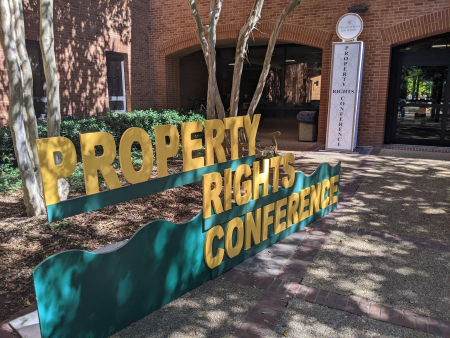
PXL_20220927_164202969

We spoke on the second panel of the day at the 2022 Brigham-Kanner Property Rights Conference at the William and Mary Law School. The subject of our panel — which included Professors David Callies, Tim Mulvaney, and Dave Owen — was “Reshaping the Framework Protecting Property Under the Roberts Court.

Here’s a rough transcript of my remarks.

————————————–

President Reveley, Professor Butler, distinguished Brigham-Kanner Prizewinners (present and future), mentors, colleagues, family and friends: thank you for the opportunity to speak today.

The story goes that when asked what it was like to be a part of the “Rat Pack,*” that Dean Martin responded “It’s Frank’s world, we just live in it.”

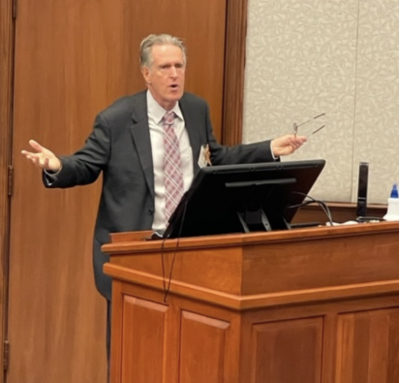
Fd5_62PUoAEo-y8

When I first heard the title of this portion of the program and the discussion of how and if the Roberts Court is reshaping property, my first reaction was a paraphrase of Dean

Continue Reading Brigham-Kanner Property Rights Conference 2022 Report: It’s Chief Justice Roberts’ Property World, We Just Live In It

The facts of the Connecticut Appellate Court’s opinion in Schaghticoke Tribal Nation v. Connecticut, No. AC 43811 (Sep. 27, 2022), really stand out.

Back in the day — and we mean waaaaay back in the day — as in 1801! — the State of Connecticut sold some land which in 1752 (!) the Colony of Connecticut had allowed members of the Schaghticoke tribe to use,.

Flash forward to present day when the Nation sued, alleging the 1801 sale was a breach of the State’s trust duties, and a taking of the Nation’s private property. The short story is that the trial court dismissed and the appellate court affirmed. But the real interesting story is the longer one, and we hope you find the time to read the opinion’s factual recitation.

That longer story starts in 1736 when the tribe settled in an area along the Housatonic River. In response

Continue Reading Connecticut’s 1801 Sale Of Tribal Land Was Not A Taking

  Screenshot 2022-09-20 at 10-17-17 Amazon.com I'm with stupid

Coulda been worse.

When the Third Circuit’s published opinion in Yaw v. Delaware River Basin Comm’n, No. 21-2316 (Sep. 16, 2022) popped up in our feed we got a slight frisson in anticipation – a claim that the Commission’s banning of fracking was a taking.Thank you Knick for opening the federal courts back up to takings claims!

But alas, no decision on the merits. After all, one of the downsides of federal court is the higher justiciability barriers that must be overcome before the court deals with the merits of a takings claim. And so it is in this opinion:

Plaintiffs-Appellants—two Pennsylvania state senators, the Pennsylvania Senate Republican Caucus, and several Pennsylvania municipalities—filed this lawsuit challenging the ban. Among other things, they allege that, in enacting the ban, the Commission exceeded its authority under the Delaware River Basin Compact, violated the Takings Clause of the United

Continue Reading I Made A Takings Claim And All I Got Was This Lousy Opinion On Article III Standing

Clint Schumacher’s Eminent Domain podcast is one of those things that we almost shouldn’t post about. After all, every episode is worth your time. But this one is especially good. After all, it features our law firm colleague and friend Jon Houghton, discussing what you all know is one of our fave topics, regulatory takings.

As Clint describes it:

Jon Houghton of Pacific Legal Foundation joins the podcast today to talk about regulatory takings. This is a complex area of the law, but Jon is a true expert and breaks it down into understandable pieces. He discusses how practitioners can assess when a regulation has risen to the level of a taking. He also discusses regulatory taking issues and cases that are current.

So even though we always say “check out the Eminent Domain Podcast,” we’re saying it again. Check it out.Continue Reading Jon Houghton On Regulatory Takings – Eminent Domain Podcast

Screenshot 2022-09-13 at 14-12-11 Feed LinkedIn

One last reminder that there’ still time to register for the upcoming Brigham-Kanner Property Rights Conference at the William and Mary Law School in Williamsburg, Virginia, September 29-30, 2022. If you can’t make it to the historic campus, there’s an option to attend remotely.

In our opinion, the Conference is the best of its kind because it brings together legal scholars and the practicing bar to talk dirt law theory and practice. We also a have a full supplemental program for law students, that covers property law and careers in eminent domain law, a recruiting session, a program on international property rights, and a program on land use law.

Registration for the Conference is ongoing, and you can sign up here.

Here is the full agenda. (We’ll be speaking on Panel #2, “Reshaping the Framework Protecting Property Under the Roberts Court.”)

Come on, join us!

Continue Reading Still Time To Join Us (In-Person Or Remote) For The 19th Annual Brigham-Kanner Property Rights Conference

A short one (unpublished) from the U.S. Court of Appeals for the Sixth Circuit, considering an issue we’ve been following: what is the effect of the government’s claim that it is regulating property for what looks like a valid “police power” purpose?

As noted, that’s a road we’ve been down before. Here’s a sampling:

In Bojicic v. Dewine, No. 21-4123 (Aug. 22, 2022), the Sixth Circuit was considering a takings and due process challenge to the governor’s Co-19 shutdown orders. The court rejected the district court’s rationale

Continue Reading CA6: No “Police Power” Exception To Takings (But It’s Nonetheless Dispositive As Penn Central’s Character)

Screenshot 2022-09-08 at 11-03-58 Cedar Point Nursery and the End of the New Deal Settlement

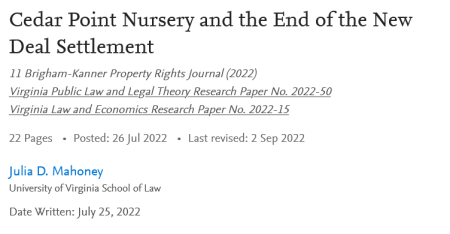
Here’s your must-read for today, a new article from U. Va. lawprof Julia D. Mahoney, “Cedar Point Nursery and the End of the New Deal Settlement.”

Disclosure: we show up in footnote * along with others for offering “comments and conversations” about the piece. 

Here’s the Abstract:

In Cedar Point Nursery v. Hassid, the United States Supreme Court ruled that a California state regulation granting labor organizations a limited “right to take access” to agricultural employers’ property constitutes a per se physical taking. Cedar Point has sparked intense criticism, with critics arguing that the decision threatens to transform the law of property rights so as to “hobble” government land use regulation and even undermine democracy. This Article explains why the objections of Cedar Point’s detractors are misplaced. Far from disabling government regulation or fomenting stasis by favoring the “already haves,” Cedar Point is best understood as another

Continue Reading New Must-Read Article: “Cedar Point Nursery and the End of the New Deal Settlement” – Property Rights Are Civil And Human Rights

The facts are pretty straightforward in the U.S. Court of Appeals’ opinion in Frein v. Pennsylvania State Police, No. 21-1830 (Aug. 30, 2022):

Eric Matthew Frein is on death row for cold-blooded murder. In 2014, he ambushed two Pennsylvania State Troopers, killing one and injuring the other. For a while, he evaded capture. Police knew he had used a .308-caliber rifle. So they got a warrant to search the home that he shared with his parents and seize that type of rifle and ammunition.

When they executed the warrant, state police did not find a .308-caliber rifle. Instead, they found forty-six guns belonging to the parents: twenty-five rifles, nineteen pistols, and two shotguns. None was a .308. Even so, the officers got a second warrant and seized them all.

Slip op. at 3.

The police eventually got their man, and Frein was tried and convicted. His appeals (including discretionary

Continue Reading CA3: Claim That Govt Is Keeping Property Seized (But Not Used) As Evidence “checks all the Fifth Amendment boxes.”