We gotta be honest here: when the substantive portion of an opinion (even an opinion about takings and exactions) begins with, “Congress created the Enterprises to, inter alia, provide liquidity to the mortgage market…” our eyes kind of glaze over. It’s going to be one of those opinions.

But we soldiered on, and slogged through the Federal Circuit’s opinion in Washington Federal v. United States, No. 20-2190 (Feb. 22, 2022). The case is about the 2008 federal takeover of Freddie Mac and Fannie Mae. We won’t go into the details, but the basic allegations in the complaint are that the fed takeover of the entities was an exaction, and a taking.

The Federal Circuit affirmed the Court of Federal Claims’ dismissal, although for other reasons. The CFC thought the plaintiffs missed the 30-day statute of repose applicable to challenging the appointment of a conservator. The Federal Circuit disagreed

Continue Reading CAFED: Fed Takeover Of Fannie Mae & Freddie Mac Not An “Exaction,” Not A Taking

Lately, we’ve been zeroing in on one of the lesser known parts of the Supreme Court’s takings canon, Yee v. City of Escondido, 503 U.S. 519 (1992), where the Court concluded that a city ordinance that limited the amount a property owner could charge a tenant for rent was not a physical invasion taking.

In Yee, the Court held that the ordinance did not intrude on the owner’s right to exclude because the owners had invited their tenants to intrude on their property when they let them become tenants. Yeah, that invitation and resulting intrusion was conditioned on the tenant paying each month a specific amount of rent and the ordinance effectively rewrote that agreement, but the plaintiff raised only a facial categorical takings claim (and thus the question of whether the city-mandated lower rent prohibited a fair return to the owner was an issue that the owners could

Continue Reading Wash App: No Taking Of Right To Exclude Because Eviction Moratorium Merely Lets Tenants Remain

CedarpointPRELcoverpage

Thank you to the editors over at The Practical Real Estate Lawyer for publishing my missive on Cedar Point Nursery v. Hassid, the U.S. Supreme Court’s recent blockbuster regulatory takings decision (and for letting me post a copy of the article here so it is available even if you are not a PREL subscriber). And you know this, but I’m going to disclose it again: my law firm represented the property owner in that case, so yes, I do have a viewpoint; take that into account while reading. 

By the way, you might consider becoming a subscriber. The journal publishes just what the title suggests it does – practice-oriented articles about dirt lawyering. Good stuff.

Thomas, Common Sense and Common Law: Defining “Property” in Cedar Point v. Hassid, 38 Prac. Real Estate Law…

Continue Reading New Article: Common Sense and Common Law: Defining “Property” in Cedar Point v. Hassid

IMG_20170323_142813

Sorry about the headline, but come on, man! We have to use clickbaity headlines every now and then to get your attention. Here’s the latest in a case we’ve been following.

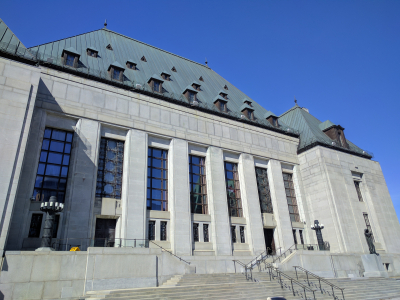
Yesterday, the Supreme Court of Canada heard oral arguments in Annapolis Group Inc v. Halifax Regional Municipality, a case involving “de facto expropriation,” or what we in the U.S. might think of as a regulatory taking.

We watched the livestream (along with a few of our northern colleagues), and if you missed it, the recording of the (2-hours and 30-minutes!) arguments can be found here — in English, with simultaneous French translation, if you want to have some extra fun.

Screenshot 2022-02-17 at 07-50-43 Supreme Court of Canada - SCC Case Information - Webcast of the Hearing on 2022-02-16 - 3[...]

Yes, there really are that many Justices
and lawyers on the argument

The Supreme Court is considering whether Halifax’s refusal to approve Annapolis Group’s development applications (consistent with its residential zoning, more specifically “future serviced development”) on

Continue Reading Important Developments In Canada (No, Not That!): Supreme Court Hears Argument In “Takings” Case

PXL_20220127_144224442

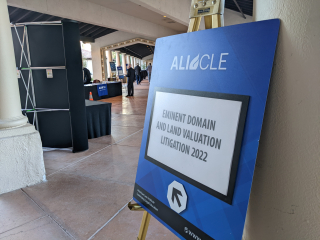
After a two-year absence in which we went remote, in the last week of last month (our usual spot on the calendar, between the playoffs and Super Bowl), we once again met in-person for the American Law Institute-CLE Eminent Domain and Land Valuation Litigation Conference.

Approximately 200 lawyers, judges, legal scholars, appraisers, law students, right-of-way agents, relocation experts, property owners, and other related professionals gathered in-person–yes, in-person–at the Scottsdale (Arizona) Resort at McCormick Ranch, to get reacquainted, learn stuff, and renew ties last made in-person in Nashville in 2020. In addition to the live attendance, we also welcomed about 50 remote colleagues, who joined the live webstream.

This was the 39th edition of the Conference, one of the most-established and successful conferences in the ALI-CLE stable of programs.

To those who joined us – thank you. This conference reminded us of why this program is so

Continue Reading 2022 ALI-CLE Eminent Domain And Land Valuation Litigation Conference, Scottsdale: You Should Have Been There!

Before we go further into the Ninth Circuit’s opinion in Ballinger v. City of Oakland, No. 19-16-550 (Feb. 2, 2022), this disclosure: this is a case in which our law firm represents the property owners. So take that into account as you read our take on the case.

The Ballingers own a home in Oakland, California, and were called away for a year while on active duty with the military. They rented their home with a one-year lease. Oakland makes property owners who want to move back into their own homes at the expiration of a lease to pay tenants a “relocation fee.” The Ballingers paid $6.5k to the tenant for the relocation fee, and sued the city for, inter alia, a physical taking of their money, and for an unconstitutional exaction of their home. The district court dismissed for failure to state a claim because the

Continue Reading CA9: We Reject Legislative/Administrative Distinction In Exactions, But City Requirement That Owners Pay Tenant To Move Back Into Their Home Isn’t A Taking

A short one from the Oklahoma Supreme Court.

In Rocket Properties, LLC v. LaFortune, No. 120000 (Jan. 18, 2022), the court issued an order that, in effect, reverses the trial court’s dismissal of an inverse condemnation case (we say “in effect” because the Supreme Court was considering a writ of prohibition, not an appeal). The trial court concluded that the inverse claim was governed by the procedural requirements of the Oklahoma Governmental Tort Claims Act.

The Oklahoma Supreme Court has long held that “[c]ondemnation proceedings do not involve a tort.” Oklahoma City v. Wells, 91 P.2d 1077 (Okla. 1939). But recently, the legislature amended the statute to change the definition of “tort” to include a legal wrong or violation of a “duty imposed by general law, statute, the Constitution of the State of Oklahoma …[,]” to specify that the tort claims statute governs “tort suits alleging constitutional rights.”

Continue Reading Inverse Condemnation Isn’t Tort, OK

If you ever get the opportunity to teach in a law school — either as a full-time legal scholar, or part-time as an expert adjunct practitioner — take it if you can. You might think you know a lot about a particular subject, but there’s nothing like spending time at the lectern in a law classroom in front of sharp and eager lawyers-in-training to sharpen your thoughts, and get you to truly understand a subject.

And folks calling you “professor” can evoke a smile.

Sensei

But if there’s one downside to the law school experience from the teacher’s side of the lectern, it’s grading. Especially at a law school like William and Mary that has a pretty strict mandatory curve. In upper-division courses that we handle like Eminent Domain and Property Rights Law and Land Use — where we’re dealing with some very high-level stuff and the quality of the

Continue Reading The Circle Is Now Complete: A Sampling Of Final Paper Topics From William and Mary Law’s Eminent Domain & Property Rights, And Land Use Courses

Screenshot 2022-01-16 at 10-15-33 Alexander Hamilton letter at center of legal fight returned
we tried to come up with a “Hamilton” reference
but
have not seen the show

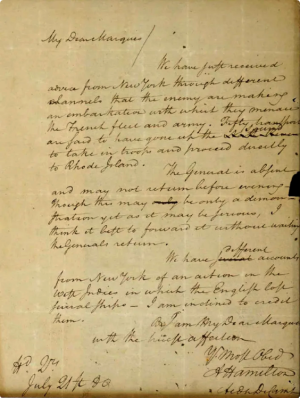
The Crane family has, for decades, had in their possession — if not their outright ownership — the “Hamilton Letter,” which Alex wrote to no less than the Marquis de Lafayette 1780.

Ownership, however, seems to be disputed, and Massachusetts claims that as a “public record,” it owned and once possessed the letter, which it alleges was five-finger discounted by a “kelptomaniac cataloger” at the Commonwealth’s Archives back in the 1940s. The Cranes argue they purchased the letter “from a reputable antiques dealer in Syracuse,” are bona-fide purchasers for value, and that the letter has been with the family ever since. 

Until the day, that is, that the feds, pursuant to a seizure warrant issued by a Virginia federal court, grabbed it. The Cranes had put the letter up for sale at a

Continue Reading New Like A Boss Cert Petition: Govt Took The Hamilton Letter It Claims Was Stolen

A developer alleged that the city didn’t live up to its contractual obligations.

The city thought it would be a good place for a new headquarters for something called “Perfect Game Incorporated.” The usual plans ensued, including agreements between the city, a non-profit redevelopment facilitator, and Preston Hollow, a “finance company that funds economic development projects for municipal governments and development corporations.” These agreements dealt with loans by Preston to the city and the facilitator; the loans were used by the facilitator to purchase two parcels in the city for the project, with some of the money remaining in escrow subject to disbursement when certain things happened.

That’s when things allegedly went awry. As the Fifth Circuit put it, “trouble ensued.” Preston claimed that the facilitator insisted on disbursement, even tough it has not yet complied with the conditions. Preston sent a notice of default, and requested that the escrow

Continue Reading When City Busts A Redevelopment Deal, It Might Face The Wheel (But Not For A Taking)