Screenshot 2021-11-17 at 13-11-12 The Realities of Takings Litigation

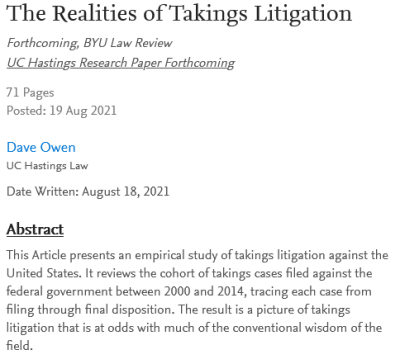
Another law review article worth reading. This one from lawprof Dave Owen, is about “The Realities of Takings Litigation” (forthcoming BYU Law Review). That title certainly got our attention – any time a law journal article is about ‘reality’ and takings, and includes empirical research, we’re going to read it.

Here’s the abstract:

This Article presents an empirical study of takings litigation against the United States. It reviews the cohort of takings cases filed against the federal government between 2000 and 2014, tracing each case from filing through final disposition. The result is a picture of takings litigation that is at odds with much of the conventional wisdom of the field.

That conventional wisdom suggests that most takings cases will involve alleged regulatory takings; that the most intellectually challenging issues will arise within the field of regulatory takings; and, more broadly, that takings litigation will play an

Continue Reading New(ish) Article: “The Realities of Takings Litigation” (Dave Owen)
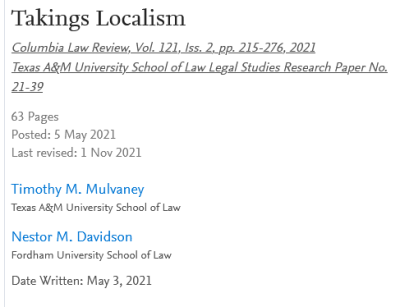
Screenshot 2021-11-15 at 11-33-55 Takings Localism

Be sure to check out the latest article from takings scholars and Nestor Davidson and Tim Mulvaney, “Takings Localism,” 121 Colum. L. Rev. 215 (2021) (pdf here).

Here’s the abstract:

Conflicts over “sanctuary” cities, minimum wage laws, and gender-neutral bathrooms have brought the problematic landscape of contemporary state preemption of local governance to national attention. This Article contends that more covert, although equally robust, state interference can be found in property, with significant consequences for our understanding of takings law.

Takings jurisprudence looks to the states to mediate most tensions between individual property rights and community needs, as the takings federalism literature recognizes. Takings challenges, however, often involve local governments. If the doctrine privileges the democratic process to resolve most takings claims, then, that critical process is a largely local one.

Despite the centrality of local democracy to takings, state legislatures have restricted local authority on property issues in a range of ways. States have expanded compensatory liability for owners facing local regulations, imposed procedural constraints on local authority, and limited the exercise of foundational local powers. Seen in its entirety, this state intervention—like contemporary “new preemption”—is acontextual and unduly rigid, cutting at the heart of the devolutionary principles underlying takings jurisprudence.

This unbalanced state role requires a recalibration of decisionmaking power between state and local government to foster intersystemic dialogue and reflection. States certainly play a crucial role in defining and protecting property interests, but they must justify choices to constrain local discretion when state and local values conflict. The extant state statutory regime dispenses with this justificatory task via a formalistic disregard for the contextualization that legitimates vertical allocations of authority. A corrective to decades of imbalance in state ordering of local authority would thus properly recognize “takings localism.”

Free up local governments, or tie their hands…which is better? After reading this, you decide.
Continue Reading New Article: “Takings Localism” (Tim Mulvaney & Nestor Davidson)

It takes a bit of work to work your way through the Arizona statute being challenged in the U.S. Court of Appeals’ opinion in CDK Globall LLC v. Brnovich, No. 20-16469 (Oct. 25, 2021). But we recommend you read the opinion and do the work nonetheless, because it tells us something about the way the Ninth Circuit views the right to exclude.

The statute, known as the “Dealer Law,” deals with the way car dealers treat the data they obtain from their customers. Data like the cars themselves, parts, services and the like, but also things like credit history and social security numbers. Like pretty much every other thing these days, that data is managed by proprietary software. Not surprisingly, there are specialized vendors who license the industry-specific, proprietary software. According to the opinion, those vendors in the past allowed dealers to extract the data from the proprietary platform

Continue Reading CA9: Once You Open The Door For One, You’ve Opened It For Everyone

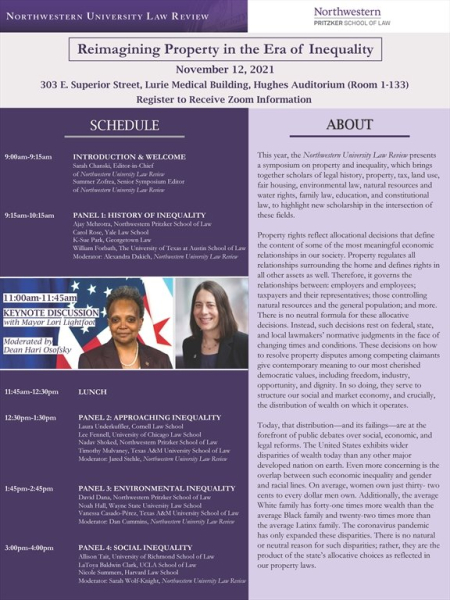
“This year, the Northwestern University Law Review presents a symposium on property and inequality, which brings together scholars of legal history, property, tax, land use, fair housing, environmental law, natural resources and water rights, family law, education, and constitutional law, to highlight new scholarship at the intersection of these fields.”

More information, as well as registration to attend remotely, here.

Nulr_symposium_posterContinue Reading Still Time To Sign Up For Northwestern L. Rev.’s Symposium: “Reimagining Property Rights in the Era of Inequality” (Friday, Nov. 12, 2021)

There’s not a lot of direct takings love in the U.S. Court of Appeals for the Second Circuit’s opinion in Melendez v. City of New York, No. 20-4238 (Oct. 28, 2021), but there’s enough there that you might want to read it anyway.

Because the opinion resurrected the plaintiffs’ Contracts Clause claim. You heard that right, their Contracts Clause claim. The plaintiffs asserted that New York City’s ordinance that prohibiting “threatening” a tenant due to their Co-19 status violated free speech and due process rights, and the city’s ordinance voiding personal guarantees for commercial leases impaired their lease contracts. The district court dismissed the case for failure to state a claim, concluding that the guaranty ordinance served a legitimate public purpose and did not favor any class.

The Second Circuit affirmed dismissal of the free speech and due process claims, but also concluded that the complaint alleged a plausible

Continue Reading CA2: NYC’s Eviction Moratorium May Have A Contracts Clause Problem

21a0226p-06

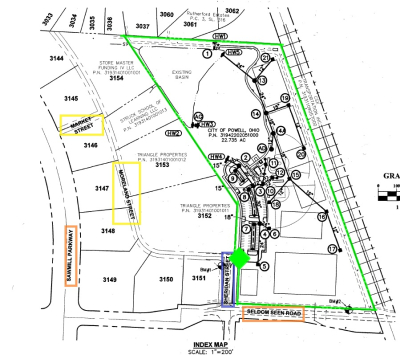
We thought we posted the U.S. Court of Appeals for the Sixth Circuit’s recent opinion in a takings case,  Golf Village North, LLC v. City of Powell, No. 20-4177 (Sep. 23, 2021), earlier, but a search of the blog reveals we did not, so here we go.

The City built a new 23-acre public park (highlighted in green on the map above), which had been dedicated by the developer, Golf Village North, as a condition of subdivision. A road that led to the one of the park entrances was to be made a public road (blue highlighted). The City’s plans noted that approval of the park construction and opening the blue road to the public were contingent on the City securing easements from Golf Village for public access to the private streets.

The city tried to obtain these easements but Golf Village declined. Notwithstanding the city’s plans required

Continue Reading CA6: City Park Causing Public To Use Private Roads Not A Taking Because Owner Can Erect Roadblock

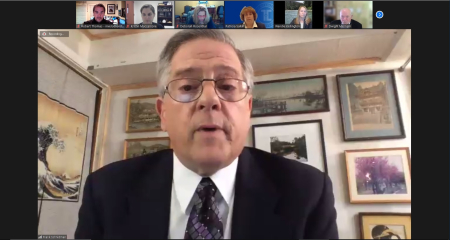
FrankLUI Co-Chair Prof. Frank Schnidman introducing the faculty
Here are the links to the cases and issues that we just finished speaking about at the 35th Annual Land Use Institute (more information on the LUI here). Today was day 1 of a multi-day remote program and the sessions are available ala carte, so there’s still time to join in and learn.

Supreme Court

  • Cedar Point Nursery: the Supreme Court affirms the “keep out” vibe in property law. Yes, there are three “exceptions” to the presumption that any physical intrusion into property is a taking (torts, entries allowed under “background principles,” and legal exactions), but overall a very strong affirmation of property rights.
  • Pakdel v. San Francisco: the “final decision” ripeness requirement in takings cases is “relatively modest” and turns on “de facto” readiness. Yes, it’s a technical requirement, but let’s not get too technical about it.
  • PennEast Pipeline


Continue Reading Links And Materials From Today’s Land Use Institute Takings/Eminent Domain Session

Here’s a new law journal article, just published, which we recommend everyone read.

Michael M. Berger, “Whither Regulatory Takings,” 51 Urban Lawyer 171 (2021). Available online here.

If you need encouragement to read it, here’s a sample:

The thrust of this article is severalfold. First, Holmes was right. His simple conclusion on behalf of eight Justices encapsulated the crux of modern government: while government needs to be able to regulate, zealous regulators can “go too far” and, when they do, regulation becomes a taking. The Constitution drew a line in the sand that may not be crossed without consequences. Second, a cautious Supreme Court thereafter left the Holmesian standard intact and nibbled around the edges, adding alternative descriptors that confused and confounded the situation. Third, the solution to the problem of how to define a regulatory taking lies in the simplicity of the common law. One of

Continue Reading New Article (Must-Read): Michael Berger, “Whither Regulatory Takings”

Here’s the latest in a case we’ve been following (one in which we guessed from the beginning was headed where it is today).

The Zitos claim that their property was taken without compensation. They sued for compensation in federal court. Knick tells us that this is okay, right? Well, the problem for the Zitos is that they claim the State of North Carolina did the taking. And you know what that means: 11th Amendment “immunity.” You can’t sue a State for money in federal court without its consent. And North Carolina didn’t consent.

The District Court dismissed. It concluded that it might have allowed the takings claim for compensation to proceed in federal court except that the Fourth Circuit already concluded that a federal court is barred from considering a takings claim against a state if state law recognizes a takings claim. See Hutto v. South Carolina Retirement System

Continue Reading New Cert Petition: The Self-Executing Fifth Amendment Abrogates 11th Amendment Immunity

Untitled Extract Pages

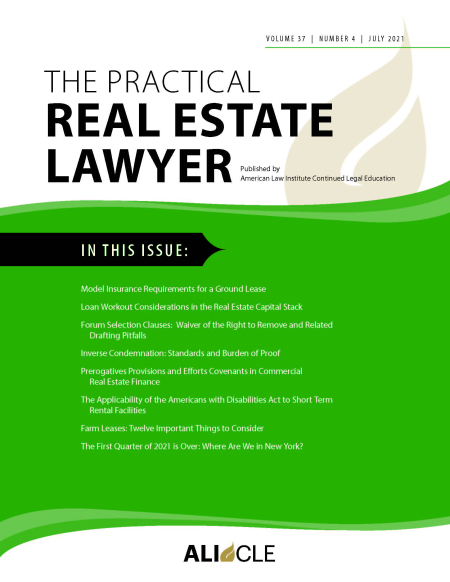
Worth reading: an article in ALI-CLE’s Practical Real Estate Lawyer, authored by our friends and colleagues Steve Clarke, Justin Hodge, Jeremy P. Hopkins, and Christian Torgrimson, “Inverse Condemnation: Standards and Burden of Proof.”

A subscription to PREL costs, but for this issue the good people at ALI have made it available for free. Lucky you. But you really should get a subscription — PREL publishes useful articles like this frequently.

And since we’re on the subject of ALI-CLE, we can’t resist reminding you that registration for the 2022 ALI-CLE Eminent Domain & Land Valuation Litigation Conference is underway (including reservations for the limited room block at the Scottsdale Resort). Please register and make your plans to join your colleagues (including the authors of the article!) in January in Scottsdale.Continue Reading New Article: “Inverse Condemnation: Standards and Burden of Proof” (ALI-CLE Practical Real Estate Lawyer)