OK, we get that law is a serious business and that one should never make light of others’ situations. Each person’s claim is important to them, at the very least.

But after reading today’s Federal Circuit opinion (unpublished, nonprecedential) in Bench Creek Ranch, LLC v. United States, No. 20-2151 (May 7, 2021), we couldn’t help but make a couple of lighthearted movie references.

First, the above clip from one of the “Bill and Ted” movies is there because the Bench Creek case alleged that the feds are liable for a taking due to its failure to prevent wild horses from invading their land where they drank Bench Creek’s water.

Bench Creek alleged in its complaint that, after a wildfire in July 2017, hundreds of wild horses on federal lands—owned by the United States and managed by the Bureau of Land Management—drank water that belonged to Bench Creek under a
Continue Reading Fed Cir (unpub.): Feds Not Liable For Taking When Wyld Stallyns Drink Your Milkshake

We’re hoping that someone can explain the Florida District Court of Appeal’s recent opinion in Bondar v. Town of Jupiter Inlet Colony, No. 4D19-2118 (May 5, 2021) in a way that makes sense other than the old apocryphal tale of “I don’t know why we do things this way, except that we’ve always done things this way.”

Before we get to the details, a slight detour. This is another one of those cases about substantive due process. Now don’t get us started on that one — we get that it might seem odd to suggest that the Fourteenth Amendment’s Due Process Clause limits the government’s power beyond requiring fair procedures. After all, the words are right there in the text: “nor shall any state deprive any person of life, liberty, or property, without due process of law.” But work with us here: we’ve always viewed the phrase much

Continue Reading Fla App Doubles Down On That Weird Property Isn’t “Property” Thing

R.S. Radford’s most-recent article, Knick and the Elephant in the Courtroom: Who Cares Least About Property Rights? in the latest issue of the Texas A&M Journal of Property Law, should be next on your to-read list. 

Here’s the summary of the article:

Throughout the thirty-four-year history of Williamson County, one fact was taken for granted. Never directly mentioned but always looming in the background of two rounds of oral argument before the Supreme Court in Knick was the premise that relegating takings claims to state court made it less likely that property owners would prevail on those claims than if they could be filed in federal court in the first instance. This Article examines that premise and finds little support for it in the historical record.

Part I of this Article discusses Williamson County and highlights the logical, doctrinal, and procedural confusion associated with the opinion, both in its

Continue Reading New L Rev Article: Knick Won’t Mean Much Until Federal Courts Get Over “Strong Distate, If Not Outright Contempt” For Land Use Matters

20180805_155746_HDRThat rail crossing in Chicago

We’ve noted before that gun cases have life of their own, often divorced from strict legal logic. Throw in takings, and you’ve got a recipe for a difficult challenge.

But add to the mix a Supreme Court überlawyer, and maybe your chances go up. Who knows for sure. Only the nine at 1 First Street, NE do. 

So it is with this cert petition, filed yesterday, raising both Second Amendment keep-and-bear-arms and Fifth Amendment takings questions. The issue is New Jersey’s decision to make large capacity magazines illegal (well, technically to lower the already-limited capacity of rifle and pistol magazines from 15 to 10). The problem, the petition argues, is that the ban didn’t just apply prospectively, but covered legally-possessed magazines also, and requires owners to give them to the government, transfer them to third parties who may legally possess them, or

Continue Reading New Cert Petition (Clement): Making It Illegal To Keep High-Capacity Magazines Declared Contraband Is A Taking

Titles

Two very interesting law review articles (essays) by well-known property experts are now available in the Notre Dame Law Review:

  • Thomas Merrill, The Compensation Constraint and the Scope of the Takings Clause, 96 Notre Dame L. Rev. 1421 (2021). Professor Merrill asks “whether the established methods for determining just compensation can shed light on the meaning of other issues that arise in litigation under the Takings Clause.” This idea is worth exploring in much greater detail, and amplifies a thought we’ve long had: instead of trying to forge new ground when trying to figure out whether a government action results in a taking, might it not be simpler and more consistent to look at an established body of law that truly informs the subject, valuation and just compensation? For example, see our thoughts on Murr v. Wisconsin, in which we suggested that instead of a new federal


Continue Reading Your Friday (And Weekend) Reading: Merrill On Compensation; Epstein On Valuation

20160126_164144

Here’s one we’ve been waiting to drop. In San Jacinto River Authority v. Medina, Nos. 19-0400, 19-0402 (Apr. 16, 2021), the Texas Supreme Court held that “statutory takings” under the Texas Government Code include both physical invasion takings as well as regulatory takings.

This case stems from flooding allegedly caused in part by the San Jacinto River Authority’s release of water in response to Hurricane Harvey. The property owners whose land was flooded sued, asserting takings and inverse claims under both the Texas Constitution, and the “Private Real Property Rights Preservation Act.” The Authority sought dismissal of the statutory claim arguing that it covers only regulatory takings, not physical takings like the takings here.

In case you are not familiar with the statute, it is a waiver of governmental immunity for lawsuits “to determine whether the government action of a political subdivision results in a taking under this chapter.

Continue Reading Texas’ Takings Statute Allows Claims For Both Physical And Regulatory Takings

We’ve been meaning to post this one for a while, and it appears our procrastination has paid off: the Court has asked for a response.

Normally, we’d summarize the case and the issues, but in this instance, the cert petition‘s Question Presented lays it all out:

Petitioner, Next Energy, LLC, commenced acquiring blocks of five-year oil leases in 2011 to drill high volume horizontal hydraulic fracturing (horizontal hydraulic fracturing) wells to recover oil from shale formations. Shale oil leasehold interests, like all mineral interests, are separate, distinct leasehold interests from the surface of the land. Horizontal hydraulic fracturing is the only economically viable method to recover shale oil from Next’s leases. The value of the shale oil constitutes the entire value of Next’s leases. At the time the leases were acquired, Illinois law allowed the horizontal hydraulic fracturing process. In mid-2012, after the lease blocks were acquired but

Continue Reading New(ish) Cert Petition: Is Fracking Moratorium A Loretto Or Lucas Categorical Taking?

Screenshot_2021-04-12 Necessity Exceptions to Takings by Shelley Ross Saxer SSRN

Takings! Armstrong! Emergencies! Mahon! Jacobson!

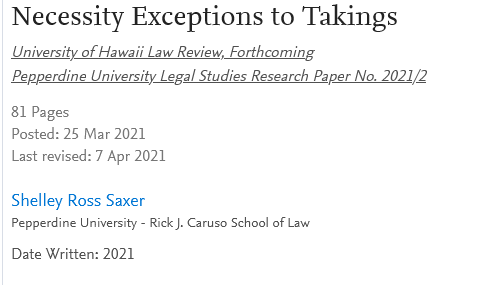
Add lawprof Shelley Ross Saxer’s latest article (forthcoming in the University of Hawaii Law Review), “Necessity Exceptions to Takings” to your reading list.

Get it at SSRN here.

Rather than summarize it for you, we’ll just post the abstract:

The doctrine of necessity has strong roots in the common law of tort and property going back hundreds of years. In the United States the doctrine has been applied in various situations to negate judicial review of constitutional challenges to government action, most recently in some of the wildfire and flood claims resulting from disasters. But now, the states’ responses to the COVID-19 pandemic have brought one of these necessity doctrines—the public health necessity relying on Jacobson v. Massachusetts—to the forefront as courts across the country review constitutional challenges to state public health measures. With such intense review of Jacobson’s public health necessity

Continue Reading Must Read: “Necessity Exceptions to Takings” (Shelley Ross Saxer)

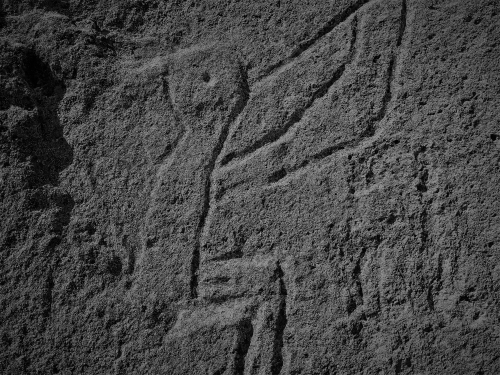
PXL_20210329_222643947This is either a petroglyph of an alien astronaut who visited Earth and gave
ancient peoples wonderful space technology like how to build
the Pyramids, or it’s a guy playing a flute.

(I’ll go with ancient astronaut.)*

When an opinion starts off by characterizing your complaint as asserting “a bevy of claims,” you know you are probably not going to be happy with the outcome.

So it is with the U.S. Court of Appeals’ opinion in Santa Fe Alliance for Public Health and Safety v. City of Santa Fe, No. 20-2066 (Mar. 30, 2021), a case in which the Alliance challenged the federal Telecommunications Act, the the New Mexico statute, and the city’s ordinance that foster the installation of cell towers on public rights-of-way. Collectively, these statutes impede or bypass the usual land-use process, which results in these (alleged) effects:

The Alliance’s membership consists of Santa Fe residents concerned


Continue Reading CA10: Plaintiffs Lacked Standing To Assert Cell Towers Took Their Property

We suggest you take a read through the California Court of Appeal’s opinion in Felkay v. City of Santa Barbara, No. B304964 (Mar. 18, 2021). It’s all there: Lucas wipeout takings, futility and exhaustion, coastal zone property rights.

This is an inverse condemnation case, seeing compensation for the city denying the owner any economically beneficial use of his property, because it was on a bluff face. Under the city’s ordinances, bluff faces can’t be built on. The planning commission staff said so, but they also recommended to the commission that this would be a taking, and the commission should therefore employ the takings safety-valve provision in the ordinance which allows the city to approve development if denial would be a taking (to paraphrase that old lung-dart commercial, “it’s better to switch than to fight”).

“No deal” the commission said, rejecting staff’s recommendation, “we’ll show ’em who is boss!

Continue Reading Cal App: Taking Verdict Affirmed – When City Asserts That Its No-Development Law “trumps whatever you might submit,” It Would Have Been Futile For Property Owner To Submit Development Application