You listened live. Or you missed that, and listened to the recording. Or, you preferred to review what others thought of the arguments. Now you can read it yourself.

Here’s the transcript of Monday’s oral arguments in Cedar Point Nursery v. Hassid, No. 20-107, the case in which the Supreme Court is considering whether California’s forbidding of agricultural property owners from keeping union organizers off their land is a taking.

Some highlights, in our opinion:

  • Several of the Justices wanted to know whether it was important that the property owners called the access required by the regulation an “easement,” even though it is not formally an easement (you know, the thing where the dominant and servient estate owners agree that one can use the land of another, that is recorded, that runs with the land, and the like. Lawprof Josh Blackman writes about that here (“


Continue Reading Read And Listen To The Oral Arguments In SCOTUS’ Latest Takings Case
In which we join the Pendulum Land Podcast (again, thank you hosts!) to talk about the Virginia Supreme Court’s recent opinion in Johnson v. City of Suffolk, the case we label the “oyster takings” case in which Hampton Roads oystermen claimed that their property was taken when the City of Suffolk and the Sanitation District dumped sewage into the river and declared a “condemnation zone” (i.e., no oyster harvesting).

Short story: the court concluded that the leases of Commonwealth-owned bottomlands in the Nansemond River did not confer a property interest. Or at least not a property interest worthy of constitutional protection. Thus, no takings claim when Suffolk and the Sanitation District dumped sewage into the river and pretty plainly interfered with some kind of right the plaintiffs owned in the lease. Just not enough of a right to require compensation.  

Our thoughts on the court’s decision

Continue Reading We Join Pendulum Podcast To Debate Oysters, Property Rights, Takings

Here are links to the summaries and analysis of yesterday’s oral arguments in Cedar Point Nursery v. Hassid, No. 20-107, the case asking whether California’s forbidding of agricultural property owners from keeping out union organizers is a taking:

Neutral


Continue Reading Cedar Point Oral Arguments Round-Up

PICT1199

Here’s the recorded arguments.

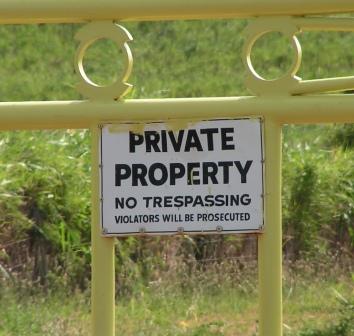
  1. California will try and push the Court to seeing this as an “anti-union” lawsuit: this is not that big of an intrusion, we’ve been doing it for 50 years under both Cal and federal law, and a ruling for the property owners will upset this apple cart and prevent unions from organizing.
  1. The property owners will try and push the Court to seeing the case as one upholding the “keep out” nature of private property. There are other means of contacting the workers, so why need to do it on this private property? Convenience? [Disclosure: my law firm, Pacific Legal Foundation, represents the property owners.]
  1. Is this case different from Kaiser and Nollan in that California’s invitation to access the nursery property is not to the general public and only to union organizers?
  1. Is this case different from PruneYard in that the owner did not


Continue Reading In California, Can A Landowner Really Say “Keep Out?” Things To Look For In Today’s SCOTUS Cedar Point Nursery Arguments

Dig this: property owners assert that the County’s right of way dedication ordinance is an unlawful exaction. You know the drill – logical nexus, rough proportionality, etc. Nollan, Dolan, Koontz. Here’s the short story: the owners sought subdivision plat approval without the dedication for public roads required by the ordinance. No deal. The County’s process allows for consideration of variances based on extraordinary hardship. The owners assert that the variance procedures violate their right to procedural due process. The District Court granted the County summary judgment.

In Pietsch v. Ward County, No. 20-1728 (Mar. 16, 2021), the Eighth Circuit affirmed. This is a Nollan/Dolan/Koontz claim. The property owners disavow that they are raising a takings claim. But you can’t fool us, property owners, we know a takings claim when we see one. “Plaintiffs’ due process and unconstitutional conditions claims are an impermissible attempt to recast a Takings claim.” Slip

Continue Reading CA8: You Can’t Fool Us, Property Owner, We Know That Nollan/Dollan/Koontz Claim Isn’t A Due Process Or Unconstitutional Conditions Claim, But Really A Takings Claim

You remember that Seventh Circuit case challenging (as, inter alia, a no-public-use taking) the location of the Obama Center in Chicago’s Jackson Park under the public trust (from the home of the American public trust doctrine, Chicago)? We wrote about it in “Friends Without Benefits: CA7 Rejects Takings Claim For Obama Center Because Citizen’s Group Lacks Property Interest In Public Park.”

This was then-Seventh Circuit Judge Amy Barrett’s first (and only) takings or property rights opinion she authored prior to her promotion to the Supreme Court.

A citizen’s group asserted it has a property interest in Jackson Park by virtue of being the beneficiary of the public trust, and that the handing over of the Park to the Obama Foundation was a private benefit regulatory taking. The plaintiff sought an injunction stopping the transfer, and did not seek just compensation.

The district court and the

Continue Reading New Cert Petition: Judge Barrett’s (Sole) CA7 Takings Opinion Is Wrong

We don’t usually post trial court rulings, but this one is very interesting, so we’re going to break our own rule.

New Orleans had a traffic camera program. Not popular, we’d suppose. People who were caught on camera brought a class action suit in Louisiana state court, arguing that the city didn’t have the legal authority to collect the fees and fines. They won, both in the trial court and in the court of appeals. The Louisiana Supreme Court declined to review the case. Meaning the judgment ordering the city to return the money illegally collected was final.

Apparently, the city didn’t do so.

So the judgment creditors sued for a taking in federal court under 42 U.S.C. § 1983. The predictable procedural arguments followed: Rooker/Feldman (nope), res judicata (nope), statute of limitations (nope).

But what about the takings claim itself? The city moved to dismiss for

Continue Reading Ipse Dixit: City’s Noncompliance With State Court Judgment Ordering Return Of Illegally-Collected Traffic Cam Fees Could Be A Taking

Here’s the cert petition, recently filed, which asks the following Questions Presented:

Petitioner owns a parcel of land in Chicago, Illinois. Chicago Terminal Railroad formerly had the right to operate a portion of rail line subject to a conditional easement over a portion of Petitioner’s property. The easement terminated according to its terms. Nevertheless, Chicago Terminal Railroad entered into an agreement with the City of Chicago to receive compensation for the terminated easement pursuant to The National Trails System Act. There is an irreconcilable split between state courts regarding whether the Surface Transportation Board can convert an expired easement by compensating the railroad, which holds no valid title, for access to create a recreational trail, a purpose not permitted by the easement’s terms.

The questions presented are:

1. Whether the National Trails System Act, 16 U.S.C. § 1241 et seq., precludes state courts from resolving, for purposes of state

Continue Reading New Cert Petition: Does the National Trails System Act “create a massive takings scheme?”

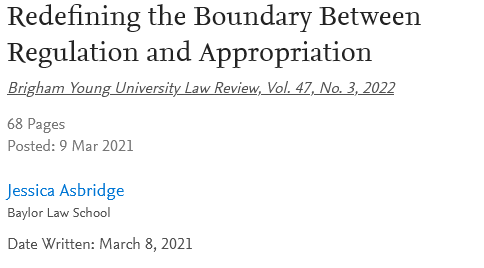
Screenshot_2021-03-10 Redefining the Boundary Between Regulation and Appropriation by Jessica Asbridge SSRN

Next up on our reading list: “Redefining the Boundary Between Regulation and Appropriation” (forthcoming, BYU L Rev), by Baylor Lawprof Jessica Asbridge. Available on SSRN here.

This one is especially relevant in light of the upcoming arguments in Cedar Point, which will consider many of the issues Prof. Asbridge writes about. 

Here’s the Abstract:

The U.S. Supreme Court currently claims to distinguish between appropriations and regulations when interpreting the Fifth Amendment’s Takings Clause. While appropriations always require just compensation to survive constitutional scrutiny, whether a regulation infringing upon property rights requires compensation is determined on an ad hoc basis, guided by concerns of fairness and justness. In Loretto v. Teleprompter Manhattan CATV Corporation, the Court attempted to define the boundary between regulations and appropriations, holding that an appropriation occurs when a government action results in a permanent, physical invasion of an owner’s real property. What constitutes a permanent, physical invasion, however, is entirely unclear due to the Court’s inconsistent decisions applying Loretto. The circumstances under which the physical takings doctrine applies has confounded the lower courts, rendering the heightened constitutional protection for appropriative actions largely illusory.

Takings Clause scholars almost uniformly call for the elimination of the Court’s physical takings doctrine. Most, if not all, critics of Loretto argue that any distinction between appropriations and regulations should be eliminated, such that all government actions short of formal acts of eminent domain should be evaluated on a case-by-case basis, with compensation only justified where the public interest is minimal or the economic hardship on the owner is great. This approach, however, would only further weaken the protection provided by the Takings Clause.

The physical takings doctrine is unsound, but, contrary to the dominant view in the scholarship, the Court’s distinction between regulations and appropriations is not. The Court has long recognized that appropriations require compensation without regard to the public interest at play or fairness and justness concerns, as shown by nineteenth and early twentieth century cases overlooked or ignored by contemporary Takings Clause scholars. Rather than define appropriations as permanent, physical invasions, however, these cases demonstrate that an appropriation occurs when government seeks to transfer the right to use private property to a third party or the government itself whereas a regulation involves the government controlling or restricting an owner’s use of property. Redefining the boundary consistent with this historical understanding would bring much needed doctrinal clarity to takings jurisprudence and further important normative considerations. Requiring compensation for all properly defined appropriative acts furthers multiple values including autonomy and political freedom and accounts for the interests of owners and non-owners alike.

Check it out. Especially before the upcoming oral arguments in Cedar Point.
Continue Reading New Takings Lawrev Article: Jessica Asbridge, “Redefining the Boundary Between Regulation and Appropriation”

It’s Monday, so we’re just going to ease into the week by (inter alia) reading a couple of law review articles:

  • Federal Courts and Takings Litigation, by Prof. Ann Woolhandler & Prof. Julia D. Mahoney: “While Knick clearly expands the lower federal court role in takings claims, many questions remain, for it is not yet clear whether federal courts will embrace a robust federal judicial role in land use cases. This Article surveys the history of takings claims in the federal courts and recommends that going forward federal courts develop an abstention doctrine particular to takings cases in order to ensure prudent deployment of judicial resources. This Article also explains why § 1331 actions may be superior vehicles for takings cases than § 1983 actions.”
  • Swallowing its Own Tail: The Circular Grammar of Background Principles Under Lucas, by Prof Gregory M. Stein: the article “argues that


Continue Reading Today’s Readings: “Federal Courts and Takings Litigation” (Woolhandler & Mahoney), “Swallowing its Own Tail: The Circular Grammar of Background Principles Under Lucas” (Stein)