We would not have guessed back in March when we posted the “first” coronavirus shut down takings complaint that we’d still be at it at the end of 2020, but here we are.

The latest is this complaint filed last week in the U.S. District Court for the District of Oregon against Oregon’s governor (in her official capacity), the City of Portland, and Multnomah County, asserting that “several provisions of law, including state statutes, executive orders, and municipal ordinances that, taken together, significantly impair Plaintiffs’ rental contracts and amount to per se takings and unreasonable seizures of Plaintiffs’ property for a public purpose without just compensation.” Complaint at 2.

The laws referred to are a series of state and municipal statutes and ordinances that establish and enforce a moratorium on termination of tenancies. Rather than go into details, we recommend you read the complaint (it’s not one of those massive

Continue Reading New Complaint: Oregon’s Eviction Moratorium Extension Is A Taking
Inverse vs takings

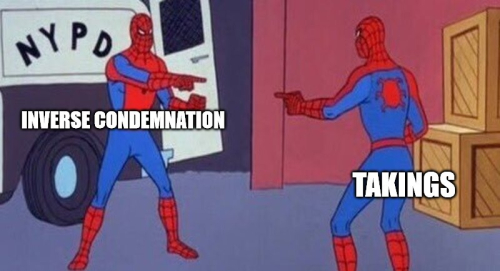
In case you weren’t already aware, Georgia law apparently distinguishes between “inverse condemnation” claims and “takings” claims.

That was not the dispositive point the Georgia Court of Appeals made in its recent opinion in HBC2018, LLC v. Paulding County School District, No. A20A1993 (Dec. 21, 2020), but we thought we’d highlight here, just because:

As a threshold matter, we note that the Bank appears to conflate an inverse condemnation claim with a takings claim. See City of Tybee Island, Ga. v. Live Oak Group, 324 Ga. App. 476, 479 (751 SE2d 123) (2013) (concluding that appellants had failed to raise an inverse condemnation claim and declining to address whether a constitutional taking claim had been raised). An inverse condemnation claim ordinarily involves affirmative government action that causes a nuisance or a trespass, which diminishes the value of private property. See Id. (no inverse condemnation claim where there was

Continue Reading No Good Deed Goes Unpunished: Bank Has No Takings Claim Because School District Had No Obligation To Cover Borrower’s Loan

Diehard

If you are like us, today’s kind of a slow day work-wise. Relax, watch a holiday movie, take it easy.

Us, we’re reading. Not totally frivolous, mind you. A couple of scholarly pieces we’ve been meaning to take a look at for a while. We recommend you do so also. Maybe not today (we understand if you want to take it really easy), but soon.

  • First, for you takings mavens: Molly Brady’s “The Domino Effect in State Takings Law: A Response to 51 Imperfect Solutions,” which suggests that “takings law has often been marked by uniformity, rather than state-level variation and innovation—uniformity driven, in part, by the force of other states’ rules. This domino effect is the consequence of both specific features of takings doctrine and organic borrowing.” Professor Brady then offers “some tentative thoughts on why property and takings law have tended to yield homogeneity and eliminate


Continue Reading Light Holiday Reading: State Takings Law, And Home Rule

As we noted in this post (“CA4 (Over Dissent): No Taking When Maryland Outlawed ‘Rapid Fire Trigger Activators’“), it was likely that a cert petition would follow after the U.S. Court of Appeals for the Fourth Circuit held (over a strong dissent) that it was not a taking when Maryland outlawed previously lawful personal property, but did not require the owners to physically turn over the banned property — here, devices that allow semi-automatic rifles to fire rapidly — to the government.

Well, here it is. In this cert petition, the owner argues that “[t]he Fourth Circuit’s decision also creates a direct conflict with the Federal Circuit which has long applied
Lucas to personal property and held that personal property is protected without regard to whether the government or a third party takes possession.” Pet. at 8.

Here are the Questions Presented:

This case is about whether

Continue Reading New Cert Petition: Declaring Property Illegal To Own Is A Taking, Even If The Govt Doesn’t Confiscate It

Photo

Here’s a big development in a case we’ve been following for a while (and in which we filed an amicus brief in support of the prevailing property owner).

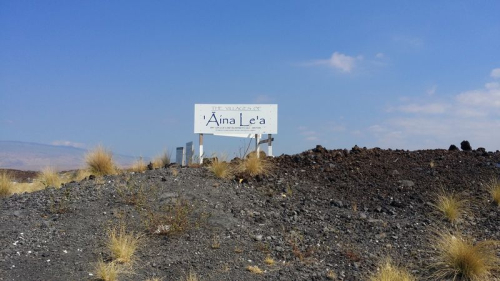
In DW Aina Lea Dev., LLC v. State of Hawaii Land Use Comm’n, No. SCCQ-19-156 (Dec. 17, 2020), the unanimous Hawaii Supreme Court held that the statute of limitations governing a regulatory takings claim under the Hawaii Constitution’s “takings or damagings” clause is six years.

The case started out in a Hawaii state court, and was removed to the U.S. District Court by the State Land Use Commission. The district court dismissed the state takings claim for missing the limitations cut-off. Hawaii has not adopted a statute of limitations expressly for takings or inverse condemnation claims. Thus, the question is what is the closest analogue claim. If there isn’t one, Hawaii has a “catch all” statute (six years) for civil claims.

Continue Reading Hawaii: State Takings Are “Self-Executing” Constitutional Violations (Not Torts Or Breaches Of Contract), Subject To A Six-Year Statute Of Limitations

Here’s the Reply in Support of what we think is a very worthy cert petition, and which responds to the recently-filed BIO.

For the background of the case, check out this post (“What Constitutes a Loss“). The property owner has also summarized the situation thusly in its petition:

The State of Hawaii zoned for agricultural use land that it knew was not viable or appropriate for such use. At the property owner’s request, it rezoned it for urban use but, after Plaintiff Bridge Aina Le‘a began developing it, the State illegally (as the Hawaii Supreme Court later held) “reverted” the land to agricultural use. A jury found this to be a 5th Amendment taking under this Court’s standards in both Lucas v. South Carolina Coastal Council, 505 U.S. 1003 (1992) and Penn Central Transp. Co. v. City of New York, 438 U.S. 104 (1978).

Continue Reading Reply In Penn Central And Lucas Takings Case

A short (unpublished) one from the Federal Circuit, Albright v. United States, No. 19-2078 (Dec. 1, 2020).

This rails-to-trails takings case turned on the predicate question: do the plaintiffs own private property? That question turned on the lex loci, and whether, under Oregon law, the original right-of-way conveyance meant to grant to the railroad an easement or a fee simple interest. 

Thus, the opinion naturally relies solely on Oregon’s property law: if the grant was for a limited purpose (“right of way” or “railroad”), then it was an easement; if the grant did not specify the use or was otherwise unlimited, it was a conveyance of fee simple. That was enough for the federal court:

In addition, none of the deeds provide for a reverter or otherwise contain language limiting the use that the grantee could make of the land. To the contrary, each of the deeds purport

Continue Reading Fed Cir: No Taking, Because Oregon Property Law Is Clear (But Is It?)

Ainalea

Here’s the State of Hawaii’s Brief in Opposition in a case we’ve been following for what seems like forever.

Check it out. The State waived response, but after a whole bunch of amici filed briefs in support of a cert grant (ours included), at least one of the Justices wanted to hear its arguments in opposition. 

Instead of the State’s “Solicitor General” filing the brief, it hired a SCOTUS player to argue that this case isn’t worth the Court’s time. The need to hire the D.C. big guns with name-recognition instead of relying on the in-house lawyers who are the State’s appellate experts somewhat belies any assertion that the State isn’t concerned about this case. 

Here are the Questions Presented as (re)framed by the BIO:

1. Whether the Ninth Circuit correctly held that Petitioner did not suffer a taking where the State rezoned Petitioner’s property because

Continue Reading BIO In Penn Central And Lucas Takings Case

Check this out, the Complaint we filed a couple of weeks ago in the U.S. District Court for the Western District of Virginia, in Grano v. Rappahannock Elec. Coop., No. 3:20-cv-00065-NKM (W.D. Va. Oct. 28, 2020).

It’s not a true “takings” case because the claims for relief are limited to due process and Contract Clause and the plaintiffs are not seeking just compensation, but there’s a takings flavor, because the due process problem alleged is failure to condemn and also provide for compensation.

We’re not going to comment in depth because it’s our case, and we’d rather just let the complaint speak for itself at this point. But the short story is that recently, the Virginia General Assembly adopted a statute directing that all existing easements in which the servient estate owner granted a right to use property for electrical distribution now include the right of the dominant estate

Continue Reading Is Virginia’s Legislative Rewriting Of Existing Electric Easements To Permit Fiber Optic Use Unconstitutional?

DSCF3357

Today, Friday, November 13, 2020, is the day that the Supreme Court is scheduled to decide whether to decide a case we’ve been following for a long time (and one in which we filed an amicus brief urging the Court to take up the case).

In Cedar Point Nursery v. Shiroma, 923 F.3d 524 (May 8, 2019), a 2-1 panel of the Ninth Circuit affirmed the dismissal of a complaint for failure to plausibly state a takings claim under Twombly/Iqbal. At issue was a regulation adopted by California’s Agricultural Labor Relations Board which requires agricultural employees to open their land to labor union organizers. The regulation is framed as protecting the rights of ag employees to “access by union organizers to the premises of an agricultural employer for the purpose of meeting and talking with employees and soliciting their support.”

The Ninth Circuit panel

Continue Reading It’s Conference Day For Case Asking How “Permanent” A Loretto Permanent Physical Invasion Taking Must Be