We listened live last week, but the court has now made the recording available in Johnson v. City of Suffolk.

This is what we call the “oyster takings” case in which Nansemond River oystermen claim that their property was taken when the City of Suffolk and the Sanitation District dumped sewage into the river and declared a “condemnation zone” (i.e., no oyster harvesting).

This is a case at the intersection of property and takings law, and environmental protection. And the public trust concept of jus publicum. The oystermen own a lease from the State of Virginia for the riverbed, which among other things, allows them to harvest some of the oysters that Virginia is so well known for. But they were forced to bring an inverse condemnation claim in state court, asserting that the City’s dumping of wastewater in the river — and prohibiting the
Continue Reading Recording Now Available In Virginia Supreme Court Oral Arguments In Takings, Property, And Public Trust Case

Screenshot_2020-11-05 Legal challenges regarding COVID-19 emergency orders

Join us next Tuesday, November 10, 2020 at 3pm ET (12 noon Pacific) for the free webinar “Shutdowns, Closures, Moratoria, and Bans,” produced by Pacific Legal Foundation and Owners’ Counsel of America.

Along with my colleagues Leslie Fields (Executive Director, OCA), and Jim Burling (PLF), I’ll be talking about the legal foundations for objections, some of the cases that have made their way to decision, and what the future might look like. To register (did I mention it was free?) go here.

Here’s the program description:

Governors and state legislatures across the country have implemented an array of policies in an attempt to contain the virus and its socioeconomic impacts. Many of these policies broadened the scope of government power while placing a heavy burden on property owners and businesses already struggling with the pandemic.

Join representatives from Pacific Legal Foundation and Owners’ Counsel of America as

Continue Reading Join Us: Tuesday, Nov. 10, 2020 (3pm ET, 12n PT) For Free (!) Webinar: “Shutdowns, Closures, Moratoria, and Bans”

Bk_2020_02_475

In case you missed any part of it: the recordings of the recent 2020 Brigham-Kanner Property Rights Conference are now available.

Go here for the descriptions of the panels, speakers, and links to the recorded sessions.

This year’s conference, held on October 1-2, opened with the Brigham-Kanner Property Rights Prize being awarded to Professor Henry E. Smith of Harvard Law School. The prize is named in honor of the lifetime contributions of Toby Prince Brigham, founding partner of Brigham Moore, LLP, and Gideon Kanner, professor of law emeritus at Loyola Law School in Los Angeles, and is presented annually to a scholar, practitioner or jurist whose work affirms the fundamental importance of property rights.

Topics covered: “Where Theory Meets Practice: A Tribute to Henry E. Smith,” “The Housing Crisis,” “Emerging Issues in Takings and Eminent Domain Law,” “The Reach of Government’s Confiscatory Powers over Exigencies and Emergencies,” and “The

Continue Reading Brigham-Kanner Property Rights Conference Videos Now Available

After Knick knocked out the “state procedures” requirement of the Williamson County ripeness doctrine, we predicted that owners’ lawyers better dust off their Federal Courts treatises that have been sitting on our bookshelves for the last three decades.

We said that because we suspected the game was still afoot, and Knick alone would not overcome that old trope of federal judges: “we are the big leagues and not super zoning boards of appealssuper monkey selfie determiners, but heaven forbid they address so “local” a topic as property. That is why it seems that the federal courts go out of their way to dodge takings and property questions.

Thus, abstention in its many forms is becoming the new Williamson County. If that doesn’t ring your bell, remember that under Pullman, a federal court will hold off on exercising its jurisdiction because the resolution of unsettled questions of state law

Continue Reading Abstention, Pullman And Otherwise: The New Williamson County

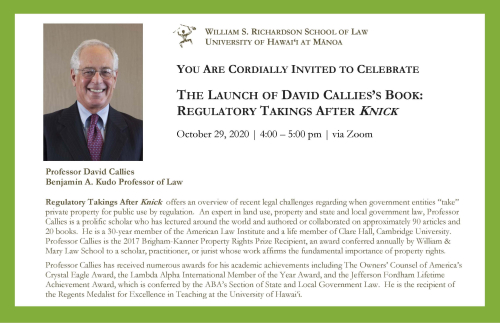
Callies Book Launch Invitation Announcement_Page_1

Come join us for the book party for Professor David Callies’ recently published (by the ABA State and Local Government Law Section) book, “Regulatory Takings After Knick.”

We’re online (of course), so you don’t have to come to Honolulu – we’re on Zoom:

Date: Thursday, October 29, 2020

Time: 4-5pm Hawaii Time

RSVP: No need to RSVP, just follow the Zoom link on the flyer below.

Is joining at 4pm Hawaii Time too late in the day in your time zone? We will be scheduling a “pre-event” on Zoom where you can record your video congratulations for Professor Callies. Details to be posted here shortly, or email us.

And yes, buy this book. As the back cover blurb notes:

The problem with so much regulatory takings scholarship — like the Supreme Court’s takings doctrine itself — is that it is muddled and murky, and casts shadow

Continue Reading You’re Invited: Book Launch For “Regulatory Takings After Knick” (David Callies), Oct. 29, 2020

We all know that despite the heightened Twombly/Iqbal federal pleadings standard, that it doesn’t mean a whole lot if a complaint survives a 12(b)(6) motion to dismiss. All this means that the court thinks it is plausible that the complaint states a claim. And that the plaintiff gets to keep going. That’s it.

But when takings claims are involved, we also know that courts can be dismissive, and a property owner surviving a motion to dismiss can be kind of a big deal.

In Hunters Capital LLC v. City of Seattle, No. C20-983 (Oct. 16, 2020), the U.S. District Court for the Western District of Washington dismissed the plaintiffs’ equal protection claims, but held that the procedural and substantive due process, and takings claims survived. This is the case on which we posted earlier, in which property owners in the part of Seattle known as CHOP (or

Continue Reading Federal Court: If It’s True That Seattle Provided Material Support To CHOP/CHAZ, That Could Be A Taking

Here’s the latest in a case we’ve been following. In this Order, the Ninth Circuit denied rehearing and rehearing en banc of the 2-1 panel decision in Pakdel v. City & County of San Francisco, No. 17-17504 (9th Cir. Mar. 17, 2020).

Earlier, the panel concluded that a regulatory takings case was not ripe under Williamson County‘s requirement. Recall that in Knick, the U.S. Supreme Court overruled the first Williamson County ripeness hurdle — the requirement that a property owner first pursue and be denied just compensation via “state procedures” — but the Court didn’t consider or disturb the “final decision” requirement.

The Pakdels sued San Francisco for a regulatory taking because of the city’s requirement that as a condition of converting a tenancy-in-common to a condominium, the owners must first offer any tenant a lifetime lease. The Pakdel’s twice requested exemptions from the lifetime

Continue Reading Certworthiness Alert: 2-1 CA9 En Banc Denial (And 9 Judge Dissental) – Is A Takings Claim Forever Unripe Because The Owner In The Past Didn’t Jump Through All Administrative Hoops?

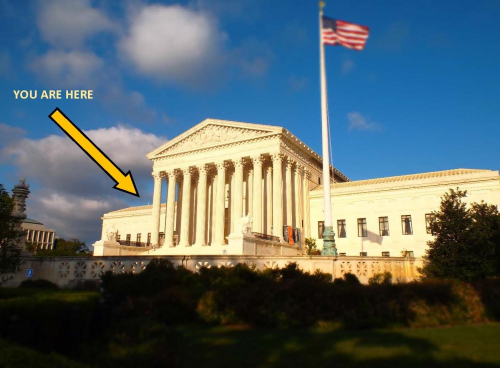
You are here

We have looked through the entire judicial and scholarly oeuvre of SCOTUS nominee Judge Amy Barrett, who today is continuing to run the gauntlet of the Senate Judiciary Committee. Naturally, our scanners were searching for any of her decisions or writings that might give us some clue how a “Justice Barrett” might treat takings and property cases, should she make the squad.

Frankly, however, there isn’t much to hold onto. As our colleagues Bryan Wenter (“What Might Supreme Court Nominee Amy Coney Barrett Mean to Property Rights?“) and Mike Ryan (“7th Circuit Rules Construction of the Obama Presidential Center Is Not A Taking Under The Fifth Amendment“) have covered, there’s just one opinion she authored or joined in which takings was on the docket: a recent decision about the challenge to the Obama Center being erected in a Chicago public park, Protect Our Parks, Inc v.

Continue Reading “Fidelity to the law means going where it leads, and sometimes it leads to the conclusion that a law is unconstitutional.” What Might A “Justice Barrett” Portend For Property Cases?

You know those times you go to the store and try to get a refund on something you’ve purchased, and instead of cash back, you get a gift card, only useable at the same store? Or when, instead of refunding your plane ticket, the airline gives you some limited-time credit for a future flight? Anyone like those?

Well, a fascinating case from the New Mexico Court of Appeals, Premier Trust of Nevada, Inc. v. City of Albuquerque, No. A-1-CA-34784 (Oct. 1, 2020) reminds us of the risks associated with these things.

Albuquerque has an impact fee ordinance which developers must pay to offset the costs of needed infrastructure such as roads, drainage, parks, and public safety facilities. To satisfy the exaction requirement, the property owner could either pay money, build the improvements, or give the city property. If the value of these exactions was more than the impact

Continue Reading NM App: No Property In Impact Fee Gift Card