Here’s a cert petition that we’ve been waiting to drop in a case we’ve been following. This one asks whether a state legislature’s virtual elimination of a cause of action is a taking.

The harsh reality is that farms and ranches can stink. But in Right to Farm Acts, many state legislatures, Indiana’s included, have concluded that farming and ranching are so important that the consequences (“negative externalities“) that naturally occur have to be accepted. One Indiana court summed up Right to Farm Acts as well as anyone when it noted, “so long as the human race consumes pork, someone must tolerate the smell.” Shatto v. McNulty, 509 N.E.2d 897, 900 (Ind. App. 1987). Let’s call it a “stink easement.”

Indiana’s version stands somewhat apart from others, however. Like many other states, it bars lawsuits which assert that a long-standing agricultural operation is a

Continue Reading New Stinky Cert Petition: By Wiping Out Nuisance Claims, Right-To-Farm Act Is A Taking

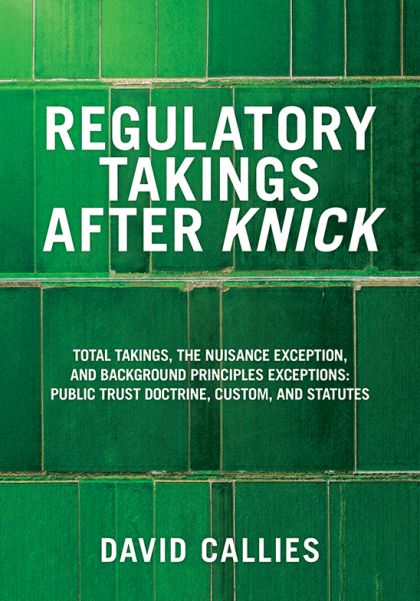
Callies_book
by David Lee Callies

Coming soon (August), a new book from lawprof David Callies on what might be our favorite subject, regulatory takings.

We had a chance to review the proofs, and we highly recommend this one for your bookshelf. We’ll bring you more once published. But for now, you can reserve your copy here.

Here’s the description:

Regulatory Takings after Knick summarizes the Supreme Court’s recent decision in Knick v. Township of Scott which does away with the state action prong of the Court’s former ripeness test and what it means for the law of regulatory taking of property. It emphasizes total takings after Lucas v. South Carolina Coastal Commission and the exceptions which permit government to so strictly regulate property as to permit no economically beneficial use of it.

The Supreme Court’s recent decision in Knick v. Township of Scott has been aptly described by some commentators


Continue Reading New Book Coming In August: Regulatory Takings After Knick by David Callies

Our Louisiana friends have a great word — lagniappe — that we’re not sure we understand precisely, but to us has always meant that little something extra. As Mark Twain wrote, “[i]t is the equivalent of the thirteenth roll in a ‘baker’s dozen.’ It is something thrown in, gratis, for good measure.” As far as we can tell, however, it’s meant to be something you give to others, not a little something extra you keep for yourself.

Maybe that message didn’t make its way up to Michigan, because until the Michigan Supreme Court’s ruling in Rafaelli, LLC v. Oakland, County, No. 156849 (July 17, 2020), local governments apparently were free to treat themselves to a little something extra when they foreclosed on property for the owner’s failure to keep up with their property tax payments. They would sell the property, pay themselves the taxes owed, and then pocket anything

Continue Reading Michigan: Gov’t Keeping The Change From Tax Delinquency Sale Is A Taking

20160114_125445

Here’s the latest in a case we’ve been following for what seems like forever. This is also a fact situation that has resulted in litigation in a variety of different fora, and at times has seemed like the final exam question in a Federal Courts law school class. We wrote about this latest phase — the issues raised by the Ninth Circuit’s opinion — in this article, even.

We won’t go into the background of the case, but if you are interested, you can find out more at this post (“What Constitutes a Loss“). The property owner has also summarized the situation thusly:

The State of Hawaii zoned for agricultural use land that it knew was not viable or appropriate for such use. At the property owner’s request, it rezoned it for urban use but, after Plaintiff Bridge Aina Le‘a began developing it, the State

Continue Reading New (Mike Berger) Cert Petition: “This case is the proverbial ‘Exhibit A’ of much that is wrong [with takings law].”

Here’s the latest order in one of the various challenges to coronavirus-related shut down orders. (See here, here, here, here and here, for example.)

In Xponential Fitness v. Arizona, No. CV-20-01310 (July 14, 2020) (unpub.), the U.S. District Court for the District of Arizona denied preliminary relief in a case which sought an injunction against the Arizona governor’s orders. The complaint including a takings claim among others (contracts clause, due process, equal protection, as well as state law claims). The only relief sought for the taking was an injunction, not just compensation. 

[Sidebar: interestingly, there’s no mention of the Eleventh Amendment, despite the State of Arizona being the lead defendant in the case; we haven’t taken a dive into the docket to see if the State consented, or objected elsewhere to being haled into federal court.]

To the court, that was fatal to the likelihood of the plaintiffs’ success on the merits. Here’s the entirety of the court’s takings analysis:

Plaintiffs’ Fifth Amendment takings claim cannot support their request for injunction relief. See Knick v. Twp. of Scott, Pennsylvania, 139 S. Ct. 2162, 2176 (2019) (“As long as an adequate provision for obtaining just compensation exists, there is no basis to enjoin the government’s action effecting a taking.”). “The Fifth Amendment does not proscribe the taking of property; it proscribes taking without just compensation.” Williamson Cty. Reg’l Planning Comm’n v. Hamilton Bank of Johnson City, 473 U.S. 172, 194 (1985), overruled on other grounds by Knick, 139 S. Ct. 2162. Thus, even if the June 29, 2020 Executive Order did violate Plaintiffs’ Fifth Amendment rights, Plaintiffs would not be entitled to injunctive relief because damages are the proper remedy for a taking. See Bridge Aina Le’a, LLC v. State of Hawaii Land Use Comm’n, 125 F. Supp. 3d 1051, 1066 (D. Haw. 2015), aff’d sub nom. Bridge Aina Le’a, LLC v. Land Use Comm’n, 950 F.3d 610 (9th Cir. 2020).

Slip op. at 16.

Before we move on, a comment. We’re not sure that just compensation should be considered the only remedy for a taking. First, we’ve seen cases in which the Supreme Court has recognized that an award of just compensation is not the sole way to raise a takings claim. You can raise it as a defense to some government action (“you can’t do X, government, because to do X without compensation would be an unconstitutional taking” – this is more like a rule that government cannot act except in conformity with the constitution than an actual “takings” claim for compensation). The raisin case (Horne v. USDA) is a good example. Another is Kaiser Aetna v. United States, 444 U.S. 164 (1970), where the property owner raised a similar argument in response to the Corps of Engineers’ district court lawsuit under the Rivers and Harbors Act.

Or, you might raise a takings argument affirmatively by declaratory judgment:

MR. JUSTICE REHNQUIST suggests that appellees’ “taking” claim will not support jurisdiction under § 1331(a), but instead that such a claim can be adjudicated only in the Court of Claims under the Tucker Act, 28 U.S.C. § 1491 (1976 ed.). We disagree. Appellees are not seeking compensation for a taking, a claim properly brought in the Court of Claims, but are now requesting a declaratory judgment that, since the Price-Anderson Act does not provide advance assurance of adequate compensation in the event of a taking, it is unconstitutional. As such, appellees’ claim tracks quite closely that of the petitioners in the Regional Rail Reorganization Act Cases, 419 U. S. 102 (1974), which were brought under § 1331 as well as the Declaratory Judgment Act. See App. in Regional Rail Reorganization Act Cases, O.T. 1974, Nos. 74-165, 74-166, 74-167, 74-168, p. 161. While the Declaratory Judgment Act does not expand our jurisdiction, it expands the scope of available remedies. Here, it allows individuals threatened with a taking to seek a declaration of the constitutionality of the disputed governmental action before potentially uncompensable damages are sustained.

Duke Power Co v. Carolina Env. Study Group, Inc., 438 U.S. 60, 71 n.15 (1979). We get that just compensation is the usual remedy, and the most common. But the sole remedy? Jury’s still out on that one, in our opinion.

Want more on the theory and practice of challenging these type of emergency orders? Please plan on joining us next week, Wednesday, July 22, 2020, at 1pm ET (10am PT) for a long-form program on “Emergency and Police Power: Property Claims in Times of Crisis,” sponsored by the ABA Section of State and Local Government Law. Our speakers are Professors Craig Konnoth (Colorado) and John Nolon (Pace), and one of the lawyers on the forefront of the nationwide legal challenges, Harmeet Dhillon (San Francisco). I’ll be moderating, along with Professor Sarah Adams-Schoen (Oregon).

Would you like a deeper dive into takings and these type of emergency orders? Check out our soon-to-be-published article, “Evaluating Emergency Takings: Flattening the Economic Curve” (forthcoming 2020).

Xponential Fitness v. Arizona, No. CV-20-01310 (D. Ariz. July 14, 2020) (unpub.)

Continue Reading Federal Court: No Takings Claim To Enjoin COVID Shut-Down Order

It was mostly a win for the property owners in today’s Federal Circuit opinion in Hardy v. United States, No. 19-1793 (July 15, 2020).

The opinion isn’t heavy on the takings doctrine. It spent most of the time affirming the Court of Federal Claims’ conclusion that the plaintiff-owners owned property under Georgia law (their predecessors had conveyed easements, not fee simple interests, and thus maybe had their reversionary interests taken when, after the rails were abandoned, they were converted to trails use).

Check it out for the nuances of Georgia property law. Is this an easement, a fee, a right-of-way, or something else? Whatever the feds wanted them to be, the court agreed with the owners that Georgia said they were easements. And we know who defines property, mostly, for purposes of the takings clause in this case: Georgia.

The balance of the opinion was more of a draw

Continue Reading A Not Too “Takey” Takings Opinion From The Federal Circuit

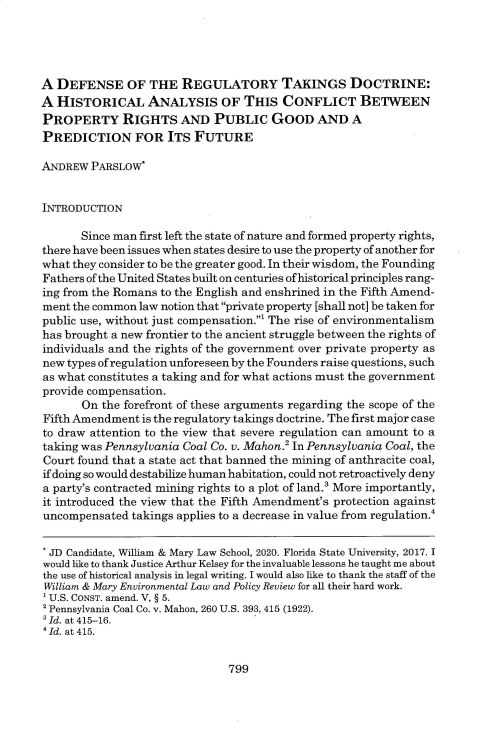
Parslow article

I must say that am pretty chuffed that one of my (now former) William and Mary Law students published a law review article, and he wrote about…takings. And Blackstone, and history.

Read it: Andrew Parslow, A Defense of the Regulatory Takings Doctrine: A Historical Analysis of This Conflict Between Property Rights and Public Good and A Prediction for Its Future, 44 Wm & Mary Environ. L. & Pol’y Rev. 799 (2020).

Well done! Continue Reading New Article: “A Defense of the Regulatory Takings Doctrine: A Historical Analysis of This Conflict Between Property Rights and Public Good and A Prediction for Its Future”

KingStreet

Breaking! In H.C. Cornuelle, Inc. v. City and Cnty of Honolulu, No. 14068 (Haw. July 17, 1990), the Hawaii Supreme Court held that the City and County of Honolulu inversely condemned a strip of private property in downtown when it prohibited development and use of that land because the City intended to acquire it in the future for a road-widening project.

Wait, what? “Breaking,” you say? This memorandum opinion was issued nearly 30 years ago. What gives? Well, we remember this case from back in the day when we were just starting out, but had long forgotten about it. Plus, the same case resulted in one of the first post-Williamson County Ninth Circuit opinions, because the landowners originally sued for the taking in federal court, but were bounced out for ripeness. So they tried the takings case in a Hawaii state court. The Hawaii Supreme Court’s opinion

Continue Reading HAWSCT: City’s Prohibiting Use Of Property Pending City Acquisition Is Land Banking Taking

We joined friend and colleague Clint Schumacher for the milestone 50th episode of his essential Eminent Domain Podcast

If you are not already a subscriber and regular listener, you should be. Clint features interesting guests (present company excepted) and listening in is a good way to keep our community together, especially when many of us may be feeling isolated and shut off from our friends and fellow property law travelers.

The 50th Episode is indeed a milestone. Anyone who has tried it knows that putting together a podcast is nowhere near as simple as you might think. Scheduling guests. Getting the sound right. Mixing boards. Editing it so the guest doesn’t sound completely illiterate (thanks for removing the “you knows” and “uhhhhhs,” Clint). Bumper music. So thank you Clint, for providing this service for the rest of us. (If you have any suggestions for guests or topics, be sure

Continue Reading We Join Clint Schumacher For The 50th Episode Of The Eminent Domain Podcast To Talk COVID Takings

OK, takings mavens, what’s your guess on whether a court would conclude there’s been a taking when a state bans “rapid fire trigger activators” (“devices that, when attached to a firearm, increase its rate of fire or trigger activation”)?

Under the law, it is a crime to “manufacture, possess, sell, offer to sell, transfer, purchase, or receive” that kind of device, and you can’t transport one into the state. The plaintiffs are folks who owned a device, plus an organization (Maryland Shall Issue, Inc.).

If you guessed “no taking,” you would have accurately predicted the U.S. Court of Appeals’ opinion in Maryland Shall Issue, Inc. v. Hogan, No. 18-2474 (June 29, 2020), which held there was not a taking under either the Fifth/Fourteenth Amendment, or the Maryland Constitution. Oh, and MSI, Inc. didn’t have organizational standing.

The takings part of the opinion starts on page 13. We’ll leave it

Continue Reading CA4 (Over Dissent): No Taking When Maryland Outlawed “Rapid Fire Trigger Activators”