Here’s the latest in a case we’ve been following (briefs here, and oral argument recording here).

Any eminent domain lawyer will tell you that loss of access cases can be difficult. In some jurisdictions, you have to lose all access before the court will consider you harmed. Or the courts see a difference between a loss of “direct” access versus “circuitous” access. All we know is that from an owner’s perspective, access to the property can be a key element of its value.

The big question in these cases is who gets to decide: the judge or the jury? And many courts for whatever reason (fear of jury compensation verdicts, perhaps?) cut off the inquiry with bright line no-compensation rules that seem designed more to reserve for judges the critical questions than to facilitate a searching inquiry to whether the property owner has truly suffered a loss

Continue Reading In Virginia, Where The Baffled Courts Now Compose “Major” vs. “Minor” Streets
Screenshot_2020-05-23 CT CMECF NextGen

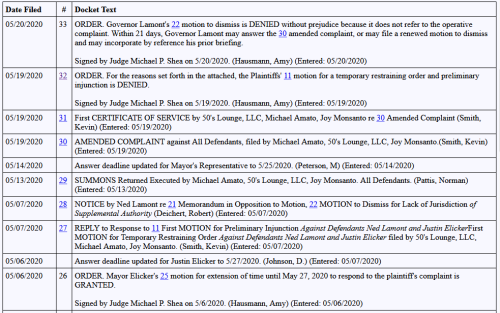
Things moving quickly: remember way back when — in April, was it? — when a Connecticut lounge owner sued a mayor and the governor, asserting that a shut-down order was a taking

Well, the court recently denied the plaintiffs’ request for a temporary restraining order.

There’s nothing in the Ruling about the takings claims as far as we can tell, but we suggest you read it nonetheless because it relies heavily on a U.S. Supreme Court case that has once again become prominent: Jacobson v. Massachusetts, 197 U.S. 11 (1905). That’s the one where the Court held that it was not an unconstitutional deprivation of liberty to require Jacobson to get a vaccine. We think that case and the general sense that courts give a lot of leeway to the other branches when evaluating their responses to emergencies (especially during the emergency) is going to get a

Continue Reading Court Denies Plaintiffs’ TRO In Coronavirus Challenge

Another complaint asserting that a business that had to shut down is entitled to compensation for a taking (among other claims). The business in this case is a law firm, and the complaint is a class action. This joins a long (and growing) list of similar complaints. See here, here, here, here, here, here, here, here, here and here, for example. 

This complaint alleges both a Lucas total wipeout taking, as well as an ad hoc Penn Central type taking.

Read more analysis from Allan Zhang (“Law Firm Cites Founding Fathers in Suit Against Governor Cuomo and Attorney General“) from McKirdy Riskin Olson DellaPelle, our friends and colleagues in New Jersey.

Complaint, Hoganwillig, PLLC v. James, No. 1:20-cv-00577 (W.D.N.Y. May 13, 2020)

Continue Reading New Coronavirus Complaint: Shut Down Order Took Our Law Firm (NY)

Programming note: On the weekend we’ve set aside to remember our nation’s war dead, we thought we’d repost this one, about how Arlington National Cemetery came to be, and how yes, there’s a takings story there.

———————————————————

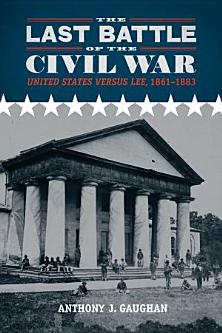
LastbattlebookYou know how we’re always saying that the provisions in the Takings Clause are “self-executing,” that even in the absence of a waiver of sovereign immunity, the Tucker Act, and section 1983, property owners would still be able to maintain a claim for compensation? Well here’s an article that explains that how that rule was first articulated, and not in a dry academic way, but with a fascinating historical story.

It’s the tale of United States v. Lee, 106 U.S. 196 (1882). We knew the land that is now Arlington National Cemetery was once owned by Robert E. Lee, but we can’t say that we gave much thought to how it became


Continue Reading Memorial Day 2020: Arlington National Cemetery And Takings

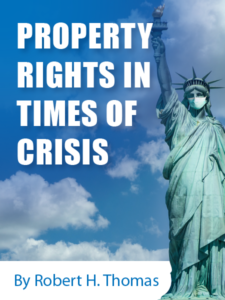
BLOG-article-RHThomas-2020-05_450x600-225x300

Here’s what we’re reading today as we enter a long weekend (who can tell?):


Continue Reading Saturday Readings: Commandeerings, Business Reopenings, #coronalaw Property Rights

Our shut-in time has got us to thinking.

We’re all environmentalists now. This is the precautionary principle writ large. In a way, this is only part of a greater problem.

Welcome to the Twitterverse. We now have access to a vast amount of data — very often on a granular level — and this moves faster than the ability

Americans like to work

Americans are pretty wiling to give our elected leaders a lot of slack

playground Constitution has serious legs

Most don’t understand that their rights are, in normal time, highly restricted, at least in courts

takings lawyers are not really surprised as everyone else – we’re used to courts deferring to what may look like excessive and unwarranted assertions of governmental power. Unlike a lot of other litigation involving the government, representing property owners in eminent domain or takings cases

basic takings doctrine is really incoherent

we already

Continue Reading Things I’ve Learned (Am Learning) About #CoronavirusLaw

Last Friday, we had the good fortune to moderate a debate between two scholars — F.E. Guerra-Pujol and Ilya Somin — on the question of takings and emergencies (“COVID-19 & Property Rights: Do Government Actions in Response to the Coronavirus Pandemic Create Compensable Takings?“). This issue has resulted in a flurry of claims nationwide. See here, here, here, here, here, here, here, here, here and here, for example)

Note: the recording of that session will be available and when ready, we’ll post it here. 

Professor Guerra-Pujol has also written up some post-session thoughts on his blog, prior probablity. In “Property rights panel: a recap,” he summarizes his thoughts and those of Professor Somin. 

Rather than summarize his summary, we simply suggest you visit his blog and read it (it’s a quick read).

The entire discussion

Continue Reading A Good Time To Make Bad Law?

The hits keep on coming. Here’s the latest complaint alleging that a coronavirus-related shut-down order is a taking (among other things).

This joins a long list (see here, here, here, here, here, here, here, here and here, for example) of complaints alleging takings. We’re guessing there’s no horizon on such claims in sight yet.

Here’s a summary of the takings claim:

The Orders and Emergency Directives effectively amount to an impermissible “partial” or “complete” taking in violation of the Takings Clause of the Fifth Amendment to the U.S. Constitution in that the prohibition of Plaintiffs’ operation of their “Non-Essential Business” constitutes a regulatory taking of private property, for public purpose, without providing just compensation therefore. Furthermore, the Orders and Emergency Directives violate the Takings Clause of the Fifth Amendment in that the complete prohibition of the business operations of “Non-Essential Businesses&rdquo

Continue Reading One More Coronavirus Takings Complaint (Nevada, pt. II)

Even as some jurisdictions are easing the restrictions, here is the latest coronavirus-related complaint asserting a taking. This one was filed in an Illinois federal court, and joins an ever-growing list of similar claims (see here, here, here, here, here, here, here and here).

The complaint is a “pure” takings claim — it doesn’t challenge the authority of the governor to shut things down, nor does it challenge the “readily-apparent public purpose” of the action. See Complaint at 5, ¶ 10.

The remedies sought? “WHEREFORE, Plaintiffs request that the Court declare the action of the State a taking of private property for public benefit, and order the determination of Just Compensation to the Plaintiffs by a jury pursuant to Illinois Law, and all other appropriate relief.” Complaint at 10.

We wrote down our thoughts on these type of claims in this piece:

Continue Reading One More Coronavirus Complaint (Ill.): Indefinite Business Closures Are Takings