Here’s the latest complaint challenging the virus-related business shut down orders springing up nationwide. (Other lawsuits are posted here and here.)  

This one alleges a host of constitutional violations (and defamation!) after the Connecticut governor banned large gatherings and ordered all restaurants and bars to close, and the New Haven mayor publicly “highlighted” the plaintiff — a lounge — as a noncompliant business.

Relevant for our purposes here, buried in the complaint is a takings claim:

Count Eleven – Violation of Constitutional Rights of The Right To Receive Compensation For A Taking of Property as to Defendant Ned Lamont

73. Paragraphs 1 through 22 and 58 through 72 of the Complaint are incorporated herein.

74. Lamont’s order limiting the activities of businesses and deciding which businesses can remain open based on their purposes regulates the use of private property to such a degree that it effectively deprives the Plaintiffs of

Continue Reading Another Takings Challenge To Business Shut Down Order

Join us next Tuesday, April 14, 2020, at 12 noon Hawaii Time (3pm PDT, 6pm EDT) for a free webinar sponsored by the Grassroot Institute of Hawaii, “Safety vs. Freedom: Are There Limits to Lockdowns?” Register here

Here’s the description of the program:

Governments at every level in Hawaii have responded to the coronavirus pandemic by implementing lockdown measures never before seen in the United States during peacetime. We have been forced to give up many of our freedoms, but by what authority can our governor and mayors shutter our businesses, declare vast swaths of our communities “non-essential” and make us stay home? Are there any legal limits to these shutdowns?

Joining us for a free webinar at noon, Tuesday, April 14, to help answer these questions will be Grassroot Scholar Robert Thomas, a widely published attorney who is a director with the law firm

Continue Reading Safety Dance: Are There Limits To Lockdowns? Free Webinar April 14

We’re certainly not going to delve in detail into the 109 single-spaced pages of the majority and dissenting opinions in the New York Court of Appeals’ ruling in Regina Metro. Co., LLC v. N.Y. State Div. of Housing and Community Renewal, Nos. 1-4 (Apr. 3, 2020). New York’s rent control law is infamously labyrinthine, and we’re by no means learned in its nuances (and have no desire to become so). But there’s a lot to digest in the opinion, and it might be worth your time to dig into certain parts. 

For our purposes, here is the short version. While an appeal was pending in these cases, the legislature amended the statute (“sweeping changes”) and extended the statute of limitations and “the nature and scope of owner liability in rent overcharge cases.” The question before the court was whether the new requirements govern the case. In other words, whether

Continue Reading Shades Of Eastern Enterprise: Applying “Meaningful” Rational Basis Review, NY Court Of Appeals Shields Retroactive Rent Control Law From Takings Analysis

Here’s another complaint (here’s the first) challenging a state’s business shut-down order as a taking. This time it is Colorado, and the complaint seeks an injunction and compensation.

Here are the highlights:

  • “As a result of the [shutdown] Orders listed above that restrict the gathering of more than ten people at a time, the plaintiff’s parish has ceased conducting weekly Mass, has ceased offering the Eucharist, and has ceased hearing confessions. The defendants’ conduct has impaired the plaintiff’s ability to freely exercise his religious faith, in violation of the Fifth Amendment.” 
  • “The plaintiff is a cook at a local restaurant.” The restaurant is now closed. “Because the defendants’ Orders have limited the use of the plaintiff’s place of work for the owner of the premises, such a limitation constitutes an exercise of eminent domain over those premises.” 
  • “An increase of less than 1% in our death rate is


Continue Reading Another Complaint Challenging Emergency Shut-Down Orders As Takings

20160114_125445

Here’s an article, just published in the American Planning Association’s monthly magazine, Planning (read the entire April issue here), summarizing the Ninth Circuit’s latest foray into regulatory takings, Bridge Aina Lea, LLC v. State of Hawaii Land Use Comm’n, No. 18-15738 (9th Cir. Feb. 19, 2020).

In Legal Lessons – What Constitutes Loss? we write about the decision and the court’s conclusion that losses short of 100% do not qualify for a per se Lucas taking, and are not enough to tip the scales for a Penn Central taking either. The opinion also adds to the growing confusion about whether the regulatory takings doctrine deals with use or value.  

Our thanks to the APA for asking us to contribute, for making the editing process so easy, and for allowing reprinting of the piece here. Check it out. 

Legal Lessons – What Constitutes a Loss? Planning Magazine (Apr. Continue Reading New Article: Ninth Circuit’s Latest Foray Into Lucas And Penn Central Takings

We don’t usually post trial court decisions, but when one comes along that tees up some interesting issues and is likely to get pushed further up the food chain, we’re all ears.

That’s the case with the Eastern District of North Carolina’s order in Zito v. North Carolina Coastal Res. Comm’n, No. 2:19-CV-11-D (Mar. 27, 2020). A North Carolina property owner alleged that the application of the Commission’s shoreline setback rules are a taking, and filed a suit in federal court. Yes, this is a federal court deciding a regulatory takings claim (yay, Knick). 

The property owners did all of the right things to ripen their claim. They obtained a final agency decision (helpfully labeled the “Final Agency Decision”) and were denied a variance. And although the owners filed their federal lawsuit before Knick, by the time the District Court was considering the Commission’s motion to dismiss,

Continue Reading Backing Back Into Williamson County: Federal Court Case Tees Up 11th Amendment Immunity For Takings

Here’s the latest in a case we’ve been following. We even visited the site with our class last year. 

Today, the Virginia Supreme Court heard argument on the petition for appeal (streaming above from the webstream, or download the mp3 here) in what we call the oyster case because it involves the property rights of Nansemond River oystermen, whose oyster beds were polluted by sewage from the City of Suffolk.

Bottom line from today’s argument: no decision yet. These arguments are short (10 minutes), only the petitioner is allowed to argue, and today’s argument did not elicit any questions from the three-Justice panel. So we wait. 

Some background, since this is a case at the intersection of property and takings law, and environmental protection. The oystermen own a lease from the state for the riverbed, which among other things, allows them to harvest some of the oysters that Virginia

Continue Reading SCOVA Oral Argument: Does A City Have The Right To Pollute Chesapeake Bay?

Real_liberty

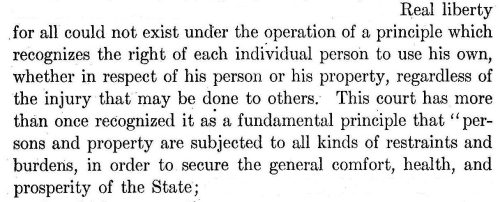
Here’s what we’re reading today, spurred by the headlines swirling around all of us. Mostly cases about the role of the courts when government curtails liberty or property rights under its police or emergency powers. We’ve now seen the first lawsuit claiming that an order to shut down businesses is a due process violation and is a regulatory taking requiring compensation, and we’re hearing about official quarantines, citations for people violating stay-home orders, and the like. 

We started with the vaccination cases. These got us to thinking that if the government can for the most part force people who don’t want vaccinations to get vaccinations (violating their bodily integrity), then how will a court treat seemingly less-invasive intrusions into liberty or property in the name of public health? 

In Jacobson v. Massachusetts, 197 U.S. 11 (1905), the Court distinguished “an absolute right in each person to be, at all

Continue Reading More Readings: “Real Liberty,” Vaccination, Plague, Police Power, And Takings

Well, here it is. What looks like the first complaint to be filed challenging a state governor’s order to shut down businesses to “flatten the curve.” 

The complaint seeks class action status, and raises section 1983, due process, and Fifth and Fourteenth Amendment takings claims. It seeks damages, compensation, a declaratory judgment, and, interestingly, an injunction prohibiting enforcement of the shut down order “unless, and until, a mechanism is established to provide (a) just compensation for affected businesses and (b) appellate review of Governor Wolf’s classifications determining whether individual businesses are ‘life sustaining.'” Complaint at 39.

We’ve written about this issue recently here:

More, from law.com

Continue Reading First Takings Lawsuit Challenging Business Shut-Down Order

The materials we were reading yesterday (particularly Steve Silva’s “History: Fire and Blood(worth),” got us to thinking. There, Steve wrote about the  September 2, 1666 London fire which destroyed 80% of the city, the government’s emergency powers, and compensation. He also brought up a subject we had not know of before: the subsequent legislation — the Fire of London Disputes Act  1666 (18 & 19 C. II. c.7)* — which created the “Fire Court.”

That court — comprised of learned judges from existing courts (K.B., Common Pleas, and Exchequer) — was created to resolve “Differences touching Houses burned or demolished by reason of the late Fire which happened in London” between landlords and tenants. The court began its seating on January 1, 1668. The legislation charged the court with resolving disputes about the required rebuilding, property boundaries, the “Rents as if the same had not been burned,” and

Continue Reading Time For A “Coronavirus Disputes Court?”