19-1277.Opinion

The work of the courts goes on, and as long as there’s stuff to report, we’ll keep reporting as usual.

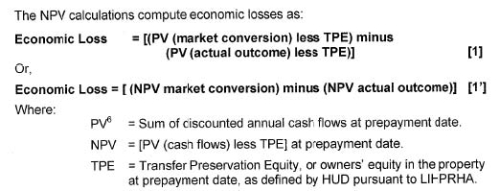
Yesterday, the U.S. Court of Appeals for the Federal Circuit issued an important takings decision in a case and issue we’ve been following for what seems like forever. In Anaheim Gardens, L.P. v. United States, No. 19-1277 (Mar. 25, 2020), the court held that a property owner in a regulatory takings case asserting a Penn Central taking may prove the “economic impact” factor by introducing evidence “by demonstrating their lost opportunity to earn market-rate rental income after prepaying their mortgages.” Slip op. at 17. The Court of Federal Claims had precluded such evidence, concluding instead that the before-the-regulation and after-the-regulation method was the only proper way. 

Here’s the short story: the feds adopted programs providing incentives to developers to build low-income housing. The programs offered below-market 40-year mortgages

Continue Reading Mi Casa Ain’t Su Casa: Proof Of Lost Opportunity Is Evidence Of Penn Central’s “Economic Impact” Factor

As long-time readers know, we often kvetch about the way many courts ignore the Palazzolo rule that simply because someone obtains property subject to preexisting restrictions on use does not preclude them automatically from raising takings claims. See here, here, here, and here, for example. More about the Palazzolo case here, including video.

But not all courts get it wrong, however. Now you can add to the plus-column the Florida District Court of Appeal (Second District)’s decision in Jamieson v. Town of Fort Myers Beach, No. 2D19-238 (Mar. 25, 2020).

The court held that a property owner who purchased land that earlier had been designated as 100% “wetlands” on the Town’s land use map was not prohibited from pursuing takings (and since this is Florida, Bert Harris Act) claims. The case is a two-fer, because the court also concluded that the claims were ripe

Continue Reading Talkin’ ‘Bout My Palazzolo: Takings Claim Not Precluded Because Owner Purchased Land Already Subject To Wetlands Regs

IMG_20170727_105403

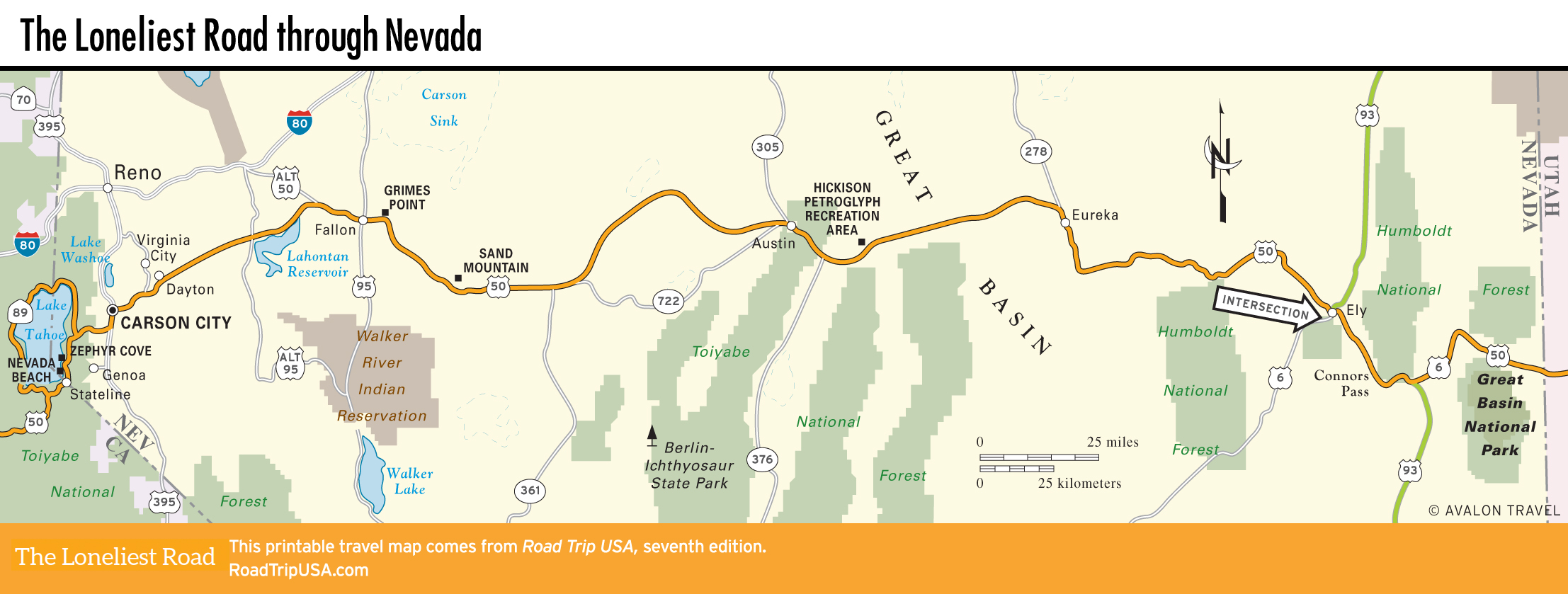
US 50 in Nevada – the “Loneliest Road”

Here’s the cert petition which we and our Nevada colleague Luke Busby filed today, asking the U.S. Supreme Court to review this Question Presented:

Conflicting with Loretto v. Teleprompter Manhattan CATV Corp., 458 U.S. 419 (1982), the Supreme Court of Nevada concluded that to prevail on a physical takings claim a property owner must show that a flood “effectually destroy[ed] or impair[ed] [the property’s] usefulness.”

The question presented is:

To constitute a taking under the Fifth and Fourteenth Amendments, must a physical invasion also destroy or substantially impair an owner’s economically beneficial uses of property?

Rather than summarize the case and the issues, here’s the Introduction: 

Physical occupations—as distinctly invasive public uses of private property—are treated by this Court differently than regulatory takings. Although the Court has consistently avoided adopting categorical rules in most takings cases, it has also long-recognized that

Continue Reading New Cert Petition (Ours): Must An Owner Whose Land Is Flooded Also Prove “Substantial” Loss Of Use?

The current headlines — and a couple of inquiries from colleagues and clients — got us to thinking about government power in times of crisis and the tension between that power and property and other individual rights. 

On one hand, court decisions going back over the centuries have told us that courts are reluctant to interfere with government power that the government asserts further the public “health, safety, and welfare” (what we in the U.S. call the “police power”). But at what point do such exercises of government power require compensation to a property owner who as a consequence of the limitation on their rights suffers a loss?

So we dusted off our law books and assembled a primer of what we thought were some of the more interesting and important decisions over the centuries on the question. This is not a comprehensive list, of course, and if you think

Continue Reading Emergencies, Police Power, Commandeering, And Compensation: Essential Readings

Here’s the cert petition we’ve been eagerly awaiting in a case we’ve been following about Seattle’s rewriting of the traditional lessor-lessee relationship.

The petition arose out of facial takings and due process challenges to Seattle’s “first in time” rule for residential leasing. The city adopted an ordinance requiring owners to rent to the first tenant who applies that meets the owner’s screening criteria.

The Washington Supreme Court tossed aside a long line of its own cases which held that the Washington Constitution’s takings clause is not interpreted by the same analysis the U.S. Supreme Court employs for the Fifth Amendment. Not so the Washington court held, we might in the future decide that the Washington Takings Clause provides greater protection, but for the time being we conclude that federal takings doctrine is so clear that we simply adopt it wholesale. (The court based this conclusion on Tahoe-Sierra. Really! Of

Continue Reading New Cert Petition: Seattle’s “First In Time” Tenant Rule Is A Taking And Due Processey

This just in. In Pakdel v. City and County of San Francisco, No. 17-17504 (Mar. 17, 2020), a three-judge panel of the U.S. Court of Appeals for the Ninth Circuit affirmed the dismissal of a regulatory takings claim which the District Court threw out for not being ripe under Williamson County‘s “state procedures” requirement.

Wait, you say, didn’t the Supreme Court toss that requirement out in Knick? Yes, but it also did not disturb the separate requirement that the government charged with a taking have made the final decision applying the regulations to the property which is claimed to have been taken.

The panel thus affirmed on other grounds because the plaintiffs had not obtained an exemption from the regulation. Yes, this is the “variance” argument.  

We’re reading the opinion in more detail, but wanted to push it out quickly so that others weigh in. We’ll have

Continue Reading Williamson County’s “Final Decision” Rule Lives! CA9: You Still Need To Ask The Govt For An Exemption To The Rules

Missed out on the 2021 ALI-CLE Eminent Domain and Land Valuation Litigation Conference swag?

Well fear not: here’s your chance to get your high-class reminder — a kit of road warrior essentials — to save the Conference date on your calendar. We’re already underway with planning the agenda and faculty, so it’s never too soon to block it off (January 28-30, 2021, at the 4-Diamond DoubleTree Resort, Scottsdale, Arizona). 

If you were not able to get your swag in Nashville, send us a note (rht@hawaiilawyer.com) and we shall gladly drop one or two in the mail to you.

While supplies last!  Continue Reading Unboxing The 2021 (Scottsdale) ALI-CLE Eminent Domain Conference Swag: Get Yours Today!

2587424782425260032

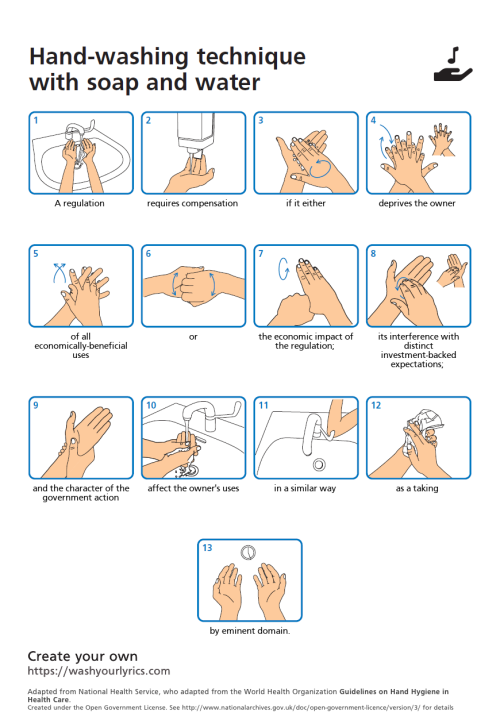
A minimum of twenty seconds, they say.

To help you do it right, here’s a mantra / mnemonic for you to say (silently, please) while you accomplish the task.

Keep healthy, everyone! Continue Reading Wash Your Hands!

Here’s the latest in a case we’ve been following that involves a local government prohibiting, via a zoning ordinance, the mining of silica (used as “frac sand”). Kind of like how Pennsylvania barred certain coal mining in our old friend, Pennsylvania Coal Co. v. Mahon, 260 U.S. 393 (1922). 

In Minnesota (where our story takes place) the right to subsurface minerals is separate from the rest of the land. Kind of like how Pennsylvania law recognized subsurface rights as a separate “stick” in Mahon. Here, the plaintiff owned several leases which allow it to mine silica. Sounds like a property interest, no? 

Well, no. At least not to a majority of the Minnesota Supreme Court, which held in Minnesota Sands, LLC v. County of Winona, No. A18-0090 (Mar. 11, 2020) (affirming the court of appeals) that the right to mine silica was a property right, but

Continue Reading Pennsylvania Coal Revisited: Outlawing Silica Mining Isn’t A Taking, Even Though Mining Rights Are “Property” Under State Law

EX A

Here’s the cert petition that we’ve been eagerly waiting to drop in a case we’ve been following (and which gathered a lot of public — and academic — attention and outrage). 

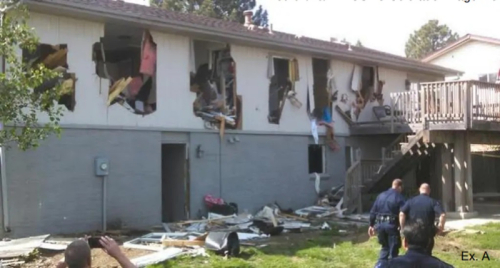
Yes, this is the case where the Village police pretty much destroyed a family home in the course of their efforts to dislodge a shoplifter who had taken refuge there while fleeing. Homeowner sought compensation for a taking. The Tenth Circuit, however, concluded “no taking” because the police were exercising the police power. And you can’t have a taking where the government is exercising the police power.

We were not terribly surprised by the ruling as grossly unfair as it is, because it is pretty typical: customs agents inspect and seize your laptop at the border to check it out but destroy the data on the hard drive? no taking; DEA holds your legal prescription drugs as evidence against

Continue Reading New IJ Cert Petition: Purposely Destroying Your House Could Be A Taking, Even If Govt Was Exercising Its Police Power