


We were not as creative as our colleague Paul Henry (see below), but our Planning Co-Chair Joe Waldo and I wanted to personally invite you to join the “big guns” in our area of law at the 37th Annual ALI-CLE Eminent Domain and Land Valuation Litigation Conference, January 23-25, 2020, in Nashville, Tennessee.

We’ve assembled an excellent faculty, and an agenda that covers the hot topics of the day. Go here to view the complete faculty list and agenda. Water rights, Knick, appraisal, ethics, civil rights, and a whole lot more in three days of the longest (and we think best) conference in our area of law. Also, for those new to the field, Andy Brigham and Jack Sperber are again leading their “Eminent Domain 101” program. A great way to learn the topic, or for experienced lawyers to get a quick refresher on the basics. Your registration
Continue Reading Don’t Miss Out: Join The “Big Guns” And Secure Your Space At ALI-CLE’s Upcoming Eminent Domain & Land Valuation Litigation Conference (Jan 23-25, 2020, Nashville)

Here’s the video of (most, but not all of) the recent session featuring four lawprofs discussing “Originalism and Constitutional Property Rights” at the Federalist Society lawyers’ meeting. 

Interesting debate, all about the text of the Fifth and Fourteenth Amendments, the “original public meaning of the Takings and Due Process clauses, and all that heady stuff. Here were our major takeaways:

  • Professor Somin argued that decisions like Kelo and Berman are not consistent with the original public meaning of the terms of the Takings Clause. 
  • Professor Merrill asserted there’s a good textualist argument that the Public Use Clause is not a limitation on the government’s power to take. If there’s a private benefit taking, that is best handled by other parts of the Constitution (such as due process).
  • Also, from Prof. Merrill: between Kelo and the backlash, the backlash was the “true constitutional moment.”
  • Professor Lazarus thought the regulatory


Continue Reading What Is The Original Public Meaning Of The Fifth (And Fourteenth) Amendments?

20170918_185734_Richtone(HDR)

Here’s the latest in a case we’ve been following for a while, Smyth v. Conservation Comm’n of Falmouth, No. 19-223 (cert. petition filed Aug. 16, 2019). 

The petition seeks review of a Massachusetts decision which held that a judge, not a jury, determines Penn Central takings questions, and also that the owner lost anyhow because, you know, Penn Central. The petition asks the Supreme Court to review these Questions Presented:

  1. Whether the loss of all developmental use of property and a 91.5% decline in its value is a sufficient “economic impact” to support a regulatory takings claim under Penn Central.
  2. Whether a person who acquires land in a developed area, prior to regulation, has a legitimate “expectation” of building and, if so, whether that interest can be defeated by a lack of investment in construction?
  3. Whether the Court should excise the “character” factor from Penn Central regulatory


Continue Reading Latest In SCOTUS Penn Central Cert Petition

Check this out: the Complaint, filed a couple of days ago in federal court against the State of New York (and others), that alleges the state’s recently-adopted rent control regulations is a taking (among other claims). 

It’s a long complaint so we shall leave it to you to delve into the details yourselves. Most interesting to us is that the complaint’s first named defendant is the State of New York as the State of New York.

What about Eleventh Amendment immunity, you ask? 

Read on. 

Compliant, 74 Pinehurst LLC v. State of New York, No. 1:19-cv-06447 (E.D.N.Y. Nov. 14, 2019) 

Continue Reading New Federal Court Complaint: State’s Rent Control Is A Taking

Untitled Diagram-Page-1(1)

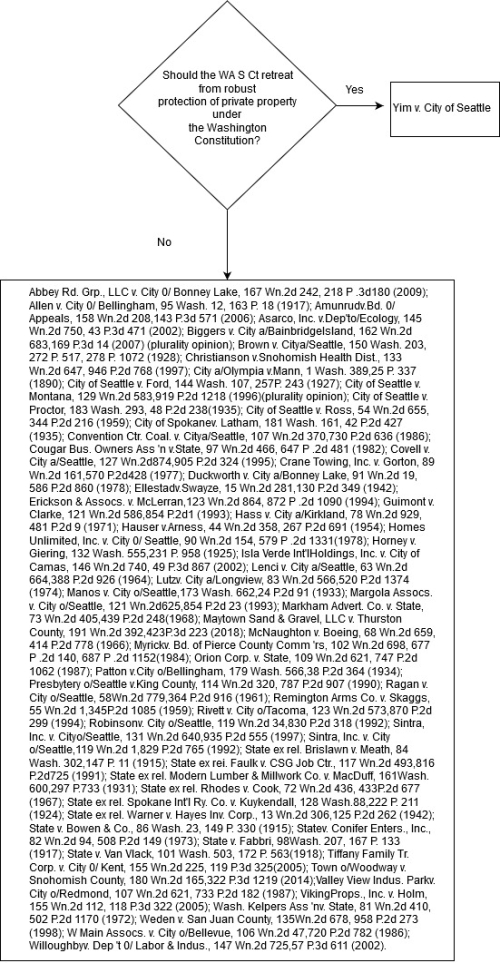
We add a flowchart to this post because the Washington Supreme Court on page 15 of its opinion in Yim v. City of Seattle, No. 95813 (Wash. Nov. 14, 2019) (em banc) (Yim I), includes a flowchart that purports to solve the regulatory takings puzzle once and for all.

Really.

You should check it out. We use “purports” because (surprise, surprise) the court gets it wrong. Flowcharts — also known as decision trees (if A, then B) — are supposed to help, not confuse. And this one doesn’t help if you are trying to figure out if a regulation effects a taking under the Fifth Amendment (and, as a result of the Yim I opinion, under the Washington Constitution). 

If that were not bad enough, in a companion opinion in the same matter (on certified questions from the federal court), Yim v. City of Seattle, No.

Continue Reading Washington (State) Supreme Court: All Those Opinions In Which We Held That Our Property Owners Have Greater Protections Under The State Constitution Were Just “Confused”

Yesterday’s Supreme Court arguments in what is known as the “DACA case” would normally not be something we’d cover on this blog. Yeah, the issue of whether the executive branch has the power to unwind (or, as the cert petition puts it to “wind down”) a prior administration’s executive actions is interesting and all that, but it’s just not in our usual AO (Area of Operations). 

But after reviewing the transcript, we think that those of you who are interested in regulatory takings might find it worth skimming. The reason is that the plaintiffs’ case is for the most part built on their reliance on the DACA program and nonenforcement of immigration statutes. We conformed our behavior to the existing rules in reliance on those rules remaining in place, and therefore a subsequent executive administration can’t revoke those rules, is how we see the argument. For example,

Continue Reading Regulatory Takings Lawyers: Why You Should Pay Attention To The DACA Case

Check this out. The Complaint that we’ve been meaning to post for a while, filed last month in a Los Angeles U.S. District Court, alleging that California’s new rent control laws are a taking, among other things.

Are rent control laws takings? Yes, pretty sure about that. But will courts conclude that they are takings? If past experience is any guide, courts look for (and find) ways to conclude they are not takings, because, you know, this is one government regulatory scheme that people — here, tenants, can rely on (compared to others, where if you claim a property right in government regulation you are, in Chief Justice Roberts’ words, a “chump”).

Chump on, rent control challengers.

Complaint, Better Housing for Long Beach v. City of Long Beach, No. 2:19-CV-08861 (C.D. Cal. Oct. 15, 2019)… 

Continue Reading New Fed Ct Complaint: City’s And California’s New Rent Control Laws Are Takings

Here’s the OA video (courtesy of the Michigan Supreme Court) from last week’s arguments in what we’re calling the “keep the change” case. 

That’s the one where the government is arguing that after a property owner was late paying $8.00 in property taxes, the government is not only entitled to foreclose on the property, but to keep the difference between the sales price and the taxes and penalties owed. As our Louisiana friends might say, that’s a bit more than lagniappe

Eight bucks is more like a rounding error than a significant underpayment, but we get that you do owe every cent. And that when you don’t pay on time, they can hit you up for the taxes owed, the interest, and penalties. But as Gilbert & Sullivan wrote in their famous treatise on Remedies, “let the punishment fit the crime.” They can’t just pocket the difference

Continue Reading Oral Argument In Michigan “Keep The Change” Takings Case

Check out this story by JD Morris (“PG&E renews push to avoid strict liability for 2017, 2018 fires“) in the San Francisco Chronicle, about the recent (and ongoing) California wildfires, and the issue of what has been called the “unusual,” “unique,” and “so-called” doctrine of inverse condemnation in that state’s courts.

Recall that the theory is that when private property is damaged by a wildfire and a utility’s equipment is a substantial cause (or in the words of a recent California Supreme Court opinion, there’s a “robust nexus” between the damage and some public purpose improvement), that is a taking or damaging under the California Constitution. Like all takings and damagings resulting in the obligation to provide just compensation, traditional tort notions of fault and negligence don’t play a role. As the U.S. Supreme Court noted in Armstrong v. United States, 364 U.S. 40 (1960)

Continue Reading California Utility: To Hold Us Liable For A Taking Would Be A Taking

Registration underway, so come join us! Agenda full of hot topics in takings and appraisal law! The best national faculty! Renew friendships, and make new colleagues! And Nashville! 

Download the brochure and make your plans for January. (Don’t wait, we’ve sold out the past three years.)Continue Reading Register Now! ALI-CLE Eminent Domain And Land Valuation Litigation Conference (Nashville, Jan 23-25, 2020)