Here’s a two-fer that covers very difficult and unsettled subjects in takings law: judicial takings and rent control. 

In this cert petition, New York property owners assert that the New York Court of Appeals (the state’s highest court for those of you who do not watch Law & Order (dun-dun)), took private property when the court held that the petitioner’s apartments are governed by the Rent Stabilization Law.

That holding subjected luxury apartments that were never formerly governed by rent control to the tenant’s power to renew less-than-market rent in perpetuity. The petition asserts that before the Court of Appeals’ ruling, “It was settled as a matter of New York law and practice … that Section 421-g property was eligible for luxury decontrol[.]” Pet. at 35.

Here are the Questions Presented:

In Stop the Beach Renourishment, Inc. v. Florida Department of Environmental Protection, 560 U.S. 702

Continue Reading New (Judicial Takings!) Cert Petition: NY Court Took Property When It Disallowed Deregulation Of Luxury Rent Controlled Apartments

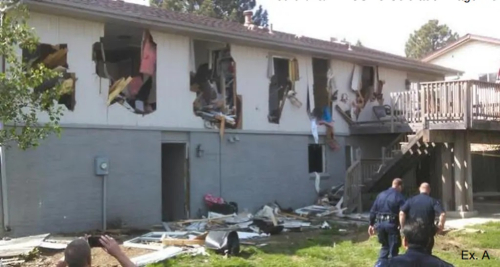
EXHIBIT A

We’re back again at that supposed distinction between the police power and the eminent domain power, which reminds us of that old tale about President Lyndon Johnson:

After reviewing a contingent of Viet Nam-bound Marines in California, Lyndon Johnson strode purposefully toward what he thought was his helicopter. “That’s your helicopter over there, sir,” said an officer, steering the President toward a different craft.

“Son,” replied Johnson evenly, “they are all my helicopters.”

Well, it’s all government power. 

But not to the Tenth Circuit, which in this unpublished order concluded that when local SWAT teams destroyed an innocent family’s house to dislodge a fleeing suspect who had for hours holed up there and taken shots at the police, it wasn’t a taking because, guess what, the police were not exercising eminent domain power, it was the police doing what police do.

The Tenth Circuit relied on the fact that

Continue Reading CA10: SWAT Attack On Home Where Shoplifting Suspect Holed Up Isn’t A Taking

With the ongoing wildfire dramas ongoing across California, several of you have asked us to collect the posts we have done about inverse condemnation liability in one place. So here you go:

As you can see from the above video, this one isn’t over. Stay tuned.Continue Reading All Of Our Past California Wildfires And Inverse Condemnation Posts

Here’s the State of Hawaii’s response to an amicus brief we filed in a case that asks the Hawaii Supreme Court to resolve the question of what statute of limitations governs takings claims under the state constitution. We argued that constitutional claims such as these might not be subject to legislatively-imposed statutes of limitations, and that if they can then the majority rule in most state courts is that the adverse possession statute of limitations applies. 

The State argues that a takings claim is a breach of contract claim (as some states conclude), and thus a two-year statute of limitations applies. The property owner in this case argues that it is a six-year limitations period under Hawaii’s “catch-all” civil claims statute. 

So, how does your jurisdiction do it?

Defendants-Appellees’ [State of Hawaii] Response to Brief Amicus Curiae of Owners’ Counsel of America 

Continue Reading State’s Amicus Response: Two-Year Statute Of Limitations In State Law Takings Claims Because Inverse Condemnation Isn’t The Same As Eminent Domain

Update 10/25/2019: an astute and seasoned correspondent writes that the issue of whether a property owner must raise constitutional issues in the administrative proceedings was settled in a published opinion that involved the same agency, the California Coastal Commission. See Healing v. Cal. Coastal Comm’n (1994) 22 Cal. App. 4th 1158 (we put in in California citation style just because) (“These [the takings questions] are questions for a court of law to decide at an evidentiary trial, not by mandamus review of an administrative record of proceedings where the parties’ right to present evidence was limited by the very nature of the administrative process.”).

Why the Coastal Commission doesn’t know its own law, escapes us.  

++++++

Hat tip to Benjamin Rubin at the California Eminent Domain Report for writing up a recent opinion issued by the California Court of Appeal, Greene v. California Coastal Comm’n, No. B293301 (Oct. 9

Continue Reading Cal App: Agency Has Power To Adjudicate Whether The Agency Itself Is Taking Property (Really)

Emoji_u1f4a9.svg

There’s nothing terribly novel in the Texas Court of Appeals’ opinion in City of Houston v. The Commons at Lake Houston, Ltd., No. 14-18-00664-CV (Oct. 15, 2019), but we highlight it here for a couple of reasons. 

First, the court’s holding that a regulatory takings claim was not ripe because the property owner had not sought a permit — and as a consequence, the city had not yet reached a “final decision” whether the regulations in question (which require that buildings in an area be built at least two feet above certain floodplains) — reminds us that the first prong of Williamson County ripeness is alive and well (even though this was a case purely under Texas law, so Williamson County did not govern). The court noted that the owner “had not any permit of plat applications, or requests for variances, denied as a result of the amended

Continue Reading City Engineer’s Email Was Not “Official Action” Triggering Vested Rights Even If You Responded With A Smiley Emoji

We’re in California, where we’re playing Lincoln Lawyer for a few days because in its infinite wisdom, the utility company has preemptively shut off power for one week due to the threat of wildfire inverse condemnation lawsuits. We’re actually playing Chevy Tahoe Lawyer, because we’re literally working out of a truck since that’s the only place with power, and we can at least drive to where there’s a (weak) connection to the developed world. 

But court deadlines don’t wait for California’s absurdities, so we do what we need to do.

And that includes filing this amicus brief in a case we’ve been following, Campbell v. United States. That’s the case in which a Federal Circuit panel held that the Tucker Act’s six-year statute of limitations in takings claims against the United States starts to run upon the taking, and “the taking may occur before the effect

Continue Reading Amicus Brief: Federal Circuit Assumes Plaintiffs Understand SCOTUS’ Regulatory Takings Doctrine Better Than SCOTUS Understands Regulatory Takings Doctrine

IMG_20191004_124327

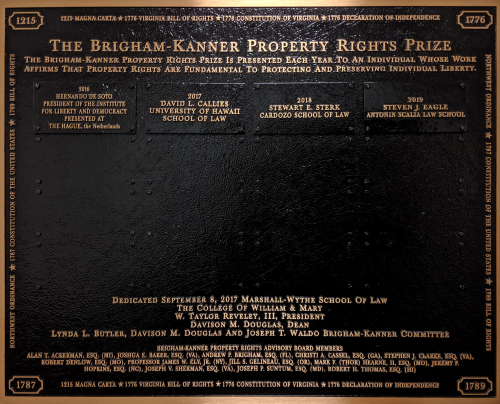
Here is a transcript of the remarks I delivered today at the 2019 Brigham-Kanner Property Rights Conference. I was honored to join lawprof Henry Smith and Florida Supreme Court Justice (ret.) Ken Bell (who authored the Florida court’s opinion in Stop the Beach Renourishment which was challenged in SCOTUS as a “judicial taking”) to speak about “Public Resources and Private Rights” (moderated by Professor Katherine Mims Crocker). After paying our respects to 2019 B-K Prize winner Professor Steven Eagle, we each addressed some part of the question.

—————————-

The New New Property

As always, I bring to you tidings of “aloha” from the state where the legislature thought it was a going to reduce the price of residential housing by taking fee simple interests from “A” and giving them to “B,” the leaseholders

Where now, the median price for a single-family, two bedroom, one bath

Continue Reading 2019 Brigham-Kanner Conference: The New New Property – Public Resources And Private Rights

IMG_20191003_114853

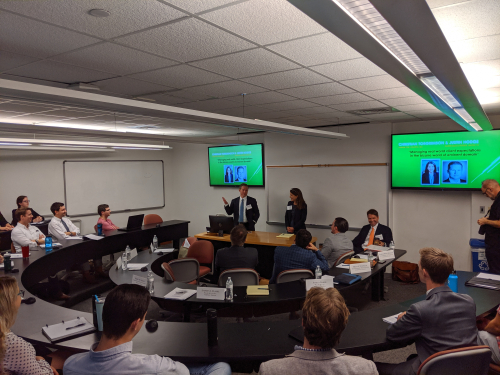
Today’s the kickoff events for William and Mary Law School’s Brigham-Kanner Property Rights Conference. We started the day with eminent domain and property law attorneys speaking about the practice of law (pictured above, Justin Hodge (TX) and Christian Torgrimson (GA)).

Toronto’s Shane Rayman and I spoke about international and comparative property and eminent domain (expropriation) and how even though our way of approaching cases may be different, the goals are the same: justice and fair treatment for our clients. And what we can learn about our own cases by looking at how other jurisdictions do it. 

In that vein, here are the links to the cases we (and others) mentioned:


Continue Reading 2019 Brigham-Kanner Property Rights Conference Kickoff