Yes, we did memes in our Knick brief, and in a follow-up blog post.
But colleague Benjamin Tozer has taken it to the next level.
We’re not worthy! Continue Reading Video: What Federal Takings are like post-Knick


Yes, we did memes in our Knick brief, and in a follow-up blog post.
But colleague Benjamin Tozer has taken it to the next level.
We’re not worthy! Continue Reading Video: What Federal Takings are like post-Knick
If you are going to be attending the ABA Annual Meeting in San Francisco next month, here are some of the CLE and other programs of interest to property, land use, and eminent domain types, sponsored by our Section, the State and Local Govt Law Section:
Thursday, Aug. 8
In June 2019, the Supreme Court overruled its Williamson County precedent, which required that property owners, as a practical matter, must bring their Fifth Amendment takings claims against state or local governments in state courts. The Court’s new decision, in Knick v. Township of Scott, allows them to bring their inverse condemnation claims directly in federal court. Their insights into this important decision and its ramifications will be discussed by panelists who pled both sides of this case. Moderator: Steven J. Eagle, Professor Emeritus,
Continue Reading Dirt Lawyer CLE At ABA Annual Meeting (San Francisco)
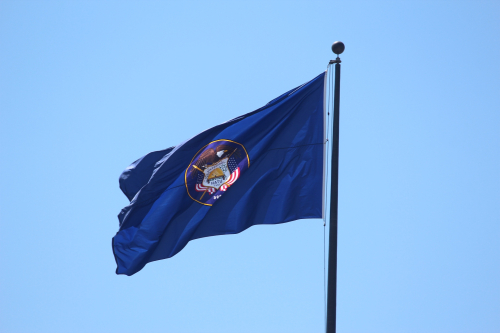
The flag of the State of Hatu
Williams, a prisoner, thought that Utah prison officials should have paid him interest on his prison account. Acting as his own attorney, he sued under § 1983 for a taking and for a deprivation of due process in federal court, raising claims against the Utah Department of Corrections, several state prison officials in their official capacities, and the bank in which his prison account was housed (and several bank employees). The federal district court dismissed, but not on the Eleventh Amendment grounds you might think.
Williams appealed to the Tenth Circuit, which, in Williams v. Utah Dep’t of Corrections, No. 18-4058 (July 8, 2019), affirmed the dismissal, expressly analyzing the claims under the Eleventh Amendment.
That provision, as you are aware, establishes a state’s immunity from lawsuits in federal court. Over the years, courts have created exceptions to the general rule that
Back to Knick for a bit. Our colleague Dwight Merriam has penned a response to a recent op-ed by U.S. Senator Sheldon Whitehouse (D – RI).
The good senator, if you weren’t aware, was also the guy who argued and lost the Palazzolo case all the way back in 2001. Apparently, he’s still sore about that, because in response to Knick, he wrote, “‘Knick’-Picking: Why a Recent Supreme Court Ruling Signals a New Day,” in which he argued that the decision “is a gift for big-money developers and regulated industries.” (Neither Ms. Knick nor Mr. Palazzolo is or were a big-money developer or a regulated industry, in case you were wondering.)
Merriam doesn’t see it the same way as the august senator. In “Senator is Wrong About ‘Knick’ Ruling,” he sets the record straight (originally published at law.com).
* * * *
Senator Whitehouse
Continue Reading Guest Post: Senator Is Wrong About Knick Ruling
Here’s the first post-Knick property owner victory. That was quick!
Now before you get too excited, this is a GVR (“grant, vacate, remand”) in which the Court, having decided Knick, granted the pending petition, vacated the judgment by the Ninth Circuit, and “REMANDED for further consideration in light of Knick v. Township of Scott, 588 U. S. ___ (2019).”
In Honchariw v. County of Stanislaus (oral argument video above), the Ninth Circuit concluded that California law provided the property owner an adequate opportunity to raise takings and due process claims in a California court, and therefore his federal takings claim in federal court wasn’t ripe under Williamson County. Honchariw disagreed, and argued that California had not provided an adequate opportunity, that “[t]he deicison below was stone-cold wrong under Williamson,” and that this case “may be a useful sister to the Court’s grant of certiorari in [Knick
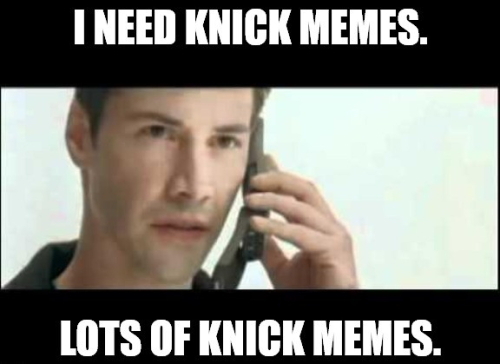
We’ve resisted for as long as we can.
Here’s our take at telling the Williamson County and Knick story, 100% in memes.
Why, you may rightly ask?
Well, it started with our Knick amicus brief, which included a meme that we thought captured well the injustice of property owners being prohibited by Williamson County from raising their federal constitutional claims in federal court (or anywhere, for that matter).
And then, as these things often do these days, the tail started wagging the dog. Readers didn’t want our cogent and deep analysis, they wanted more Knick memes. And rather than post those willy-nilly, we decided to do ’em all in a single post, and be done with it.
So here you go. For those of you who dig this stuff, read on. If you think we missed any, or would like to send your own to fill
We’ve already set out our general thoughts about the Supreme Court’s decision in Knick v. Township of Scott in a series of posts on the case. But we haven’t yet noted what the case might mean on the ground in Hawaii, our home turf.
In a client alert we did: Hawaii’s property owners now have many more options for fighting back against oppressive government regulation of property than they did last week:
Here’s the cert petition in a case we’ve been following.
In Guerin v. Fowler, 899 F,3d 1112 (9th Cir. 2018), a three-judge panel of the Ninth Circuit held that Washington state officials’ failure to return daily interest that was allegedly skimmed from the plaintiffs’ state-managed retirement accounts could be a taking.
The panel rejected the State’s argument that because the Washington Court of Appeals held that Washington’s retirement statute didn’t require the payment of daily interest at all, the plaintiffs didn’t have “property” the state officials took when they kept the interest. If it isn’t “property” under state law, the State asserted, it isn’t “property” for purposes of the Takings Clause.
Not quite, the court concluded. Daily interest on principal is one of those “core” and “traditional” property rights that a state simply cannot disavow. In short, while state law usually defines property, there are certain sticks that transcend
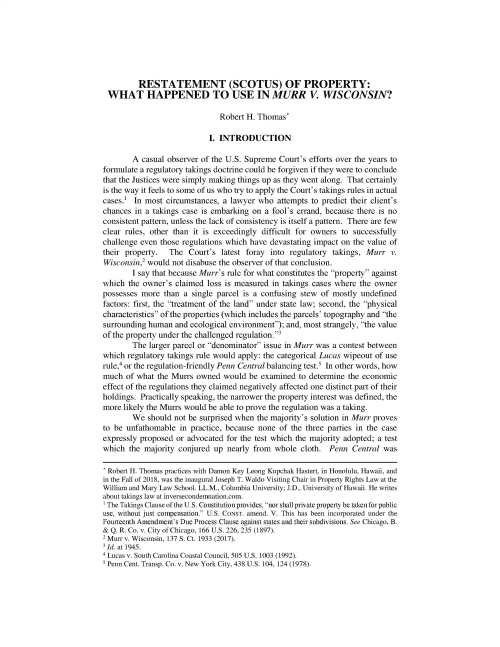
Here’s the article, recently published in the UMKC Law Review with thoughts on Murr v. Wisconsin, the case about the “denominator” issue in regulatory takings cases.
We won’t get into it in detail (if you are interested, you can read the article yourself), except to say that therein we offer views of what test the Court should have adopted to analyze whether the Murr family’s two parcels should be considered as one parcel for purposes of whether they were denied productive use of their property by Wisconsin’s environmental regulations. As you recall the Justice Kennedy authored Murr majority adopted a test with a mishmash of factors (what we waggishly labeled his “social justice warrior” test). The article argues that the Court should have instead applied the old “three unities” test from larger parcel questions in eminent domain. That test focuses on the owner’s joint use of the property.
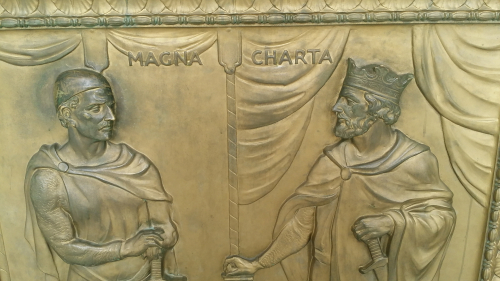
Yes, this is detail from the Supreme Court’s front door.
This is the first in what will be a short series of five posts with thoughts on the landmark decision in Knick. In this installment, a crash course in the extensive doctrinal background necessary to understand why the Knick Court did what it did. Here are the related posts:
* * * *
The opinions in last week’s ruling by a sharply-divided Supreme Court, Knick v. Township of Scott, No. 17-647 (June 21, 2019) employed a lot of very evocative language: “aborning,” “Catch-22,” “loot,” “shaky,” “sue me,” “overthrows,” “smashes,” “smithereens” “first crack,” “points for creativity.” But ultimately, the most important