This is the second in a series of five posts taking a look at last week’s landmark ruling by a sharply-divided Supreme Court, Knick v. Township of Scott, No. 17-647 (June 21, 2019). Here are the related posts:

In this post, we’ll take a look at the case which finally convinced the Supreme Court that it was time to revisit the Williamson County state-litigation ripeness rule, Knick v. Township of Scott, 862 F.3d 310 (3d Cir. 2017). What we call the Case of the Zombie Zoning Inspectors

* * * *

The Township of Scott, Pennsylvania, apparently

Continue Reading Knick Analysis, Part II: The Court Finds A Vehicle In A Zombie-Zoning Case
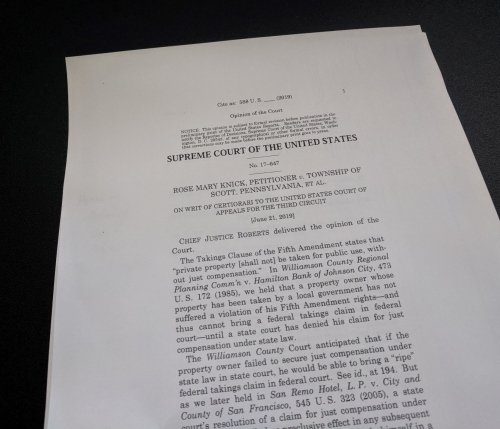
IMG_20190621_150358

This is the third in a series of five posts taking a look at last week’s landmark ruling by a sharply-divided Supreme Court, Knick v. Township of Scott, No. 17-647 (June 21, 2019). Here are the related posts:

In this post, we’ll take a deeper dive into the three opinions: Chief Justice Roberts for the five-Justice majority (Roberts, Thomas, Alito, Gorsuch, Kavanagh), Justice Thomas’ short stand-alone concurring opinion, and Justice Kagan’s dissent (joined by Justices Ginsburg, Breyer, Sotomayor, and Kagan).  

* * * *

BLUFs

Here are the bottom lines up front, the lenses though which we think you should read each of

Continue Reading Knick Analysis, Part III: What It Means To “Take” Property Without Just Compensation – “A bank robber might give the loot back, but he still robbed the bank.”

Ill_be_back

This is the fourth in our series of five posts with thoughts on the landmark decision in Knick. In this installment, the dissent. Related posts:

* * * *

We cannot mask our disappointment with the dissenting opinion. We usually appreciate Justice Kagan’s opinions and measured approach, even while dissenting. And after the first oral arguments in October, we thought there was a chance, albeit slim, that she might see things Ms. Knick’s way.

But even though we were pretty sure she would rule for the government, we didn’t anticipate as vehement a defense of Williamson County‘s “no violation until you sue the government for

Continue Reading Knick Analysis, Part IV: Why Not Let Sleeping Dogs Lie? The Dissent And Stare Decisis

One does knick meme

This is the fifth and last in our series of posts with thoughts on the landmark decision in Knick. In this post, we’ll be puling out our crystal balls, and doing a bit of forecasting. Here are the related posts:

 * * * *

The execrable state-litigation ripeness requirement is overruled. Ding-dong, the wicked witch is dead. No longer will our only federal review of a federal constitutional issue be limited to petitions for cert at SCOTUS. We can “simply” go to federal court. 

So now what?

Continue Reading Knick Analysis, Part V: What’s Next?

A lot is being written about Friday’s Supreme Court opinions in Knick v. Township of Scott, No. 17-647 (U.S. June 21, 2019) (including us). Here’s a sampling. 


Continue Reading Knick Round-Up

Kungfu

We’ll be doing a longer post with our thoughts on the U.S. Supreme Court’s landmark ruling in Knick v. Township of Scott, No. 17-647 (June 21, 2019). But here’s the big picture.

It appears that at least five Justices finally seem to understand what we in the property bar have been saying for decades – that the essence of a federal “takings” claim against a local or municipal government is that “by regulation, you have deprived my property of ‘productive use’ [as Chief Justice Roberts noted on page 14 of the slip opinion], and you have not compensated me.” So it is enough that the government hasn’t paid me, and I have no obligation to “ripen” my federal claim by chasing down the local government for compensation in state court.

So nearly 100 years after Justice Holmes famously opined for the Court in Pennsylvania Coal Co. v. Mahon,

Continue Reading Williamson County Overruled: After Nearly A Century, Supreme Court Finally Has Figured Out What A Regulatory Takings Claim Looks Like

One does knick meme

Property lawyers, dust off your Federal Rules of Civil Procedure, and federal judges your long vacay from dealing with regulatory takings and inverse condemnation cases is over, because this just in: by a 5-4 margin (Chief Justice Roberts authored the majority opinion, with Justice Kagan writing the dissent), the U.S. Supreme Court today finally (finally!) overruled the state-litigation prong of the Williamson County ripeness doctrine. Knick v. Township of Scott, No. 17-647 (June 21, 2019).

Yes, overruled. Not trimmed around the edges. Overruled. 

Here’s what our quick skim turns up as a critical passage:

The Court in Williamson County relied on statements in our prior opinions that the Clause “does not provide or require that compensation shall be actually paid in advance of the occupancy of the land to be taken. But the owner is entitled to reasonable, certain and adequate provision for obtaining compensation” after a taking.

Continue Reading “The state-litigation requirement of Williamson County is overruled.”

The recent opinion of the Texas Court of Appeals (First District) in University of Houston v. Jim Olive Photography, No. 01-18-00534 (June 11, 2019) addressed a fascinating (and still unsolved) question: does intellectual property qualify as “property” for purposes of the takings clause? 

The court held “no,” but that answer isn’t definitive.  

The facts of the case are pretty simple: Jim Olive took a photograph which — shame on them — the University used on its website without compensating Mr. Olive. He sued the University in a Texas state court for taking his intellectual property, seeking compensation. 

If your first instinct was to say this looks like copyright infringement, you’d be right. Problem is, copyright claims are brought in federal court. But state cannot be sued for damages there. And copyright claims are “tort-y” which means that if a copyright holder sues the state government for damages in state

Continue Reading Public University’s Rip-Off Of Photograph Is Copyright Infringement, Not A Taking

In Cranston Police Retirees Action Committee v. City of Cranston, No. 2017-36 (June 3, 2019), the Rhode Island Supreme Court concluded that a municipal ordinance “the promulgated a ten-year suspension of the cost-of-living-adjustment (COLA) benefit for retirees of the Cranston Police Department and Cranston Fire Department who were enrolled in the City of Cranston’s pension plan” was not a taking of the pension plans’ members property.

Takings mavens should skip to page 27 of the opinion for the good stuff. First, the court assumed that the plan members possessed “property.” A COLA benefit, once vested, is property, and the parties did not challenge the trial court’s conclusion on that issue. Second, the court rejected the contention that the suspension of COLA benefits was a physical invasion or a Lucas economic wipeout. Slip op. at 30-31. This was a regulatory taking, analyzed under Penn Central‘s three-part ad hoc test.

Continue Reading RI: Ten-Year Suspension Of Pension’s COLA Adjustment Not A Penn Central Taking

A must-read for takings mavens. Property rights gurus Professor Gideon Kanner and Michael Berger have published a new article, The Nasty, Brutish, and Short Life of Agins v. Tiburon, 50 Urb. Lawyer 1 (2019). It’s the lead article in the latest volume of The Urban Lawyer, the law journal of our Section of the ABA, the Section of State and Local Government Law.

Barista’s note: since TUL ended its long-time editorial relationship with UMKC Law School last year, the journal has been published in-house, and we’ve taken on the role of Editor-in-Chief, in-between our lawyering and teaching day jobs. We recognize the efforts of our ABA editor, as well as our team of volunteer Associate Editors (our fellow lawyers who took on the responsibility of tech editing the pieces) in producing the journal. 

Kanner and Berger have written an informative (and entertaining) tour-de-force of modern regulatory takings law.

Continue Reading New Must-Read Article: Kanner & Berger, “The Nasty, Brutish, and Short Life of Agins v. City of Tiburon”