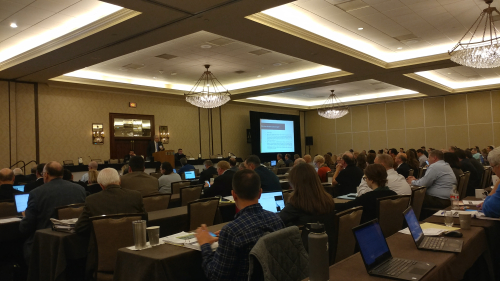
Thanks to Professor Michael Wara’s Twitter feed, here is what might possibly be the first and only example of a comic strip devoted to inverse condemnation.

Yes, it is on an advocacy site (the International Brotherhood of Electrical Workers Local 1245), and it doesn’t really go into the details of the doctrine, but come on, what did you expect? Just sit back and enjoy.

Continue Reading California Inverse Condemnation And Wildfires: The Comic
0412191003c_HDR

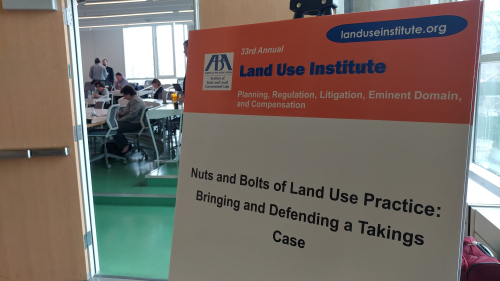
Here are the links from today’s two sessions (the first, federal water issues impacting local land use; the second, Bringing and Defending a Takings Case):

The morning started off with a talk by former Detroit Mayor (and Michigan Supreme Court justice) Dennis Archer, about Poletown, eminent domain, and economic

Continue Reading Links And Materials From Today’s Land Use Institute Sessions, Baltimore

Pretty simple facts in the North Dakota Supreme Court’s opinion in Lincoln Land Development, LLC v. City of Lincoln, No. 20180117 (Mar. 15, 2019): back in the day (the 1980’s) the City had a dirt road over private property, used to access its sewage treatment plant. Lincoln Land Development bought the property in 2005. Recently, the City graded and paved the road, raised the road bed, and added things like culverts.  

Inverse condemnation? 

The City denied liability, arguing that Lincoln Development didn’t have the right to exclude the City because the City owned an easement — either by express grant, or by implication or estoppel — and thus Lincoln Development didn’t possess property that the City had taken. 

The most interesting part of the North Dakota Supreme Court’s opinion, in our opinion, starts on page 5, where the court discusses the easement by prescription claim (after having agreed with

Continue Reading ND Supreme Court Rejects City’s Claim That “We Already Own The Property By Prescriptive Easement So Are Not Liable For A Taking”

0401191044b_HDR

Great crowd today in Austin for CLE International’s Eminent Domain seminar, co-chaired by our colleagues Chris Clough, Sejin Brooks, and Christopher Oddo. We spoke about “National Trends and Developing Issues in Eminent Domain.” 

Here are the cases I referred to which are not included in your written materials:


Continue Reading Materials And Links From Today’s Austin Eminent Domain CLE

Here’s the amici brief we signed onto for Owners’ Counsel of America, filed last week in a regulatory takings case we’ve been following.

This brief, one of several filed which urge the Court to review the Federal Circuit’s conclusion there was no taking (despite a Court of Federal Claims verdict that there was), argues that categorical rules are not useful in regulatory takings cases for the most part, and economic realities often mean that a property owner can suffer a taking even if it has not yet realized a positive cash flow from its investment in the property:

But the Federal Circuit has now pronounced a categorical rule—one that arbitrarily insulates government from takings liability no matter how strongly the Penn Central factors might otherwise militate in favor of a takings claimant. Love Terminal Partners, L.P. v. United States, 889 F.3d 1331, 1344 (Fed. Cir. 2018). What

Continue Reading New Amici Brief: Investment, Not Profit, Is What The Takings Clause Recognizes

Header image LUI 2019

Come join us at the 33rd Annual Land Use Institute, in Baltimore, Maryland, April 11-12, 2019.

As the brochure notes:

This Annual Land Use Institute program is designed for attorneys, professional planners, and government officials involved in land use planning, zoning, permitting, property development, conservation and environmental protection, and related litigation. It not only addresses and analyzes the state-of-the-art efforts by government to manage land use and development, but also presents the key issues faced by property owners and developers in obtaining necessary governmental approvals. In addition, the entire approach of the program is to provide practice pointers that give immediate “take home value” by focusing on topics relevant to the average practice of the attendee.

The keynote will be delivered by Dennis Archer, former mayor of Detroit (and former Justice of the Michigan Supreme Court, and former President of the ABA), speaking about “Detroit’s New GM Plant from

Continue Reading 33rd Annual Land Use Institute: Baltimore April 11-12, 2019

Remember Fowler v. Guerin, the decision in which a panel of the Ninth Circuit rebuffed the usual trope that the court isn’t receptive to property owners? In that case, the court concluded that Washington state officials’ failure to return interest that was allegedly skimmed from the plaintiffs’ state-managed retirement accounts was a taking. 

The court rejected the district court’s dismissal for Williamson County ripeness, for 11th Amendment immunity, for RookerFeldman problems, and for being issue precluded.

The part of the Ninth Circuit’s opinion which really stood out to us, however, was its conclusion that the plaintiffs possessed property. The State argued that the Washington appeals court had concluded that the statute in question didn’t require the payment of interest as the plaintiffs argued. Thus, the plaintiffs had no property as defined by Washington law. With no property, no taking.

The Ninth Circuit rejected that argument, concluding instead: 

We rejected a similar argument in Schneider v. California Department of Corrections, 151 F.3d 1194 (9th Cir. 1998). There we observed that “constitutionally protected property rights can—and often do—exist despite statutes . . . that appear to deny their existence.” Id. at 1199. Citing the Supreme Court’s opinion in Phillips, we noted that “a State may not sidestep the Takings Clause by disavowing traditional property interests long recognized under state law.” Id. at 1200 (quoting 524 U.S. at 167). We then held that there is “a ‘core’ notion of constitutionally protected property into which state regulation simply may not intrude without prompting Takings Clause scrutiny.” Id. This “core” is “defined by reference to traditional ‘background principles’ of property law.” Id. at 1201. In that case, we concluded that interest income earned on an interest-bearing account falls within this class of fundamental property rights. Id.

We now clarify that the core property right recognized in Schneider covers interest earned daily, even if payable less frequently. The rule that interest accrues de die in diem—“from day to day”—has an impressive common law pedigree, see, e.g., Wilson v. Harman, 2 Ves. Sen. 672, 672, 27 Eng. Rep. 189, 189, and has been widely adopted by American courts, see, e.g., Mann v. Anderson, 32 S.E. 870, 871 (Ga. 1899); Owens v. Graetzel, 126 A. 224, 227 (Md. 1924); Clapp v. Astor, 2 Edw. Ch. 379, 384 (N.Y. Ch. 1834); In re Flickwir’s Estate, 20 A. 518 (Penn. 1890). Indeed, in the state-court proceedings, DRS did not dispute that “at common law, interest was deemed to accrue daily, regardless of when it was payable.” Probst, 271 P.3d at 970 n.6 (citing 32 Halsbury’s Laws of England § 127, p. 78 (4th ed. 2005)). Because the right to daily interest is deeply ingrained in our common law tradition, this property interest is protected by the Takings Clause regardless of whether a state legislature purports to authorize a state officer to abrogate the common law. See Schneider, 151 F.3d at 1201.

We hold that the Teachers state a takings claim for daily interest withheld by DRS.

Slip op. at 10-11. 

Short version: certain “core” or “fundamental” attributes of property (sticks for those of you who like the bundle metaphor) are not completely dependent on state law, and thus cannot be defined out of existence by the state without just compensation. We’ve made that same point in several briefs over the years, including this one. The panel held that daily interest is one of those core (federal?) property rights.

The state asked for panel rehearing and rehearing en banc, in this order, the court denied it.

But two judges dissented from the denial of en banc review. First, Judge Bennett stood alone on the grounds that the injunction to order Washington officials to stop withholding interest was really a backdoor way of getting damages for which a state cannot be sued in a federal court under the Eleventh Amendment. If that issue floats your boat, check out pages 8-13 of the dissent. 

But in his dissent on the property issue, Judge Bennett was joined by Judge Ryan Nelson — both recent Trump nominees — and concluded that the panel’s holding that the “Plaintiffs have a constitutionally protected property interest in daily interest earnings, notwithstanding clear state law to the contrary,” is “unprecedented.” Dissent at 13-14 (footnote omitted). The dissenters further noted that “[i]t is an odd constitutional right the panel creates.” Id. at 14 n.3. 

States, these judges would have held, are free to define and redefine property interests: “It may be that interest de die in diem was the default at common law, but states are free to modify common law default rules, and the panel never explains why this rule is any different.” Dissent at 17. State law, and state law alone, defines property they concluded, and the legislature is free to modify state law, even to the point of eliminating the right entirely. Id. at 18. See also id. at 19 (“And the fact that no court has, before now, held that state governments cannot modify the daily interest rule when they hold cash strongly suggests that the rule is not so deeply ingrained in our tradition that states may not modify it without running afoul of the Takings Clause.”).

The dissent concluded:

Nor should we as a court create a property right to daily interest when nothing in the precedents of the Supreme Court or this court have ever even suggested that when a state awards interest, it must do so daily. The effects of the panel’s novel holding will be felt around the country in the form of legal challenges to state and federal retirement plans that similarly award interest less frequently than daily. We should have taken this case en banc to correct our errors.

Dissent at 21. 

Will there be a cert petition by the State of Washington? Seems likely, and Judges Bennett and Nelson have already written it. 

Order (denying en banc rehearing), Fowler v. Guerin, 16-35052 (9th Cir. Mar. 13, 2019)

Continue Reading Ninth Circuit Denies En Banc Review In Case Upholding “Core” And “Fundamental” Property Rights, But Two Trump Judges Dissent

Here’s one we’ve been meaning to post for a while, the latest in a case we’ve been following. Yes, its the Love Terminal Partners cert petition.

Rather than go into the details about the case, we instead refer you to our post about the Federal Circuit’s opinion, the Court of Federal Claims verdict finding a taking and awarding compensation, and the petition itself. Counsel of Record for the property owners is none other than überlawyer Paul Clement. So we really can’t improve on the Questions Presented:

In 1999, petitioners paid millions of dollars to acquire the lease to property designated for aviation use at Dallas Love Field Airport. The next year, they spent another $17 million constructing a state-of-the-art terminal, and a few years later they expanded their investment by another $6.5 million. At the time, federal law limited flights for aircraft with over 56 seats from Love

Continue Reading New Cert Petition: You Don’t Need Positive Cash Flow To Have Investment-Backed Expectations

6a00d83451707369e201bb08b7aef7970d-800wi

Here’s the latest in a case we’ve been following that has resulted in what we’re counting as no less that three lawsuits in state court (all removed to federal court by the State of Hawaii, as far as we are aware), which have gone back-and-forth between the U.S. District Court, the Ninth Circuit, and the Hawaii Supreme Court.

The latest is no different, and asks which statute of limitations applies to takings claims: the two-year personal injury statute, or the six-year “catch all.” The answer has not been definitively resolved by Hawaii’s courts, so Ninth Circuit in this order (Mar.7, 2019) booted this dispositive legal issue to the Hawaii Supreme Court by certifying this question: 

What is the applicable statute of limitations for a claim against the State of Hawai‘i alleging an unlawful taking of “[p]rivate property . . . for public use without just compensation,” Haw. Const. art. I

Continue Reading Ninth Circuit Wants To Know The Statute Of Limitations For Takings Claims In Hawaii

Thank you to our colleague, economist William Wade, for sending along this piece, reacting to a recent decision by the Massachusetts Appeals Court.

————————

Financial inconsistency bedevils takings decisions

by William W. Wade, Ph.D.

This blog recently reported on a Massachusetts Appellate Court takings case ruling (Smyth v. Conservation Comm’n of Falmouth, No. 17-P-1189 (Feb. 19, 2019)), that reversed a judgment for the plaintiff, in part, based on an erroneous economic impact evaluation under the famous Penn Central test.

Plaintiff inherited a parcel from her parents seemingly purchased in 1975 for $49,000. Plaintiff’s appraiser valued the land parcel at $700,000 with the intended development and $60,000 in its current status as an unbuildable lot. The trial court awarded damages of $640,000.

While other issues were at issue on appeal, the court ruled on the economic impact prong of Penn Central that the diminution in value, $700,000 to $60,000

Continue Reading Guest Post: Financial Inconsistency Bedevils Takings Decisions