


Our friend and colleague Dwight Merriam recently published this piece about the looming Knick v. Township of Scott decision. Yes, ripeness, and how SCOTUS will treat regulatory takings. We posted our own prognostications here (“Shaka, When The Walls Fell: Yes, Knick Will Be About Takings, But It Will Be More About Federalism“).

Awaiting ‘Knick” … Will SCOTUS Fix the Ripeness Mess?

by Dwight Merraim

The decision in an important takings case, Knick v. Township of Scott, Pennsylvania, reargued Jan. 16, is soon to be released. Be watching for it, because it could have a major impact on how governments regulate land use, and on the willingness of private property owners to challenge government regulation that overreaches. As an added bonus, we will get to see where Justice Brett Kavanaugh may position himself on property rights issues.

The issue is one of “ripeness;” specifically, whether the court should

Continue Reading Merriam: “Awaiting ‘Knick’…Will SCOTUS Fix the Ripeness Mess?”
0606191053_HDR

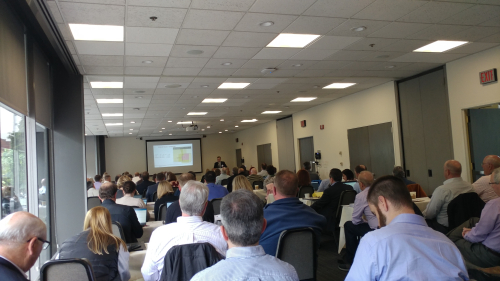
Here are the links to the cases which were not in your materials. Theme of the day: amateurs! 

Our thanks to colleagues Jill Gelineau and Paul Sundermier for asking us to present. It was good to see our Oregon friends again. 


Continue Reading Links From Today’s Portland Eminent Domain Conference

A forthcoming article in the Cornell Law Review (“Virtual Briefing at the Supreme Court“) argues that it’s an “open secret” that the way to influence a SCOTUS case is to hit up social media:

The open secret of Supreme Court advocacy in a digital era is that there is a new way to argue to the Justices. Today’s Supreme Court arguments are developed online: They are dissected and explored in blog posts, fleshed out in popular podcasts, and analyzed and re-analyzed by experts who do not represent parties or have even filed a brief in the case at all. This “virtual briefing” (as we call it) is intended to influence the Justices and their law clerks but exists completely outside of traditional briefing rules.

On the heels of that comes this: a web page and Twitter account devoted (for now) solely to a case we’ve been following that

Continue Reading Twitter Is The New Cream

With the opinion in the Knick v. Township of Scott case to drop as soon as Tuesday (we’re guessing the opinion will be by Chief Justice Roberts, by the way), hold on: we’re about to get super nerdy here. Impossibly nerdy. Yes, we’re revisiting the Star Trek analogies. We’ve been down this road before, even going so far as to have a colleague (who is perhaps even further down the rabbit hole than we are) present a takings CLE in his Starfleet uniform

The bottom line is this (and if you are not into Trek, you can stop right here): to us the key question which the Court is grappling with is whether a state’s judiciary is part of the state’s compensation system. If the majority of the justices conclude that it is, then don’t expect an out-and-out overruling of Williamson County, only a modest trim

Continue Reading Shaka, When The Walls Fell: Yes, Knick Will Be About Takings, But It Will Be More About Federalism

Short answer: no.

But the longer answer which lawprof Ilya Somin discusses in this short podcast is worth listening to. Check it out. 

Here’s the summary:

Over the last few years, taxi companies in several cities have brought lawsuits claiming that legalizing ride-share services such as Uber and Lyft violates the Takings Clause of the Fifth Amendment, because it expropriates their supposed property right to a monopoly of the taxi business. Courts have so far rejected these arguments. But they raise broader issues about the nature of property rights, and what kinds of government actions qualify as a taking. Confusion about these matters goes well beyond this specific set of cases. Could treating government-created monopoly privileges as property rights imperil valuable innovations and reforms in many parts of the economy?

We follow the issue, mostly from an academic standpoint (we’ve yet to take on one of these cases, but find

Continue Reading Lawprof: “Does Legalizing Uber and Lyft ‘Take’ The Property Of Taxi Companies?”

Remember that Christopher Nolan movie from a few years ago, “Inception,” with its dream-within-a-dream storyline?

Well, that’s what a recently-filed cert petition which asks the U.S. Supreme Court to jump into California’s inverse-condemnation-liability-for-wildfires issue reminds us of with its taking-within-a-taking argument, as detailed in the Question Presented:

Whether it is an uncompensated taking for public use in violation of the Fifth and Fourteenth Amendments for a State to impose strict liability for inverse condemnation on a privately owned utility without ensuring that the cost of that liability is spread to the benefitted ratepayers.

Let’s see if we are keeping the argument straight: it’s a taking to hold a private entity which possesses the delegated power of eminent domain liable for a taking for burning down private property unless the utility is also entitled to pass the cost of any taking judgment on to those who benefit from

Continue Reading New Cert Petition: Fifth Amendment Requires California To Spread The Cost Of Wildfire Inverse Condemnations To Ratepayers

The title of this post may have you wondering, especially the part about how a regulation that invites others to physically enter private property, is determined by a court to not be a physical taking. (The court also hints at looking at a physical taking under Penn Central, and not by applying per se rules.) 

At issue in the Ninth Circuit’s 2-1 opinion in Cedar Point Nursery v. Shiroma, No. 16-16321 (May 8, 2019) was a regulation adopted by California’s Agricultural Labor Relations Board which requires agricultural employees to open their land to labor union organizers. The regulation is framed as protecting the rights of ag employees to “access by union organizers to the premises of an agricultural employer for the purpose of meeting and talking with employees and soliciting their support.”

The regulation, as the Ninth Circuit majority pointed out, “is not unlimited,” and regulates the “time

Continue Reading PruneYard Undone: California’s Union Easement – Which Invites Labor Organizers To Enter Private Property – Isn’t A Physical Taking

Here’s what’s on the reading list for today:


Continue Reading Tuesday Takings And Property Round-Up

We’re not quite sure what to make of this story (“The Raisin Situation“) in the New York Times, about the situation in Fresno, California, after the Horne case. You remember that one, don’t you? All about whether USDA’s seizure of raisins in order to maintain the price was a taking. 

The piece tackles a serious subject, the dwindling raisin market and the problems that have reverberated in Fresno (the raisin capital of the world), but like many stories about the raisin industry — Comedy Central did a report in which it described SCOTUS petitioner Marvin Horne as a “modern day Jesse James,” for example — this one is done in a tongue-in-cheek fashion (it appears in the “Style” section of the Times).

It reminds us of the 1980’s satirical miniseries “Fresno,” a comedic take on then then-popular nighttime soaps Dallas and Dynasty. 

But

Continue Reading The “2015 Supreme Court case that nearly leveled Fresno” – The Raisin Industry, Post-Horne

Nothing really can be done: the harsh reality is that CAFO’s (concentrated animal feeding operations) stink. But many state legislatures have concluded that farming and ranching are so important that the consequences (“externalities”) that naturally occur have to be accepted.

Right to Farm Acts, Indiana’s included, generally deprive neighboring property owners of their common law tort nuisance claims for the smell and noise, and other effects of having a nearby agricultural operation, often subject to certain conditions. One Indiana court summed up Right to Farm Acts as well as anyone when it noted, “so long as the human race consumes pork, someone must tolerate the smell.” Shatto v. McNulty, 509 N.E.2d 897, 900 (Ind. App. 1987). 

In Himsel v. Himsel, No. 18A-PL-645 (Apr. 22, 2019), that same court has now concluded that depriving neighboring landowners of their nuisance tort claims is not a taking. The opinion

Continue Reading Indiana’s Right To Farm Act Isn’t A Taking