MRGO

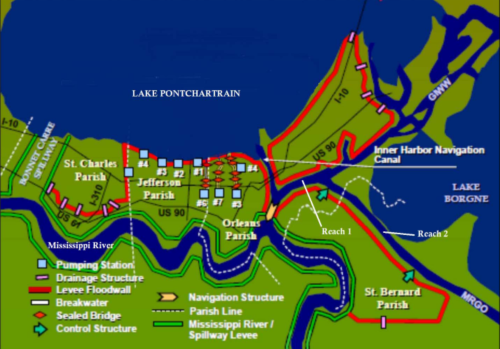
When you a federal takings plaintiff in the Federal Circuit and you pull Judge Timothy Dyk on your panel, your heart sinks. More so when he aggressively questions you in oral argument. And when you see he has written the opinion, you know it’s game over at this level.

Because we can’t remember a single case in which he’s ever held for a property owner in a regulatory takings or inverse case. He just doesn’t like property owners and their takings claims, apparently. His last big decision on flood takings, Arkansas Game and Fish, adopted a per se rule that any flooding which the owner could not prove was “permanent” is categorically immune from takings liability. His opinion for the Federal Circuit was reversed unanimously by the Supreme Court, in an opinion by Justice Ginsburg, which alone should tell you something. 

Well, Judge Dyk is at it again
Continue Reading MR-GO, Katrina Flooding: Inverse Condemnation And Schlimmbesserung At The Federal Circuit

20180419_150416_HDR

We’re in Detroit the rest of the week at the Mercy Law School for the venerable Land Use Institute, now in its 32nd iteration.

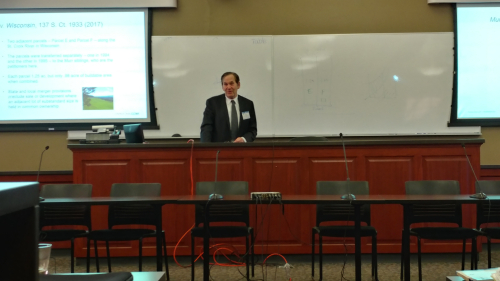
Planning Chair Frank Schnidman has assembled a great faculty including out Detroit colleague Alan Ackerman (above, talking about takings liability for flooding), and we’ll be spending the time talking inverse condemnation, public trust, planning law, homelessness, autonomous vehicles, affordable housing, RULIPA, and similar topics. We’ll be presenting on “Eminent Domain, Vested Rights, and Regulatory Takings,” “Client Representation: Developer, Government, and Citizens Groups,” and “Federal Laws Affecting Local Land Use Decision Making.” 

If you are here with us in Detroit, stop by and say hello. If you aren’t here, shame on you! This is one of the best and most affordable tuition deals in CLE.

But all kidding aside, if you are not in Detroit now, be sure to calendar these

Continue Reading Land Use Institute – Detroit

Today’s case is one of what we call “regionally classic” cases that we come across from time to time. You know, cases that just fit into all your preconceived notions about a place. Beach cases from Hawaii. Gator law opinions from Southern states. Vermont = snow law, California, land and wineries. Here’s another one of those from our Southern courts — Florida’s District Court of Appeals, to be precise — that we think fits the bill.

In Florida Fish and Wildlife Conservation Comm’n v. Daws, No. 1D16-4839 (Apr. 10, 2018), the First District Court of Appeals held that owners whose properties were physically invaded by “deer dog hunters and their dogs during the forty-four days of the year when deer dog hunting is authorized” by the Commission, have not suffered a taking because these invasions were only temporary, and “do not rise to the level of permanent

Continue Reading Fla App: That Takings Dawg* Don’t Hunt: Sporadic Trespass By Deer Dog Hunters (And Their Dogs) Isn’t A Permanent Physical Occupation

Space is filling up, but there’s still time to join us later this month in Detroit for the 32nd Annual Land Use Institute (April-19-20). 

We’ll let program Planning Chair Frank Schnidman explain all the reasons why, and we’ll add only these points: (1) it’s a very good program that won’t take much of your time (fly in for the Thursday afternoon program, stay a night, fly home on Friday evening); (2) Detroit is the place to be these days; and (3) it’s one of the best deals in CLE credits, with tuition as low as $400.

2018 Land Use Institute Brochure Detroit 5 2018

Continue Reading There’s Still Time To Join Us In Detroit: 32d Annual Land Use Institute

We don’t usually post up trial court rulings, preferring to wait until the issue percolates up through the food chain. But this one is an exception, because, well, it’s darned interesting, and we wanted to get you all on board on the ground floor.

Here’s the trial court’s order granting the plaintiffs/property owners summary judgment in the case challenging the City of Seattle’s “first in time” ordinance, under which the city established the criteria for screening tenants, and required property owners to accept the first qualified applicant as a tenant.  The city acknowledged that the ordinance “affects a landlord’s ability to exercise discretion when deciding between potential tenants that may be based on factors unrelated to whether a potential tenant is a member of a protected class.” Slip op. at 2-3. The goal was to “eliminat[e] the role of implicit bias.”

In short, because a property owner might have an

Continue Reading Seattle’s “First in Time” Tenant Rule Is A Taking

Verdictform

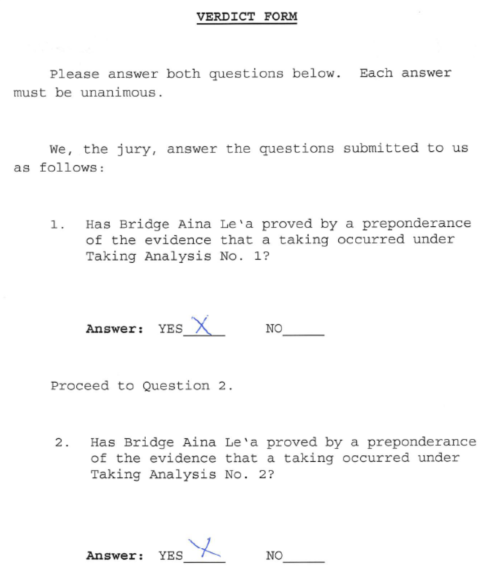
As we reported here, the U.S. District Court for the District of Hawaii just finished a jury trial in a regulatory takings case (removed by the defendant State of Hawaii from Hawaii courts) involving a stalled development on the Big Island.

The jury has returned a verdict after 8 days of trial, concluding the State is liable under both Lucas and Penn Central theories, after only 15 minutes of deliberation after their lunch break. 

But there’s more to this story, because here’s the buried lede. The court yesterday made this entry in the docket: 

EO: The court proposes to enter an order awarding nominal damages of $1 to the plaintiff and then to enter judgment in this case. This will start the running of the clock not only for appeal but also for requests for fees and costs under Local Rule 54.3. If the parties have concerns about this

Continue Reading Lunch And 15 Minutes: Federal Jury Finds State Land Use Commission Liable For Lucas And Penn Central Taking

Check out this recent article by lawprof Timothy Mulvaney, “Non-Enforcement Takings.” We’re used to situations in which government regulation results in a takings claim, but Professor Mulvaney asks about cases in which the government’s inaction is argued to result in a taking.

Here’s the abstract:

The non-enforcement of existing property laws is not logically separable from the issue of unfair and unjust state deprivations of property rights at which the Constitution’s Takings Clause takes aim. This Article suggests, therefore, that takings law should police allocations resulting from non-enforcement decisions on the same “fairness and justice” grounds that it polices allocations resulting from decisions to enact and enforce new regulations. Rejecting the extant majority position that state decisions not to enforce existing property laws are categorically immune from takings liability is not to advocate that persons impacted by such decisions should be automatically or even regularly entitled to

Continue Reading Takings By Government Inaction?

IMG_3082

This fall, I’ll be teaching a new course at the William and Mary Law School in Williamsburg, Virginia.

Here’s the description of Property Rights: Law and Theory (Law 608) from the course catalog:

Property rights and property theory have been essential components of Anglo-American law for centuries, and the protection of the right of private property ownership is one of the foundations on which the U.S. Constitution, the Bill of Rights, and the post-Civil War Amendments are built. In more recent times, however, property law has taken on a new role, and has been viewed differently than in the past, especially in light of the development of environmental law and the evolving concept of public trust.

Property Rights Law and Theory will focus on the history, policy, and, to some extent, the politics of property law, property rights, and related legal topics. We will examine how the right of

Continue Reading The Paper Chase Is On!

Here’s the latest “Map Act” case from North Carolina, one that touches a bit on the metaphysical side because it gets into the question of whether an ongoing inverse condemnation case in which the N.C. Supreme Court has already ruled that property was taken (although it did not determine the interest taken), prevents the government from instituting a direct condemnation lawsuit to short-circuit the case.

In Dep’t of Transportation v. Stimpson, No. COA17-596 (Mar. 20, 2018), the N.C. Court of Appeals held that the DOT could not institute an eminent domain action to take land that it had already been deemed to have taken — or be taking — in an inverse condemnation action.

The facts of the case are pretty straightforward. North Carolina’s Map Act (as we detailed here) allows the DOT to designate land for future highway acquisition and prohibits development in the interim. The N.C.

Continue Reading DOT Can’t Condemn Land It Has Already Deemed To Be Taking In Inverse Case