Emotionheader

Here’s the printable brochure with the details on the 32nd Annual Land Use Institute in Detroit, April 19-20, 2018. We’ve plugged the program before so we won’t do so again, except to say that you really should attend because (1) it’s a very good program that won’t take much of your time (fly in for the Thursday afternoon program, stay a night, fly home on Friday evening); (2) Detroit is the place to be these days; and (3) it’s one of the best deals in CLE credits, with tuition as low as $400.

2018 Land Use Institute Brochure Detroit 5 2018

Continue Reading April 19-20, 2018: Land Use Institute, Detroit (Printable Brochure)
For those of you who have not recently attended the ALI-CLE Eminent Domain and Land Valuation Litigation Conference (just wrapped in Charleston, planning Palm Springs 2019), here’s a small sampling of the kind of thing we do.

It’s U. Virginia lawprof Molly Brady talking about the U.S. Supreme Court’s regulatory takings decision in Murr v. Wisconsin, in the session she shared with John Groen (the Murrs’ Supreme Court counsel). A really informative session, and these clips only give a small taste. More here, from ALI-CLE, including links to the on-demand video sessions we recorded in Charleston.  

And it’s not too early to mark your calendars for Palm Springs, January 24-26, 2019. Stay tuned here for further details as they become available. 

Continue Reading Professor Molly Brady On Murr – Video Clips From The ALI-CLE Eminent Domain Conference

Missingmoney

A very interesting (pun intended) read today from the Minnesota Supreme Court.

In Hall v. Minnesota, No. A16-0874 (Mar. 7, 2018), the court held that Minnesota’s Unclaimed Property Act, under which unclaimed property is presumed abandoned and then held by the State, works a taking when the State takes possession of an interest-bearing bank account, but does not pay interest to the owner when the property is eventually reclaimed. 

That conclusion should not be all that surprising, and what makes the opinion well worth your time to read is the contrast between abandoned accounts which were interest-bearing, and those which were not. The State took possession of money and accounts of several of the plaintiffs, ranging from an unclaimed final paycheck under $100, to an interest-bearing bank account of more than $100,000. 

The Act sets out the process for reclaiming abandoned property, and the plaintiffs did so. But when

Continue Reading Minnesota’s Unclaimed Property Act Is A Taking If State Holds Interest-Bearing Account, But Doesn’t Pay Interest

Here’s the Reply Brief in a case we’ve been following, Brott v. United States, No. 17-712, in which the U.S. Supreme Court is being asked to consider whether property owners who sue the federal government for a taking are entitled to both an Article III forum, and to have the issues determined by a jury. We filed an amicus brief in support of the petition.

The Reply responds to the federal government’s brief in opposition which acknowledged the Just Compensation Clause is “self-executing” and that you have a right to “recover just compensation,” but before you can actually recover compensation, Congress must deign to recognize your Constitutional right by agreeing to be sued. And if Congress can withhold its consent to pay compensation, it surely (in the Government’s view) can dictate the terms on which an owner can recover compensation.And if that means the Court of Federal Claims and

Continue Reading SCOTUS Reply: Determining Compensation For Taking A Private Right Is A Judicial Function

If the headline of this post throws you off a bit, not to worry: it was designed to. Because the situation in the North Carolina Supreme Court’s recent opinion in Wilkie v. City of Boiling Spring Lakes, No. 44PA17 (Mar. 2, 2018), turned the usual arguments on their heads.

In condemnation cases, if the owner objects on the grounds that is being accomplished for a private — and not public — use or benefit, the remedy they seek is to stop the taking or unwind it. We can’t recall a case in which an owner sought compensation for what was claimed to be private taking. The question in the Wilkie case was whether that same approach applies in inverse condemnation cases — those in which the owner alleges that some government act other than an affirmative exercise of the eminent domain power has taken private property.

In that case

Continue Reading When Is A Taking For Private Benefit Compensable? When It’s A Statutory Inverse Condemnation In North Carolina

The last time the U.S. Supreme Court faced Williamson County in a merits case, the property owners made the mistake of not challenging that case’s “state procedures” requirement directly. An exchange with Justice O’Connor went like this; from the transcript:

Justice O’Connor: And you haven’t asked us to revisit that Williamson County case, have you?

Mr. Utrecht: We have not asked that this Court reconsider the decision in Williamson County.

Justice O’Connor: Maybe you should have.

Ouch.

But fool me once, shame on you; fool me twice…we won’t get fooled again!

This time, therefore, no mistake: the owners raised a challenge to Williamson County squarely, and as a result, there may now be a light at the end of the very bizarre ripeness tunnel that has mostly kept federal courts from reviewing claims that the U.S. Constitution has been violated.

This morning, the Court agreed to hear a case

Continue Reading New Cert Grant: Overrule Williamson County’s Exhaustion Of State Procedures Requirement?

ZPLR front page

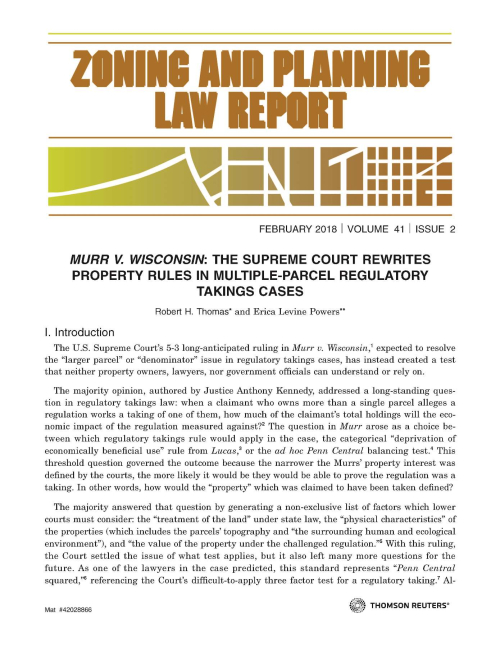
Here’s an article (“Murr v. Wisconsin: The Supreme Court Rewrites Property Rules in Multiple-Parcel Regulatory Takings Cases“), which we authored along with a colleague, published in February 2018’s Zoning and Planning Law Report, about the U.S. Supreme Court’s decision in Murr v. Wisconsin, the case about the “larger parcel” in regulatory takings.

As you might predict, we concluded that the Murr majority’s analysis was vague, unsatisfying, and generally not helpful. Strong letter to follow!

Here’s a passage from the Introduction:

The U.S. Supreme Court’s 5-3 long-anticipated ruling in Murr v. Wisconsin, expected to resolve the “larger parcel” or “denominator” issue in regulatory takings cases, has instead created a test that neither property owners, lawyers, nor government officials can understand or rely on.

The majority opinion, authored by Justice Anthony Kennedy, addressed a long-standing question in regulatory takings law: when a claimant who owns more

Continue Reading New Article: Murr And Other “Blurred Lines”

2018 LUI header Detroit-1

Mark your calendars, plan to come: Detroit, April 19-20, 2018. For what is perhaps the best deal in CLE (tuition as low as $400), the 32d Annual Land Use Institute, sponsored by our section of the ABA, the Section of State and Local Government Law.

The venue is the Detroit Mercy School of Law, and the conference hotel is the historic Westin Book Cadillac in downtown Detroit. The Land Use Institute is being held in conjunction with the Section’s Spring State and Local Law Conference. Register for one conference, and you are free to move between sessions (no additional registration fees).

Planning Chairs Frank Schnidman and Dean Patrica Salkin have assembled an excellent faculty and program for the two days. Topics include: “Nuts and Bolts of Land Use Practice: Vested Rights and Regulatory Takings,” “Public-Private Partnerships,” “Climate Change and Resilient Development,” “Client

Continue Reading 32nd Annual Land Use Institute: Detroit, April 19-20, 2018

Here’s the latest in a case we’ve been following since its inception, Brott v. United States, the case which asks the deceptively simple question of whether property owners who sue the federal government for a taking are entitled to both an Article III forum, and to have the issues determined by a jury.

The District court said no, as did the Sixth Circuit. The property owners’ cert petition asks this question:

Can the federal government take private property and deny the owner the ability to vindicate his constitutional right to be justly compensated in an Article III Court with trial by jury?

We filed an amicus brief in support, arguing that the “self-executing” nature of the Just Compensation Clause means that yes, property owner, you can bring a lawsuit for compensation if the government has taken your property: 

The government does not enjoy its usual sovereign

Continue Reading US BIO In Brott: No, The Fifth Amendment Isn’t Really “Self-Executing”

Here’s the cert petition, recently filed in a case we’ve been following as it has made its way from the Court of Federal Claims and through the Federal Circuit.

The underlying matter was litigated in the District Court and the Fifth Circuit. Those courts concluded that the plaintiff did not own mineral leases in Louisiana because under federal common law, it did not acquire any rights by prescription. The plaintiff then filed a Tucker Act claim in the in the CFC seeking compensation for a judicial taking on the theory that the Fifth Circuit’s ruling altered the plaintiff’s previously-established rights by changing the law.

The CFC accepted that fact as true, but concluded that the CFC has no jurisdiction to tell the Fifth Circuit it was wrong. The Federal Circuit affirmed, and here we are. 

Here’s the Questions Presented by the petition: 

In Stop the Beach

Continue Reading New Judicial Takings Cert Petition: Can A Federal Court Take Property By Changing The Law?