Here’s what we’re reading today:


Continue Reading Monday Round-Up: Food Takings; Honolulu And Nebraska Takings; Property Rights And The Environment

  2-017_MIAMI_LUI header_small

After a short absence and a change of lead sponsor (from ALI-CLE, to the American Bar Association’s Section of State and Local Government Law), the Land Use Institute is back on.

Download the print brochure here, or visit the LUI web site for more. It will be held February 1-2, 2017, in Miami, Florida, at the Brickell City Centre‘s Akerman Conference Center, in conjunction with the ABA’s Midyear Meeting. One of the best aspects of this program is the registration fee, a mere $300, $250 if you are a judge, an academic, young lawyer, or government attorney (perhaps the best deal in CLE). Register on line here. For those who cannot attend in-person, the LUI will be live-streamed. Register here

Planning Chairs Frank Schnidman and Dean Patrica Salkin have assembled a very good faculty and program. Topics include: “Nuts and Bolts of Land Use

Continue Reading Mark Your Calendars: The Land Use Institute Is Returning – February 1-2, 2017, Miami

Here’s the follow up to that cert petition we recently posted. In Romanoff v. United States, 815 F.3d 809 (Fed. Cir. 2016), a rails-to-trails case, the Federal Circuit was confronted with a question about how New York property law treated an easement. In that case, the easement was granted for railroad purposes, and after the railroad stopped using it, the City of New York converted it into a public recreational park, the vaunted “Highline.”

Of course, no one bothered to pay the owner of the reversionary interest just compensation as the Fifth Amendment requires, so it was forced to bring a claim in the Court of Federal Claims to recover compensation. That court, affirmed by the Federal Circuit, concluded that the reversionary owner owned nothing, because the easement its predecessor had granted wasn’t really for railroad purposes, but allowed the grantee to do anything with the

Continue Reading Amici Brief: On Unsettled Questions Of State Law In Takings Cases, Federal Courts Shouldn’t Guess

C0IlPH7UQAA2JsX

Here’s the final brochure for the upcoming ALI-CLE Eminent Domain and Land Valuation Conference, set for January 26-28, 2017, in San Diego.

Early registration gets you a discount (code CY009MK), as does multiple registrations from one office, so now’s the time to commit to joining us for our annual gathering (the 34th Annual) of the nation’s leading practitioners of eminent domain, condemnation, valuation, and takings law. There are multiple ways to register, including on line

Like in past years, the first day has three tracks: Practice, Substantive, and Condemnation 101. The latter is a one-day course for those new to the field, or as a refresher course for those with more experience. The second day, the 101 attendees will join the advanced course, and we’ll have plenary sessions in the morning, followed by Practice and Substantive tracks in the p.m. As always, attendees are free to move among

Continue Reading ALI-CLE Eminent Domain & Land Valuation Litigation Conference, San Diego, January 26-28, 2017: Final Brochure

Here’s the latest in a case we’ve been following (because we filed an amicus brief in the Federal Circuit in support of the property owners, and will be filing a brief in support of the cert petition). 

This is the case about New York City’s “Highline,” the abandoned elevated rail line which was converted into a public parkway. The problem, however, was that the federal government failed to pay just compensation to the owner of the railway easement, who was supposed to have the easement revert to it when the city stopped using it for a rail line.

The owner brought a rails-to-trails takings case for compensation in the Court of Federal Claims but that court, and the Federal Circuit, concluded that under New York law, the terms of the easement (what the Federal Circuit called a “general easement”) meant that the easement was granted not only for railway

Continue Reading New Cert Petition: When Faced With A Question Of State Property Law, Should A Federal Court Make Its Best Guess?

Here are the remarks we were to have presented today, the second day of the 2016 Brigham-Kanner Property Rights Conference, being held in The Hague, Netherlands at the International Court of Justice. The panel subject was “Property Rights in Intangible Assets.” We were unable to deliver them due to the panel running of of time, one of the dangers of being the last speaker in a lineup of four. [Protip: if ever you’re on a speaking panel, you might want to think about slotting yourself ahead of the others; some pay no regard to those behind them in the queue, exceed their allotted time significantly (even after being notified that their time is up), and don’t even bother to acknowledge their lack of respect for others.] But no matter, here we go.

Defining and Protecting Property Rights in Intangible Assets:
New Frontiers, Uncharted Waters

As you might already be able

Continue Reading Brigham-Kanner Property Rights Conference, The Hague: Property Rights In Intangible Assets

IMG_20161020_141639

Several years ago, William & Mary Law School’s Brigham-Kanner Property Rights Conference departed its usual Williamsburg, Virginia venue and held the event in Beijing. Holding the conference there allowed U.S. legal scholars and property law practitioners to share ideas and compare our ways with our PRC counterparts. The event was a great success.

IMG_20161020_091110 (3)

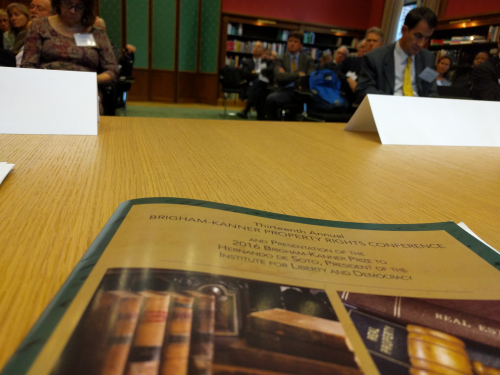
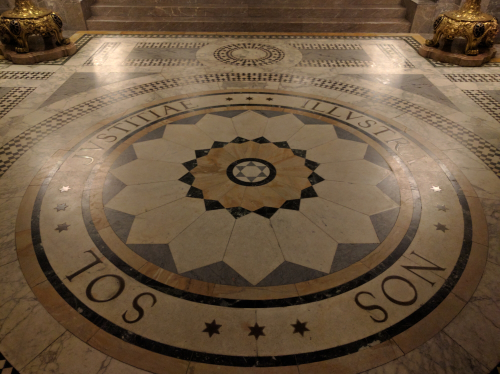
Now, W&M has followed up with another international venue for the Conference: the World Court (Peace Palace), in The Hague, Netherlands.

The Conference kicked off last night with a reception honoring this year’s Brigham-Kanner Prize winner, Peruvian economist Hernando de Soto, who opened the Conference this morning with a summary of his work and theories. One of the most intriguing is that the “Arab Spring” was a cry for property and economic rights.Count us as convinced. 

IMG_20161019_203955

The panels began their presentations today. Ours focused on how property rights contribute (or not) to developing nations. My

Continue Reading In Peace And In War: 2016 Brigham-Kanner Property Rights Conference At The World Court

Here are two cases about a topic that’s been getting a lot of traction lately in legal circles: how to deal with the so-called sharing economy. You know, things like Uber, Lyft, Air BnB, and … DogVacay. [Sidebar: that last one reminds of us Jack Handey’s faux sponsor of SNL‘s “Unfrozen Caveman Lawyer” series, “Dog Assassin” (“When you can’t bear to put him to sleep, maybe it’s time to call … Dog Assassin.”)].

This is such a developing area right now that our section of the ABA (State and Local Government Law) has formed a Sharing Economy Committee to try to discover what the rules are and should be. Ping me if you want to be a part of this group — all are welcome

Uber, Air BnB, and DogVacay aren’t taxis, or hotels, or dog walking services, they say. But they

Continue Reading Peak Posner At The 7th Circuit: Cab Companies Were Chumps To Rely On A Govt Monopoly To Protect Them From Competition

Here’s the amici brief we’re filing in a case which we told you about earlier, involving the way attorneys’ fees get calculated when a statute allows fee shifting. 

This is the afterglow of a rails-to-trails takings case, in which the property owners are entitled under the Uniform Relocation Act to attorneys’ fees. We like. 

What we didn’t like was the way the trial court arbitrarily cut the property owners’ fee request, without ever explaining why. The court simply made an across-the-board percentage reduction from the “lodestar” (a reasonable hourly rate times a reasonable time per task). And the Federal Circuit affirmed. 

So the property owners sought cert review, and now we’ve filed a brief in support. Our brief focuses on the first Question Presented: “Whether trial courts have discretion to make across-the-board percentage adjustments to the lodestar fee and, if so, what “specific proof” or “explanation” must the

Continue Reading SCOTUS Amicus Brief: Court Can’t Arbitrarily Reduce A Lawyer’s “Stock In Trade”

Here’s the latest in a case we’ve been following, and which earlier resulted in a very good decision from the North Carolina Supreme Court. 

In Kirby v. North Carolina Dep’t of Transportation, No 56PA14-2 (June 10, 2016), the N.C. Supreme Court held that the “Map Act,” a statute by which the DOT designated vast swaths of property for future highway acquisition, was a taking because the act prohibited development of designated properties in the interim. The court concluded that “[t]hese restraints, coupled with their indefinite nature, constitute a taking of plaintiffs’ elemental property rights by eminent domain.” The court remanded the case for a parcel-by-parcel determination of just compensation.

Here’s the trial court’s Order on remand, granting in part the plaintiffs’ motion for partial judgment on the pleadings on inverse condemnation liability, and ordering the NCDOT to “file plats, make deposits with the required statutory interest, and, if any plaintiff

Continue Reading NC Map Act: DOT Ordered To Pay For Designating Property For Future Highway Use (But Then Not Taking It)