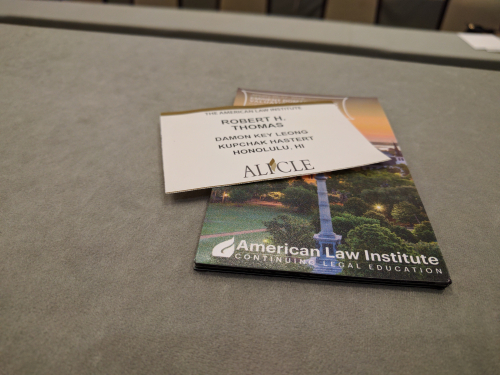
IMG_20170126_133958

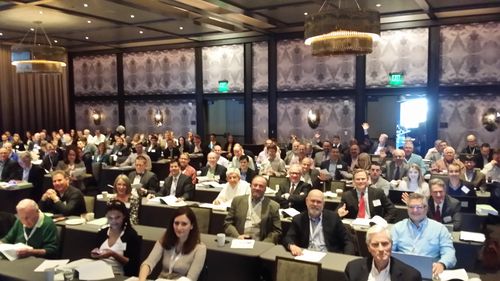
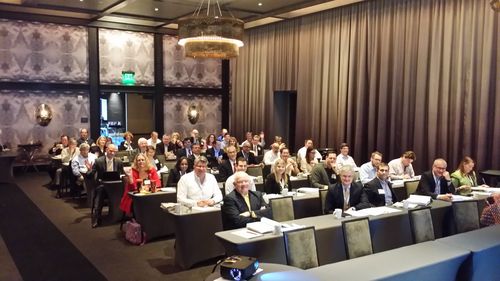
Here are the links and references to the cases we spoke about today at our opening session on the national trends in eminent domain law at the 2017 ALI-CLE Eminent Domain and Land Valuation Litigation Conference in San Diego. 

We again have a record attendance, and a good number of new attendees. If you aren’t here now, we’re sorry you didn’t make it. But fear not: ALI-CLE has already set the date and location for the 2018 Conference: save the date on your calendars now — January 25-27, 2018, Charleston, South Carolina, at the Francis Marion Hotel. 


Continue Reading Day 1, 2017 ALI-CLE Eminent Domain And Land Valuation Litigation Conference, San Diego

Here’s the amici brief we’re filing in a case which we told you about earlier, involving the way attorneys’ fees get calculated when a statute allows fee shifting. 

This is the afterglow of a rails-to-trails takings case, in which the property owners are entitled under the Uniform Relocation Act to attorneys’ fees. We like. 

What we didn’t like was the way the trial court arbitrarily cut the property owners’ fee request, without ever explaining why. The court simply made an across-the-board percentage reduction from the “lodestar” (a reasonable hourly rate times a reasonable time per task). And the Federal Circuit affirmed. 

So the property owners sought cert review, and now we’ve filed a brief in support. Our brief focuses on the first Question Presented: “Whether trial courts have discretion to make across-the-board percentage adjustments to the lodestar fee and, if so, what “specific proof” or “explanation” must the

Continue Reading SCOTUS Amicus Brief: Court Can’t Arbitrarily Reduce A Lawyer’s “Stock In Trade”

ALI2017 - Copy
ALI2017

We’ve teased some of the details on the 2017 ALI-CLE Eminent Domain and Land Valuation Litigation and Condemnation 101 Conference, to be held at the Westin San Diego, January 26-28, 2017, but here are the details you’ve been waiting for.

This is the “big one,” our annual 3-day festival of all things eminent domain, property, takings, inverse condemnation, and just compensation. Truly national in scope, this is the 34th annual edition, and the one conference you must attend. Our 2016 conference in Austin was one of the best in years, and we’re on the way to replicating it in 2017, with a great venue in an exciting city. 

Look for the web and printed brochures to show up in your mailboxes, but in the meantime, here are some of the highlights (we’ll post more in the next few days):

  • Relocation, relocation, relocation: we are featuring two sessions on this


Continue Reading Details: ALI-CLE Eminent Domain And Land Valuation Conference – San Diego, January 26-28, 2017

20160128_091958

20160128_092004

Here’s what’s going on today, the first day of the 33d annual ALI-CLE Eminent Domain and Land Valuation conference in Austin, Texas. We’re at standing room only, with a record number of attendees and our usual nationally renown faculty.

We started off the day with our usual “Eminent Domain Update” session with Amy Brigham Boulris, and as mentioned, the links to the opinions which we discussed are going to be posted in a separate post today. 

We are being followed by a panel on pipeline takings, one of the hot issues nationwide, with Joe Waldo, Matthew Ray, MAI, Thomas Peebles, and Dave Domina.

That session was followed by Professor Ilya Somin, talking about his book, “The Grasping Hand: Kelo v. City of New London and the Limits of Eminent Domain.”  

Above are our annual “proof of life” photos taken from the lectern, to show

Continue Reading ALI-CLE 2016 Eminent Domain Conference, First Day: Standing Room Only, National Expertise

After the usual preliminaries — certification of a 253-member class, subclass certifications, discovery, and motions and cross-motions for summary judgment — the parties in a rails-to-trails takings case in the Court of Federal Claims mediated the dispute and ended up agreeing to $110 million plus interest as just comp for the property taken, and slightly more than $2 million in statutory attorney fees and costs under the Uniform Relocation Act. Many of the class consented to this deal.

Class counsel and the government filed a joint motion for court approval, but a day later, class counsel sought additional fees under the “common-fund” doctrine in the neighborhood of $35 million, based on its contingency fee agreement with some members of the class which entitled them to a percentage of the total award. The CFC did some calculating:

As to whether class counsel’s request for thirty percent of the common fund was

Continue Reading Fed Circuit On Rails-To-Trails Class Action Attorneys Fees, The Uniform Relocation Act, And A Possible Circuit Split

Hawaii Business magazine has a new report about Honolulu rail. The headline asks, “How Much Will It Cost Us In The End?” 

There are questions of how much over original projections the rail project currently is. Or whether it is really over budget at all. Anywhere from zero (according to HART), to $1 billion. And, of course, whether there is an upper limit on how high the costs could go. Anyone with an interest in rail should read the story.

The only thing we have to add is that in our view (as we wrote here), the only honest answer is “as much as it takes.”

The project is already being built, and they aren’t going to simply stop now that they’ve started to pour concrete. In addition to having commenced construction, the legal machinery of the project is well underway, with properties being acquired and

Continue Reading Hawaii Business Magazine Asks: “How Much Will Rail Cost Us In the End?” Our Answer: As Much As It Takes

Railiscoming

[To reserve your space, please email your RSVP to me or Mark, or call either of us at (808) 531-8031.]

On Thursday, March 5, 2015, from 6:00 – 7:15 p.m. at the Farrington High School Cafeteria (1564 North King Street, Honolulu, Hawaii), we’re inviting property owners, businesses, and residents whose rights may be impacted by the Honolulu rail project to join us for an informational meeting about the rights of property owners when their property is targeted for acquisition for public transit projects, and how to protect those rights. 

Here’s the invite which we sent out:

Hawaii’s Constitution requires “just compensation” and monetary damages be paid if private property is taken for a public use such as the Honolulu rail project. The Honolulu Authority for Rapid Transit has already begun acquiring privately-owned property it needs for the rail corridor from the airport to Ala Moana, as

Continue Reading Property Owners Invited: Honolulu Rail Project Public Informational Meeting, Thursday, March 5, 2015, Farrington High School

20150204_161439 (1)

Here are the cases which I spoke about this morning at the 2015 ALI-CLE Eminent Domain and Land Valuation Litigation conference:

Here is our annual “proof of life” photo, the view from the dais. Proof

Continue Reading ALI-CLE 2015 Eminent Domain Conference: Links From Today’s Presentation

Lgo

ALI-CLE, the good folks who put on the annual programs on Eminent Domain and Land Valuation, and Condemnation 101: How to Prepare and Present an Eminent Domain Case, have announced the dates and venue for the 2015 conferences:

Thursday – Saturday, February 5-7, 2015 

Hotel Nikko, in San Francisco.

Those of you who have attended or taught at these conferences in the past know they are the premier programs on this topic, and feature exciting presentations and excellent faculty.

I’ve been honored to be asked to serve as the Planning Co-chair of the 32d annual Eminent Domain and Land Valuation Litigation program, stepping into the able shoes of Leslie Fields, who retired last year. Joe Waldo is continuing as Planning Co-Chair. Joe and I are currently putting together the agenda and faculty for the program, and we will have more on that soon. Andrew

Continue Reading Mark Your Calendars: 2015 ALI-CLE Eminent Domain and Land Valuation, and Condemnation 101 – February 5-7, 2015, San Francisco

One portion of the federal Uniform Relocation Act, 42 U.S.C. § 4651, requires Federal agencies participating in projects requiring the acquisition of private property to be guided by certain policies that “assure consistent treatment for owners . . . and . . . .promote public confidence in Federal land acquisition practices,” such as (and we’re paraphrasing here), do it as quickly as possible, try to get it by negotation, don’t use condemnation to leverage a lower negotiated price, and so forth. 

These policies apply to state and local condemnors when their projects involve federal funding, and in Clear Sky Car Wash LLC v. City of Chesapeake, No. 13-1492 (4th Cir. Feb. 21, 2014), the owner whose property was being condemned by the Virginia Department of Transportation asserted VDOT was not following the rules. VDOT instituted a “quick take” eminent domain action in state court, and Clear Sky went to federal

Continue Reading 4th Cir: Uniform Relocation Act Requirements Are Like The Pirate’s Code – “More What You’d Call ‘Guidelines,’ Than Actual Rules”