


Here’s the amicus brief we filed today on behalf of our colleagues at Owners’ Counsel of America, urging the U.S. Supreme Court to grant cert in Marvin M. Brandt Revocable Trust v. United States, No. 12-1173 (cert. petition filed Mar. 22, 2013).

That petition asks the Court to review a Tenth Circuit decision that continued a lower court split about the meaning of the term railroad “right of way” as used in an 1875 federal statute and federal land patents subject to the 1875 Act. The issue is whether the federal government retained an “implied reversionary interest” when it issued these patents, or whether these grants were subject only to a railroad easement. The difference is that easements may be extinguished, while reversionary interests cannot. In this case, the railway abandoned its use, after which the federal government instituted a quiet title action in federal court asserting

Continue Reading Amicus Brief In Rails-to-Trails Case: Switching Tracks To Undermine Takings Claims

Our colleague Mark M. Murakami has published the first in a series of posts on his blog about legal issues surrounding the multi-billion dollar Honolulu rail project, “Honolulu Rail and the Uniform Relocation Act.”

Because the HART rail project will involve federal funds, federal laws and regulations provide property owners (and their tenants) with additional statutory and regulatory protections above what is required by the Fifth Amendment, the Hawaii Constitution or Hawaii Revised Statutes Chapter 101.  This is the first post in a series about Honolulu Rail.

Title 42, Chapter 61 of the U.S. Code is entitled:  “The Uniform Relocation Assistance and Real Property Acquisition Policies for Federal and Federally Asssisted Programs” and provides the statutory authority for the regulations which provide the details of the various benefits of the Uniform Relocation Act program.  

Yes, his blog is Hawaiioceanlaw.com, but maritime and admiralty law is just one

Continue Reading Honolulu Rail And Federal Relocation Benefits

Bulldozersatyourdoorstep

Our Owners’ Counsel of America colleague Michael Rikon and his law firm have launched a new blog, “Bulldozers at Your Doorstep – A National Blog on Eminent Domain.”

The blog will give us Michael’s and his colleagues’ view of eminent domain and condemnation issues from their unique New York perspective, from lawyers who specialize in eminent domain defense.

Recent posts include a discussion of corridor valuation, the introduction of a bill in North Carolina to limit Kelo‘s impact, and how the U.S.’s energy independence may result in an upswing in the exercise of eminent domain.

Definitely worth following. Continue Reading New Eminent Domain Blog – “Bulldozers at Your Doorstep”

Ever since the U.S. Supreme Court’s infamous decision in Kelo v. City of New London, 545 U.S. 469 (2005), the focus of eminent domain scholarship and the public have been on the public use side of the condemnation equation.

However interesting those issues are (and they truly are), practitioners of eminent domain law understand that a vast majority of the issues in litigation still revolve around just compensation and valuation. The Supreme Court has even shown an interest, with the Justices asking questions about compensation in at least two oral arguments where the issue was not directly presented (here and here for example). While the ABA has recently published books about eminent domain generally (see here and here), it has not produced one devoted to just compensation.

But it soon will. The section on State and Local Government Law has decided to publish a book on current

Continue Reading Call For Authors: American Bar Association Book On Just Compensation Issues

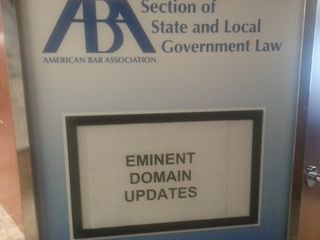
20120803_134704
Here are the cases and links that I discussed at today’s ABA session on eminent domain:

  • Kelo – Remember the holding of the case: the Court majority rejected the petitioners’ call to adopt a blanket rule that all takings supported only by claims of economic development violate the Public Use Clause of the Fifth Amendment. In declining to adopt the rule, the Court left open challenges based on lack of a comprehensive plan, claims that the advanced public use is a pretext to hide a predominant private purpose, and the old “A-to-B” private taking.
  • City of Stockton v. Marina Towers LLC (Cal. Ct. App. 2009) – The case in which the court held that the city’s resolution of necessity was so “nondescript [and] amorphous,” and “so vague, uncertain and sweeping in scope that it failed to specific the ‘public use’ for City sought acquisition of the property.”


Continue Reading Resources From Today’s ABA Eminent Domain Session

When does a party who loses a petition for rehearing actually win it?

In Bywaters v. United States, No. 2011-1032 (Fed. Cir. Mar. 1, 2012) an opinion we detailed here, a 2-1 panel of the Federal Circuit held that the property owner’s request for attorneys fees under the Uniform Relocation Assistance and Real Property Acquisition Policies Act was reasonable, but halved it because the amount of compensation sought and awarded was not that large. The majority, in an opinion by Judge Dyk, remanded the case to the Court of Federal Claims for additional calculation.

Judge Plager dissented, asserting that remand was pointless because there was nothing left for the CFC to do but apply the lodestar (reasonable rate x reasonable time), and since the panel majority did not disturb any of the CFC’s findings on those two issues, the result, absent the halving, should be the same. Small

Continue Reading Fed Circuit: En Banc Petition Denied, But Kind Of Granted

Here’s today’s second decision about attorneys fees and costs, this time in an inverse condemnation claim out of the Federal Circuit, Bywaters v. United States, No. 2011-1032 (Mar. 1, 2012).

In a class action rails-to-trails takings case under the Little Tucker Act (less than $10,000 per claim, district court venue), the trial court awarded the property owners attorneys fees and costs under the Uniform Relocation Assistance and Real Property Acquisition Policies Act. The government had stipulated to liability and the parties worked together to determine compensation for class members. Eventually, the district court approved a settlement for the entire class of approximately $1.25 million, interest included. The property owners then filed a claim seeking $832,000 in fees for 2,000+ hours of work. The market rate they sought was for attorneys in the District of Columbia (where their office is located), and not the Eastern District of Texas (the

Continue Reading Federal Circuit Talks Attorneys Fees Under The Uniform Relocation Act