


2011-05-14_16-31-39_422

Who likes paying a lot for prescription medications? Anyone?

Oregon sure didn’t like it, and it was going to do something about it. In 2018, it adopted a statute the “Prescription Drug Price Transparency Act,” which requires manufacturers to report to the State information about costs, revenues, and prices of certain prescription drugs. The Act also requires the State to disclose, in the public interest, much or all of that information to the public, provided that information is not a trade secret. Oregon has not actually disclosed any trade secrets. 

An industry association (PhARMA) sued, asserting inter alia, a facial takings claim. The District Court granted PhRMA summary judgment, concluding that the publication of trade secrets under the public-interest exception is a taking requiring compensation.   

In Pharmaceutical Research and Manufacturers of America v. Stolfi, No. 24-1570 (Aug. 26, 2025), the U.S. Court of Appeals for the Ninth

Continue Reading CA9: Pharma Has No Expectation Of Nondisclosure, So State Disclosing Trade Secrets Is Not A Penn Central Taking
If your brain goes full mobius strip when trying to figure out the California Court of Appeal’s rationale in Anaheim Mobile Estates, LLC v. State of California, No. G063421 (Aug. 13, 2025), you are not alone. 

Here’s the bottom line in this facial challenge to a California statute that limits mobilehome parks located in two municipalities from increasing the rental rate more than 3% + cost of living (or 5%) and limits the number of times a long-term tenant may be subject to such increases: the court held that the absence of a mechanism to challenge the restriction on the grounds it does not provide a fair rate of return does not render the statute unconstitutional, because the challengers have not shown the statute does not provide a fair rate of return. 

The park owner asserted that under California precedent, “a price control statute must have an individualized

Continue Reading Cal App: No Fair Return Procedures Required Unless You First Show Lack Of Fair Return

Here’s a recent cert petition which asks the Supreme Court to take up the case of a small property owner in West Hollywood, California, whose case was dismissed when he asked “[h]ow far can a city expand rent control to advance general socioeconomic policies before crossing constitutional property protections?” Pet. at 3. 

Here are the Questions Presented:

1.  Whether a municipality may transform temporary emergency rent restrictions and occupancy mandates adopted at the start of the COVID-19 pandemic into permanent rent control measures that expand benefits to tenants and the public at large at the expense of private property owners, without triggering scrutiny under the Takings and Due Process Clauses of the Fifth and Fourteenth Amendments of the U.S. Constitution.

2.  Whether the denial of leave to amend, despite the viability of property claims for takings and due process violations, constituted an abuse of discretion under this Court’s liberal standard

Continue Reading New Cert Petition: Is Expanding Temporary Emergency Measures Into Permanent Rent Control A Problem?

Here’s the latest in an issue we’ve been following.

In Fletcher Properties, Inc. v. City of Minneapolis, No. A23-0191 (July 30, 2025), the Minnesota Supreme Court held that the city barring owners from refusing to rent residential properties to a prospective tenant because the applicant is on public assistance is not a taking. 

What is colloquially known as “Section 8” is a federal program “that provides rent subsides to eligible families … to help them pay for housing in the private market.” Slip op. at 2. This is a voluntary program, both for the tenant receiving the assistance as well as the lessor who enters the program by contracting with the public housing authority.

The City of Minneapolis added discrimination based on a tenant’s receipt of Section 8 assistance to the list of forbidden reasons for refusing to rent to a prospective tenants such as “race, creed, religion, ancestry

Continue Reading Minnesota: Requiring Landlords To Rent To Tenants On Public Assistance Is Not A Taking

Here’s the latest in a case we’ve been following.

In Englewood Hospital & Medical Center v. State, No A-16-24 (July 16, 2025), the New Jersey Supreme Court rejected physical and regulatory takings claims made by hospitals which are required to treat nonpaying patients even though the Medicare reimbursements available will not cover the hospitals’ costs. 

Here’s the bottom line:  

Under the facts as presented in this case, we hold that charity care is not an unconstitutional “per se” physical taking of private property without just compensation. It does not grant an affirmative right of access to occupy hospitals; it does not give away or physically set aside hospital property for the government or a third party; and it does not deprive hospitals of all economically beneficial use of their property. We also hold that charity care is not an unconstitutional “regulatory” taking of private property without just compensation.

Continue Reading NJ: Forcing Hospitals To Lose Money To Treat Nonpaying Patients Isn’t A Taking

Here’s the latest in a case we’ve been following.

In Hudson Valley Property Owners Ass’n v. City of Kingston, No. 59 (June 18, 2025), the New York Court of Appeals held that after a municipality declares a housing emergency allowing it to regulate the amount of rent, it has the power to order lessors to refund to tenants rent which exceeded the maximum allowed amount, even if those rents had been collected prior to the declaration of the emergency. 

At least that is how we read the opinion. Due to its somewhat unusual procedural posture, the court did not actually allow the city to nail property owners for retroactive “overcharges,” it merely rejected the owners’ claims that because the statute may allow it in particular cases, it isn’t facially unconstitutional.

This was a facial challenge by property owners to Kingston, New York’s declaration of a housing emergency during

Continue Reading NY: In A Housing “Emergency,” City Can Retroactively Lower The Rent, Even Rent Collected Before The Emergency

Screenshot 2025-06-30 201407

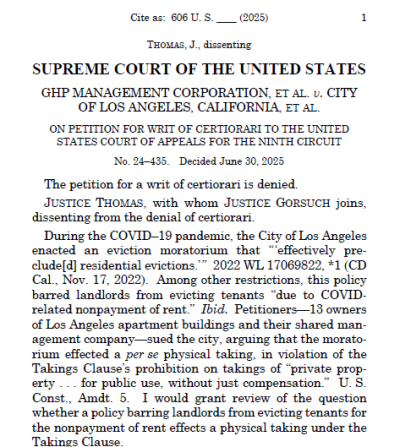
Yesterday, in this Order in a case we’ve been following, the U.S. Supreme Court declined to consider whether a municipal ordinance which allowed non-paying tenants to remain in the lessor’s property after the agreed-upon termination of a lease (nonpayment of rent) is a physical taking, or merely the regulation of the lessor/lessee relationship under the Yee theory.

You remember that theory? It goes like this: once an owner voluntarily rents property to a tenant, the government then allowing that tenant to remain rent-free when, under the rental agreement, the right to occupancy would otherwise be terminated (for failure to timely pay rent, for example) isn’t the government facilitating an unauthorized physical occupation (see, e.g., Kaiser Aetna), but rather is merely a regulation of the existing lessor/lessee relationship. The Ninth Circuit in this case, and other courts around the country have viewed Yee as compelling

Continue Reading The Other Shoe Drops: SCOTUS Declines Review Despite Acknowledged Split – Is Barring Owners From Evicting Nonpaying Tenants A Physical Taking?

Here’s the latest in a case we’ve been following. This is GHP Management Corp. v. City of Los Angeles, No. 24-435, the cert petition which asks whether a local ordinance which allowed non-paying tenants to remain in the lessor’s property is a physical taking, or merely the regulation of the lessor/lessee relationship under the Yee theory, which posits that once an owner voluntarily rents property to a tenant, the government then allowing that tenant to remain rent free isn’t facilitating an unauthorized physical occupation, but rather is merely a regulation of the existing lessor/lessee relationship. 

The petitioner property owner has filed its cert stage Reply, which means that all the briefing is in, and next up is for the Supreme Court to set the conference date. Here’s the summary of the issues from the Reply:

Respondents prefer a world where government enjoys absolute immunity from

Continue Reading Eviction Moratorium As A Physical Taking All Teed Up

Property_rights_and_the_roberts_court_Agenda_

Register now and plan on joining us on Thursday, February 27, 2025 at the U.C. Berkeley Law School for a one-day conference: “Property Rights and the Roberts Court: 2005-2025.”

Here’s the agenda. Here’s a description of the program:

For much of the past century, property rights were relegated to second-class status compared to the rest of the Bill of Rights. However, under the Supreme Court leadership of Chief Justice John Roberts, this trend has begun to shift.

In recognition of the 20th anniversary of the Chief Justice’s elevation to the Supreme Court, Pacific Legal Foundation is partnering with Berkeley Law’s Public Law and Policy Program to host a day-long conference exploring the major property rights developments and future of property rights law in the Roberts Court.

We’ll hear from two different panels of renowned legal scholars and accomplished litigators, as well as a keynote lunch discussion between

Continue Reading Join Us: “Property Rights and The Roberts Court: 2005-2025” (Feb. 27, 2025, UC Berkeley Law School)

2025 San Diego

Get ready to join your colleagues and friends in San Diego for the 42d ALI-CLE Eminent Domain & Land Valuation Litigation Conference.

The 41st Conference was in New Orleans. Here’s a report of that event, and here are our reports from prior conferences in Austin and Scottsdale.

Here are some of the highlights of the upcoming Conference:

  • Property Rights at the Supreme Court: DeVillier and Sheetz and What’s Next
  • Slow Take: Possession, Rent, Relocation, and Offset
  • The Jury’s View: How Jurors See Your Case
  • From Penn Coal to Penn Central: How to Prove “Too Far”
  • Leveraging Expertise in Eminent Domain Litigation: Working with Land Planners, Engineers, and Other Predicate Experts
  • Kelo at Twenty: What Changed, What Didn’t, and What’s on the Horizon
  • Viva Las Vegas: How the Nevada Judiciary Upheld Property Rights in 180 Land’s Inverse Condemnation Taking
  • Ethics: Guiding the Trolley: Perspectives on Professional Ethics in


Continue Reading Registration For The 42d ALI-CLE Eminent Domain & Land Valuation Litigation Conference Is Underway (Don’t Miss Out!)