Here are the cases and other materials we discussed in today’s Section of State & Local Government Law Land Use group meeting on takings:


Continue Reading Links From Today’s ABA Land Use Session

Untitled Extract Pages

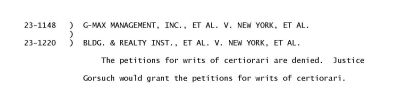
Here’s the latest in a case we’ve been following. This morning, in this Order, the Supreme Court denied cert in two cases which seemed to have a good chance at a grant, on two pressing issues which have divided lower courts, the physical occupation in tenancies (aka Yee), and the nature of the Penn Central takings test. Only Justice Gorsuch would have granted.

Here are the Questions Presented:

New York’s Housing Stability and Tenant Protection Act of 2019 transforms a temporary rent- regulation system into a permanent expropriation of vast swaths of private real estate, without just compensation, in the name of “affordable housing.” Among other things, the Act prohibits owners—even of small and midsized apartment buildings like Petitioners—from reclaiming rental units for their own personal use, and grants tenants a collective veto right over condo/co-op conversions. As Justice Thomas has observed, the constitutionality of regimes like New York’s

Continue Reading SCOTUS Declines To Review NYC Rent Control Challenge

Screenshot 2024-11-08 at 07-19-21 Track Appeals NJ Courts

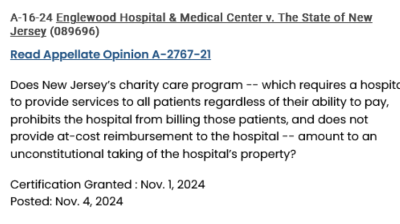
Here’s the latest in a case we’ve been following. The New Jersey Supreme Court has agreed to review the Appellate Division’s decision in Englewood Hospital & Medical Center v. New Jersey

That’s the case where several hospitals challenged a New Jersey statute which requires hospitals to take all patients regardless of their ability to pay, but does not fully reimburse under Medicaid the hospitals for the costs of treating these patients even where it results in the hospitals losing money.

The Appellate Division held this was not a categorical (Cedar Point/Loretto) or an ad hoc (Penn Central) taking.

The hospitals asserted that the statute required them to suffer a physical invasion, because the statute prohibited hospitals from excluding nonpaying patients. The court rejected the argument, in what reminded us of the Yee rent control and PruneYard commercial benefit approach, where the essential reasoning

Continue Reading NJ Supreme Court Grants Review: Is Forcing Hospitals To Operate At A Loss A Taking?

Screenshot 2024-10-24 at 12-28-24 Vacancy Taxes A Possible Taking The University of Chicago Law Review

A new student-authored journal article worth reading, Christine Dong, “Vacancy Taxes: A Possible Taking?,” 91 U. Chi. L. Rev. 1725 (2024).

Here’s the Abstract:

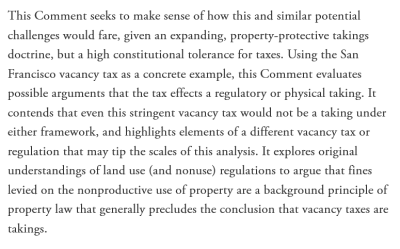
Vacancy taxes are an increasingly popular solution to the paradoxical problem of high housing demand coupled with high vacancy. Cities across the country facing housing shortages have either implemented or are considering adopting vacancy taxes to encourage property owners to rent or sell their property. Soon after San Francisco adopted a vacancy tax with one of the broadest definitions of vacancy, property owners lobbed a constitutional challenge under the Takings Clause, taking advantage of a moment of doctrinal instability.

This Comment seeks to make sense of how this and similar potential challenges would fare, given an expanding, property-protective takings doctrine, but a high constitutional tolerance for taxes. Using the San Francisco vacancy tax as a concrete example, this Comment evaluates possible arguments that the

Continue Reading New Article (Comment): “Vacancy Taxes: A Possible Taking?” (U. Chi. L. Rev.)

Here’s the latest in a case we’ve been following, which asks whether a local ordinance which allowed non-paying tenants to remain in the lessor’s property is a physical taking, or merely the regulation of the lessor/lessee relationship under the Yee theory, which posits that once an owner voluntarily rents property to a tenant, the government then allowing that tenant to remain rent free isn’t facilitating an unauthorized physical occupation, but rather is merely a regulation of the existing lessor/lessee relationship. In short, you let ’em in property owner, so suck it up.

The property owner has now filed this cert petition challenging that rationale.

As we’ve noted previously, some courts’ reliance on Yee in this and similar situations is a misreading of that decision. Besides that, these courts essentially upend the longstanding common law of property governing the owner/tenant relationship, and the contractual nature of that relationship

Continue Reading New Cert Petition: Eviction Moratorium Transferred Possession Easement To Nonpaying Tenants

Screenshot 2024-10-11 at 08-06-50 RPFSS

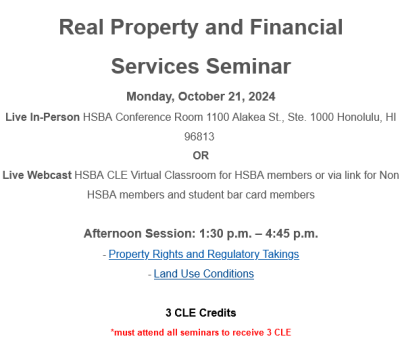
Hawaii lawyers (and those barred in the 808), take note: On October 21, 2024, the Hawaii State Bar Association will hold its annual Convention, and as always there’s a full lineup of CLE programs so you can meet your MCLE requirements.

Thanks to the Real Property & Financial Services Section, there’s a significant dirt law component. First, there’s “Property Rights and Regulatory Takings” the program on which we are presenting along with Dwight Merriam and lawprof Shelley Saxer. Here’s the official description:

This course will provide a survey of property rights and regulatory takings with an emphasis on recent decisions from the United States Supreme Court. Panelists include distinguished faculty and practitioners that will address impact fees, development rights, taking claims, rent controls, and other current issues.

Following us will be a program on “Land Use Conditions” with Cal Chipchase, Brad Saito, and a lawyer

Continue Reading Hawaii Dirt Lawyers: Don’t Miss “Property Rights & Regulatory Takings” CLE At The HSBA Convention (In-Person & Webcast)

Be sure to read the entirety of Lawprof Ilya Somin’s recent post on Volokh,Federal Appellate Court Rules in Favor of Takings Lawsuit Against the CDC’s Covid-Era Eviction Moratorium.”

There, he analyzes the Federal Circuit’s recent 2-1 opinion in Darby Dev. Co., Inc. v. United States, No. 22-1929 (Aug. 7, 2024) (we wrote up the case here: “Deepening A Lower Court Split, Fed Cir (2-1) Reinstates CDC Co-19 Eviction Moratorium Temporary Takings Claim“).

Professor Somin does a better job that we did offering his thoughts on the “authorized” issue, concluding:

To me, the decisive factor should be that the Takings Clause nowhere says that compensation is only required for legal government actions or for those specifically authorized by statute. Rather, the Clause imposes a general rule that compensation must be paid whenever the government takes private property for “public use.” That, of course, can happen

Continue Reading Lawprof Somin: “Federal Appellate Court Rules in Favor of Takings Lawsuit Against the CDC’s Covid-Era Eviction Moratorium”

20151205_145921

This one is a must-read.

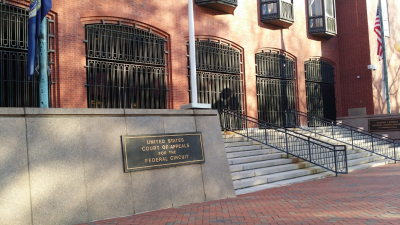
In Darby Dev. Co., Inc. v. United States, No. 22-1929 (Aug. 7, 2024), the U.S. Court of Appeals for the Federal Circuit held that the Court of Federal Claims should not have dismissed Darby’s complaint for failure to state a physical invasion takings claim.

The short takeaways:

  • Takings claims do not require the government action be legally authorized (here, the courts invalidated the government action, after which the plaintiff sued for a taking), only that the government action was “authorized” and thus can be “chargeable to the government.”
  • Prohibiting evictions is not merely a regulation of the landlord-tenant relationship. Yee v. City of Escondido is distinguishable, and does not categorically exempt all actions that implicate the landlord-tenant relationship from physical takings challenge.

We think the longer story is worth your time. Here it is.

As you may recall, the Center for Disease Control purported

Continue Reading Deepening A Lower Court Split, Fed Cir (2-1) Reinstates CDC Co-19 Eviction Moratorium Temporary Takings Claim

81XRFQ5ONQL._SL1500_

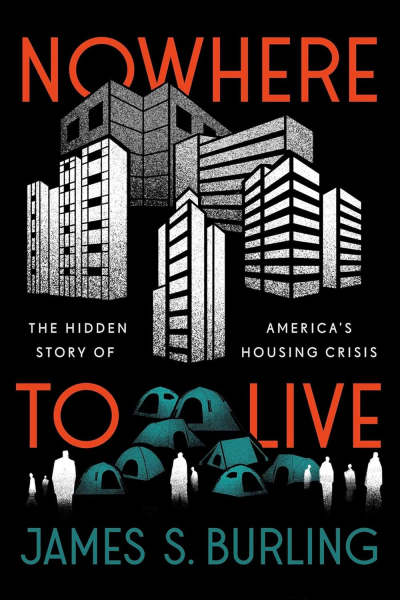
If you are in the California Southland (or plan to be in the next week), please be sure to reserve on your calendar Tuesday, August 13, 2024, to join us in-person for the launch of our colleague Jim Burling‘s forthcoming book, “Nowhere to Live: The Hidden Story of America’s Housing Crisis.”

Here’s a blurb about the book, which is available for preorder on Amazon:

A century of policy mistakes ruined America’s cities and created an unprecedented housing crisis.   
 
For many families, homelessness is no longer someone else’s problem. It is right around the corner, a real threat in their own immediate future. Our housing crisis is the result of a long history of government policies, court cases, and political manipulation. While these disparate causes make up a tangled web, they have one surprising root: the attack on private property rights. For more than

Continue Reading Book Launch Event, Aug 13, 2024: Jim Burling, “Nowhere to Live: The Hidden Story of America’s Housing Crisis”

As we noted here (“SCOTUS Denies Review To Remaining Rent Control Takings Petitions: “Important and pressing question” (Just Not In This Case)“), a small silver lining in the Court declining review was the statement of Justice Thomas accompanying the denial, where he noted the issue is an “important question,” and set out a rough roadmap to future challenges.

Here’s a cert petition which asserts this is the case to take up the issue. Here’s the Question Presented:

New York’s Housing Stability and Tenant Protection Act of 2019 transforms a temporary rent- regulation system into a permanent expropriation of vast swaths of private real estate, without just compensation, in the name of “affordable housing.” Among other things, the Act prohibits owners—even of small and midsized apartment buildings like Petitioners—from reclaiming rental units for their own personal use, and grants tenants a collective veto right over condo/co-op conversions. As Justice

Continue Reading We Heard You, Justice Thomas: NY Property Owners File New Takings Cert Petition Challenging Rent Control