
Here’s what we are reading today:
- “The Dead Hand Of Rent Control” – Richard Epstein TEXT
- XXX
XXXContinue Reading Thursday Takings Round-Up: Rent Control, Traditional Forums For Public Speech


Here’s what we are reading today:
XXXContinue Reading Thursday Takings Round-Up: Rent Control, Traditional Forums For Public Speech
Here’s what we’re reading today:
Continue Reading Thursday Round Up: Pretextual Takings, Squatting, Unconstitutional Conditions
Check this out: lawprof Ilya Somin has posted “Squatters’ Rights Laws Violate the Takings Clause” at Volokh.
His thesis is just as the title suggests, arguing that state statutes that treat trespassers as tenants are government-authorized physical occupations, and thus are takings:
Ideally, state and local governments should make it easy for property owners to swiftly remove squatters, and should subject the trespassers to civil and criminal sanctions. But where they instead facilitate this violation of property rights, the laws that do so violate the Takings Clause of the Fifth Amendment, which requires payment of “just compensation” whenever the government takes “private property.”
Professor Somin relies on Cedar Point, and addresses the narrow exception to the general rule from that case that all physical invasions and occupations are takings without regard to the diminution in use or value or the owner’s expectations, where the government had enabled
Continue Reading Lawprof Ilya Somin: “Squatters’ Rights Laws Violate the Takings Clause”
New York state, as you might already know, regulates the rent an owner of residential property may charge to a tenant. Under a statute adopted in 1974, regulation is triggered by a locality’s declaration of a housing emergency, and the restrictions extend for the duration of the declared emergency. Most famously — or infamously — New York City has declared a housing emergency under the statute since that time, and indeed has considered housing an “emergency” for over a century. The 1974 statute also applied to three other NYC-adjacent counties, but not the entire Empire State.
Well, in 2019 the legislature changed that, and “allowed municipalities statewide to opt in to the rent adjustment scheme created by the [1974 Emergency statute] upon a declaration of emergency due to a housing vacancy rate of 5% or less[.]”
In 2019, Kingston was thwarted when it determined its vacancy rate was 6.7% —
Continue Reading NY App Div: Inflation, Bah! Rent Gets Cheaper In Kingston!
Be sure to check out this interview (“Rent Control Is a ‘New York Tragedy’“) on Hamodia, with law Professor Richard Epstein.
As you might expect, the interview is full of insights and bon mots. There’s even a reference to the judicial takings case, Stop the Beach Renourishment. And a lot of things that just make you shake your head because anyone who had done a modicum of thinking on the rent and vacancy control issue can tell there’s no real “exit strategy” by the governments who impose it, and that when the music stops — as it must, eventually — someone is going to be left standing up without a chair. It is not, at least as practiced in New York, “sustainable” (in today’s parlance).
And when you go to the New York courts, it’s a death trap. They’re all consistently pro-government in these cases. You try

When it comes to the longstanding ALI-CLE American Law Institute-CLE Eminent Domain and Land Valuation Litigation Conferences, we’re always ready to go. You know that. But this year’s version — the 41st — was buzzing like no other in recent memory.
Maybe it was the New Orleans venue with its atmo, food, and music for our after-class activities, or even the timing (the second-to-last week on the Mardi Gras parade season, and our conference hotel was right on the routes). It might have been the nice weather (oh, it rained buckets one evening, but there wasn’t an ice storm like we experienced in Austin in 2023). Or maybe it was the capacity crowd, and new topics and speakers on the agenda. Or maybe it was just the prospect of seeing our friends and colleagues again after a year.
Here’s a photo essay of some of the Conference highlights.
And
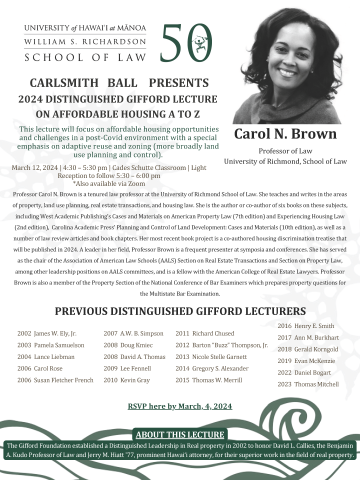
Join us and our Land Use class, in-person on the campus of the University of Hawaii Law School (or online via Zoom, where it will be livestreamed), as Richmond Law lawprof Carol Brown delivers the 2024 Distinguished Gifford Lecture in Real Property, on March 24, 2024, at 4:40 p.m. Hawaii Time in the Cades Schutte classroom.
Her talk is titled “Affordable Housing A to Z” and is very timely. More details on this flyer.
Made possible by the generosity of one of Hawaii’s premiere dirt law firms, Carlsmith Ball, LLP.
Space is limited, so please RSVP here.
Yesterday, the other shoe dropped. In this order the U.S. Supreme Court denied review to a case that we’ve long been following, which challenged aspects of New York’s draconian rent control laws as a taking, 74 Pinehurst v. New York.
We say the “other shoe” because ever since the Court denied review months ago to other challenges to rent control (yet kept relisting Pinehurst, which was always among the two strongest of the multiple challenges), it appeared this round of petitions was doomed, and the Court was holding off denying review, to allow one or more Justices to write something. To us, it was unlikely that the Court would deny some of the petitions outright, while at the same time agreeing to take up the issue in another case. Grant-and-hold seemed the most likely scenario there. Absent that, we didn’t expect these last two to be granted.
So
Check out the U.S. Court of Appeals’ opinion in Peace Ranch, LLC v. Bonta, No. 22-16063 (Feb. 13, 2024), where the court concluded that the owner of a mobilehome park could bring a federal court challenge to a California statute, even before the state applied the statute and enforced it.
There’s a mobilehome park in Southern California — Rancho La Paz — that straddles the line between two separate municipalities, Anaheim and Fullerton. When the owner of the park upped the rent, the municipalities undertook efforts to impose a form of rent control. But those efforts ultimately failed.
Not to be outdone, the state representative from the area pushed for, and got adopted a state statute that seems curiously tailored to cover only Rancho La Paz: certain “qualified” mobilehome parks can only raise the rent a certain amount. The definition of a “qualified” park in the statute is limited
Continue Reading Peace Out: CA9 OK’s Pre-Enforcement Challenge To Rent Control Statute
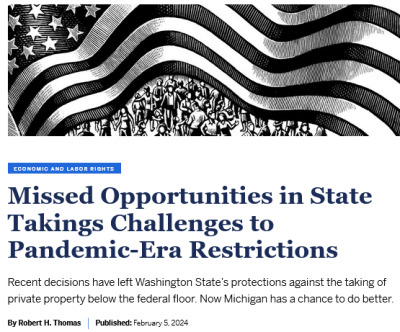
Thank you to the Brennan Center for Justice at NYU Law School’s State Court Report (#statecourtreport) for publishing our piece “Missed Opportunities in State Takings Challenges to Pandemic-Era Restrictions.” The title gives a hint about what this is about: how state and local government’s reaction to Co-19 spurred challenges not only under the U.S. Constitution, but under state constitutions. We give examples of — and comment on — missed opportunities and out-and-out errors in several approaches.
Here are the opening paragraphs:
Responding to the Covid-19 pandemic, the federal government and many state and local governments imposed a variety of restrictions on individuals and businesses. The Centers for Disease Control and Prevention, for example, purported to suspend the ability of property owners to evict nonpaying tenants — a move the U.S. Supreme Court rejected as beyond the agency’s power. State and local governments adopted similar eviction moratoria, and many directed