


20141104_135324

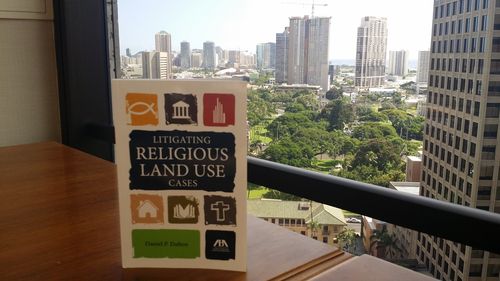
A big thank you to our friend and colleague from Detroit, Dan Dalton, who sent us a recently-published book which he authored, “Litigating Religious Land Use Cases.” 

This book discusses how to litigate such a religious land use case on behalf of a religious entity pursuant to the Religious Land Use and Institutionalized Persons Act (“RLUIPA”)  and the First Amendment. While the First Amendment dates to the founding days of the United States, RLUIPA is a much more recent federal law that can serve as an effective tool in protecting the property interests of religious organizations.

A must-have for any land use lawyer (even if you don’t focus on religious land use cases, or don’t represent religious organizations in such cases), Dan’s book is a great overview of the applicable law, and a primer on the various causes-of-action that can pop up in these type of controversies.

Continue Reading New Book: Litigating Religious Land Use Cases (Dan Dalton)

If that title doesn’t grab you, nothing will. Here’s the description of an upcoming program from the American Planning Association that looks awfully interesting:  

The Planning and Law Division of the American Planning Association is pleased to host the upcoming webcast Sex, Guns & Drugs:  Planning for Controversial Land Useson Wednesday, October 22nd from 1:00 to 2:30 PM CST. Registration is $20 for PLD members, $40 for nonmembers, and $45 for webinar registration plus a Planning and Law Division membership. Presented by Daniel J. Bolin and Gregory W. Jones of Ancel Glink, this webcast will explore if and where controversial businesses belong in communities.

The U.S. Constitution guarantees freedom of expression, freedom of religion, and the right to bear arms. But it’s not that simple. Businesses that rely on these constitutional guarantees continue to generate controversy in communities across the country. To compound matters, state legislatures from Arizona to Massachusetts have been busy granting new — and in many cases, previously unheard of — rights to marijuana and firearm retailers.This has rapidly drawn planners and zoning practitioners into the debate over how these businesses best fit into their communities, and whether their communities are legally obligated to accommodate these uses in the first place. Spend an hour learning about the issues and regulatory strategies from around the country. 

Webcast—Sex, Guns & Drugs:  Planning for Controversial Land Uses

October 22, 2014

1:00 – 2:30 PM CST

More information here

, including registration. 
Continue Reading Upcoming Webcast: “Sex, Guns, And Drugs: Planning For Controversial Land Uses”

Our friends and colleagues over at RLUIPA Defense blog Evan Seeman and Dwight Merriam have posted on a case is generating some media attention, and might be interesting to watch.

Orlando wants — what else — a new sports venue. A soccer stadium. And the city is using — what else — eminent domain to get it. One property standing in the way is a family-owned parcel which currently is being used for a church. [Barista’s note: soccer, you have hit the Big Leagues when municipalities are using their eminent domain power to take private property for your stadiums.] You know the drill: city offers low, owners want high, a deal doesn’t materialize, and the next thing you know, eminent domain complaint filed. 

So check out “RLUIPA & Eminent Domain – City of Orlando to Take Church Property to Construct Major League Soccer Stadium.” And while you are at it, see

Continue Reading RLUIPA And The Condemnation Of Church-Owned Property

Here’s what we’re reading today:


Continue Reading Must Read Monday: RLUIPA Ripeness, “The Taking Issue,” Oysters In The Wilderness, Precondemnation Damages

The U.S. Court of Appeals for the Eleventh Circuit, in Temple B’Nai Zion, Inc v. City of Sunny Isles, No. 12-12094 (Aug. 29, 2013), held that the Williamson County ripeness doctrine did not prevent the Temple from bringing its RLUIPA (and related) claims in federal court. 

The right result for sure. But wait, you say, isn’t Williamson County a ripeness rule for takings claims? After all, it supposedly is based in the language of the Fifth Amendment (the taking isn’t unconstitutional until just compensation has not been paid, and there’s been no “taking” until the government has made a final decision)? No matter, several courts have extended the Williamson County doctrine beyond takings claims, requiring plaintiffs in free speech, due process, and religious land use cases to exhaust administrative remedies before they come to federal court.

The Eleventh Circuit rejected the defense, but not because Williamson County simply doesn’t

Continue Reading 11th Cir: RLUIPA Case Not Unripe Under Williamson County

What’s the difference, if any, between a “cemetery” and a burial, and are burials in cemeteries exempt from archaeological review? That’s one of the issues the Hawaii Supreme Court agreed to review in this Order, by which it accepted the DLNR’s application for a writ of certiorari.

In Hall v. Dep’t of Land and Natural Resources, No. 12-0000061 (Dec. 14, 2012), the Intermediate Court of Appeals held that a development proposed by the historic Kawaiahao Church in Honolulu is not exempt from historic preservation review, and the state should have required the preparation of an archaelogical inventory survey prior to the State Historical Preservation Department’s check off on the project, even though the development is located in the Church’s cemetery.

The DLNR’s application posed the following Questions Presented:

Defendant-Appellee Kawaiaha‘o Church (the “Church”) is attempting to construct a multi-purpose building (“MPC Project”) on its grounds for use

Continue Reading HAWSCT To Review Kawaiahao Church Cemetery Case

Here are my remarks from last week’s Brigham-Kanner Property Rights Conference at the William & Mary Law School in Williamsburg, Virginia. Our panel spoke on “Property Rights in Times of Economic Crisis,” and included lawprofs James W. Ely (Vanderbilt), William Fischel, (Dartmouth), and Eric Kades (William & Mary). See the complete faculty list and agenda here.

+++++++++++++++++++++++++++++++++++++++

Aloha, I bring you greetings from the land of Midkiff, the land of Lingle.

I practice in the jurisdiction that believed it would cure our economic ills to use eminent domain to bust up the legacy land trusts, and make sure that everyone who owns a home could also own the fee simple interest.

Which they may now do, provided they can afford our median price for a single-family residence, $637,000.

I practice in the jurisdiction that believed that it would be a good idea to try and bring

Continue Reading Professor Ely, You Magnificent Bastard, I Read Your Book!

Thanks to Municipal Minute for pointing out a new blog that should be of interest to our readers. Our friend and colleague Dwight Merriam and his firm are publishing RLUIPA Defense a “one-stop comprehensive site stocked with cases, trial materials, briefs and scholarly articles all about avoiding and defending against claims taken under the Religious Land Use and Institutionalized Persons Act (RLUIPA).”

Our biggest question: how do you pronounce “RLUIPA?” (Practice tip: get the Judge to say it first, then pronounce it the way s/he does.)

If Dwight and his blogmates can resolve that one, we’d be grateful.

Check it out here. Continue Reading New Land-Usey Blog: RLUIPA Defense

Several lessons from the Ninth Circuit’s opinion in Oklevueha Native American Church of Hawaii, Inc. v. Holder, No. 10-17687 (Apr. 9, 2012), a case involving the First Amendment and the Religious Freedom Restoration Act:

  • Do not send your weed via FedEx
  • Especially a pound of weed.
  • Even if you claim the weed is used for religious purposes.
  • Especially when your church “only exists to espouse the virtues of, and to consume, entheogens.”
  • If you do, and FexEx narcs you out to the feds (you do know what the “Fed” part of “FedEx” is short for?), don’t expect the feds to give your weed back, dude.
  • Bogarting your weed does not violate the RFRA, which does not provide for money damages either, man. It’s like sovereign immunity has not been waived. 
  • Consider yourself lucky the feds didn’t charge you with a crime, even though they might in


Continue Reading Feds Bogart Entheogenic Church’s Weed

Today is Good Friday, an official holiday in the State of Hawaii, so we’re reposting our annual recounting of how it came to be that the State celebrates the date of the crucifixion. Turns out that it doesn’t really, it’s just coincidence that the “spring holiday” occurs on the same day. Or so says the Ninth Circuit. Continue Reading 9th Circuit On The Constitutionality Of Hawaii’s Good Friday Holiday: Go Shopping Or Something