Mark your calendars: Dwight Merriam and his team at Robinson & Cole are conducting a webinar/teleconference CLE, “Religious Land Use and Institutionalized Persons Act Claims – Strategies for Local Governments to Avoid or Defend RLUIPA Actions.” Also on the faculty is Professor Marci Hamilton, one of the nation’s leading church/state scholars and the Paul R. Verkuil Chair in Public Law at the Benjamin N. Cardozo School of Law, Yeshiva University.

The webinar will be held on March 13, 2012, but the early registration deadline (for a substantial tuition discount) is February 17, 2012. Here’s a description:

After the Religious Land Use and Institutionalized Persons Act (RLUIPA) was signed into law over a decade ago, religious institutions nationwide began filing claims against municipalities alleging that certain zoning and land use decisions violated RLUIPA and infringed upon their right to religious exercise.

RLUIPA suits continue today. Courts have ordered

Continue Reading March 13, 2012: RLUIPA Webinar

Update: cert denied.

This might be academic at this point, since this case was up for consideration by the Court at the September 26, 2011 conference and it didn’t make the grant list (yet). But the amicus brief filed by the local chapter of the American Planning Association in City of San Leandro v. International Church of the Foursquare Gospel, No. 11-106 (cert. petition filed July 11, 2011), is worth reviewing for its walk-through of the land use process in one East Bay city.

The brief’s bottom line: it’s all about planning:

Land use planning and related zoning laws and decison-making enable local governments to preserve their distinct characters. Indeed, a general plan translated long-term values into comprehensive, complicated documents that describe how, why, when, and where to build or rebuild while challenging and inspiring members of the community with a vision of what might be — and

Continue Reading Amicus Brief In RLUIPA Case: Planning Is A “Compelling Interest” Justifying Denial Of Church’s Request For Rezoning

Not the California Court of Appeals, Second District. Edna Valley Watch v. County of San Luis Obispo, No. B223653 (Aug 2, 2011), slip op. at 2, n.2 .

Oh yeah, the holding: administrative proceedings are “actions” thus entitling parties — opponents of the building of a church — who participated in those proceedings and in the subsequent lawsuit to attorney’s fees. Continue Reading “The numbers are from [the appellants’] motion for attorney’s fees. Their mathematics appears to be incorrect. But who is going to care about a few dollars?”

In a case we’ve been following, a San Francisco Bay Area municipality has filed a cert petition asking the U.S. Supreme Court to review the Ninth Circuit’s opinion in International Church of the Foursquare Gospel v. City of San Leandro, No. 09-15163 (Feb. 15, 2011). In that case, the Ninth Circuit held that the church had established enough to get to trial under RLUIPA’s “substantial burden” provision, and reversed the district court’s grant of summary judgment to the city.

The court held that there was a triable issue of fact regarding whether the city’s denial of the church‘s request for a an amendment to the zoning code and a conditional use permit to allow the construction of new facilities on industrial land imposed a substantial burden on the church’s religious exercise under RLUIPA. The court applied the “strict scrutiny” standard of review, and held that the city failed

Continue Reading New Cert Petition: What Standard Of Review For RLUIPA “Substantial Burden” Cases?

We tend not to think of churches as “blighting” their neighborhoods. But what about a church in a downtown “entertainment” district, where the nearby businesses are bars, nightclubs, and liquor stores, and placing a church in the area might limit the availability of liquor licenses?

In a sort of reversal of the usual LULU (locally undersirable land uses) issue, in Centro Familiar Cristiano Buenas Nuevas v. City of Yuma, No. 09-15442 (July 12, 2011), the Ninth Circuit considered whether a municipality ran afoul of RLUIPA’s “equal terms” provision when it required a church to seek a conditional use permit before it could relocate to a downtown entertainment area, and then denied the permit because it might limit the liquor licenses that could be issued to nearby businesses.

Arizona law prohibits issuance of a liquor license to any new bar, nightclub, or liquor store within 300 feet of a church

Continue Reading 9th Circuit: Church’s Use Permit Requirement Violates RLUIPA Equal Terms

ABA_SLG Next week (May 12 – 15, 2011), the ABA Section of State & Local Government Law is meeting in Portland, Oregon.

This is our Spring Meeting (complete agenda here), and is co-sponsored by the Urban Land Institute and the American Planning Association. In addition to the business and administrative meetings (I promise, the meeting of the Condemnation Law Committee will be brief), we’ve lined up an impressive selection of CLE programs. Topics include:

  • Green Building – This panel will discuss the issues of Green Building Ordinances, ongoing cases involving the preemption of local green building codes under federal law and other challenges and pitfalls with Green Building Ordinance initiatives.
  • Cyberbullying – This program will explore the challenges that the Internet brings to protecting students from harassment while at the same time respecting


Continue Reading Upcoming CLE And ABA State & Local Govt Law Section Meeting (Portland)

512n15x1gdl_ss500_

Hat tip: the Clancy Brothers‘ “They’re Moving Father’s Grave to Build a Sewer” (via Gideon Kanner). As we noted in our earlier post, life has imitated art: Chicago is seeking to take cemetery and move the graves in order to expand O’Hare airport.

As reported here (“High court ducks battle between O’Hare, cemetery), the saga now appears to have ended. The Illinois Supreme Court has denied review of the court of appeals’ September 2010 decision allowing the condemnation.

The court of appeals concluded that the claims of the living relatives of the residents of St. Johannes Cemetery were adjudicated in federal court when the district court dismissed their complaint for failure to state a claim and the Seventh Circuit affirmed. Thus, their subsequent claims in state court were res judicata (that means “claim preclusion” to you young ‘uns).

Here, all claims, both federal and state, clearly

Continue Reading “Now, What’s The Use Of Having A Religion, If When You’re Dead Your Troubles Never Cease…”

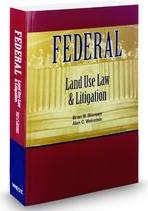
P13513986-160025L I’ve just received my copy of the 2010 revision of Federal Land Use Law & Litigation by Brian W. Blaesser and Alan C. Weinstein (West, $225).

Here’s the description of the book from West’s site:

Examines all federal, constitutional, and statutory limitations on local land use controls, discussing cases, regulations, liability, defense strategies, doctrines, and antitrust restrictions. Comprehensively reviews Supreme Court and lower federal court decisions that consider the constitutionality of land use regulations. Discusses complicated free speech issues affected by federal land use law, and municipalities exercising home rule powers. Examines issues such as: constitutional and statutory limits, First Amendment limitations on land use controls, federal remedies and attorney’s fees, liability and immunity issues, litigation guidelines, zoning, subdivision controls, growth management, model complaints, and selected constitutional and statutory decisions.

Federal Land Use Law & Litigation is an eminently useful single-volume research and reference guide. It’s well-organized, and although it

Continue Reading Book Review: Federal Land Use Law and Litigation, 2010 edition

What we’re reading today – not all of it property or land use law related:


Continue Reading Friday Round-Up: Kagan On Property, RLUIPA, Second Amendment, CEQA, And Title VII (Yes, Title VII)

Here are items we’re reading today, in no particular order:

  • Bill Ward’s thoughts on Klumpp v. City of Avalon, the recent New Jersey Supreme Court case about inverse condemnation and beach restoration. Our take here.


Continue Reading Wednesday Potpourri: Inverse Condemnation And Beaches, Rail Takings, And More “Adult-Oriented” Land Use