


Muchmagnacarta

Here’s the latest in a case we’ve been following which presents an important issue. So much so that we filed an amicus brief in support of the property owner.

In Town of Apex v. Rubin, No. 206PAA21 (Aug. 22, 2025), the North Carolina Supreme Court held that if a taking is determined to be for private benefit and not a public use or purpose, title and right of possession “revest” with the original owner.

The court also held that if, as here, the condemnor had already seized the land and completed construction, a court is not powerless to address it and may order the condemnor to “restore the land to its pre-construction condition. Whoa.

In short, this is an important one that is well worth your review. 

Before we get underway, a note: recall that the North Carolina Constitution does not have a “takings” or “just compensation” clause. Does

Continue Reading NC: If A Taking Is Determined To Lack A Public Use, Title Revests In Private Owner. If Construction Already Taken Place, Restoration Is An Available Remedy

Please add this one to your podcast listening queue: the latest episode of Bound by Oath, produced by John Ross at the Institute for Justice. BBO isn’t a typical podcast, but more of an audio documentary as we have noted before. If you aren’t a subscriber, you really should be. 

This episode focuses on regulatory takings, and the sleight-of-law that governments frequently employ to avoid the merits of takings claims, or perhaps worse yet to avoid paying compensation even after ordered to. Cases detailed include DeVillier, Agins, First English, Violet Dock Port, Ariyan. This episode is a great companion piece to BBO‘s episodes on Euclid (zoning), Pennsylvania Coal (reg takings), and Berman (Public Use). 

Put on your “self-executing” hat and take a listen! 

Here’s the description of the episode:

The Fifth Amendment says that the government must pay just compensation when it takes

Continue Reading Must-Listen Podcast: “Neat Takings Tricks” (Bound by Oath, S3, E3)

What to say about the Colorado Supreme Court’s recent decision in Nonhuman Rights Project v. Cheyenne Mountain Zoo, No. 24SA21 (Jan. 21, 2025), wherein the court resolved the momentous and highly controversial question of whether an elephant is a person?

Our first temptation is to see this through the takings lens (surprise), and snark that courts seem be very willing to consider ridiculous cases like this one, determine whether a monkey owns a “selfie” that he snapped, and rule that bees qualify as “fish” in a statute because the legislature didn’t think to modify the term “invertebrate” in a list of marine invertebrates with the term “marine” — yet it is beneath the dignity of judges to consider cases where — oh, the humanity!they may be called on to be Super Zoning Boards of Appeals.

Our other snarky thought was the outcome of this case

Continue Reading Bees May Be Fish In California, But Here In Colorado, Elephants Ain’t Persons

If you thought the issue of whether it is a Fifth Amendment taking for a state or local government to “keep the change” after satisfying a tax debt was settled by the U.S. Supreme Court in Tyler v. Hennepin County, 598 U.S. 631 (2023), you’d be right.

Then what was there left for the New Jersey Supreme Court to decide in 257-261 20th Avenue Realty, LLC v. Roberto, No. A-29-23 (Jan. 9, 2025)? Some interesting stuff, it turns out.

And before you conclude that this is just piling-on, remember — they wanted this: after Tyler, instead of reading the U.S. Supreme Court’s decision and the writing on the wall, some state and local governments, unhappy with being cut off from a source of easy money, tried to figure ways to avoid or negate the rule that if there’s money left over after you satisfy a tax debt

Continue Reading NJ’s Forfeiture Statute Is A Taking Of Surplus Home Equity

Following up on our recent post about the California Coastal Commission denying permission for Space-X to increase the number of annual launches from Vandenberg, comes this, the other shoe.

The Commission has now been sued, with Space-X alleging that the Commission denied permission due to CEO Elon Musk’s political leanings and his public statements.

I really appreciate the work of the Space Force,” said Commission Chair Caryl Hart. “But here we’re dealing with a company, the head of which has aggressively injected himself into the presidential race and he’s managed a company in a way that was just described by Commissioner Newsom that I find to be very disturbing.”

Here’s the complaint, filed in the U.S. District Court (Central District of California). 

Was the Commission’s denial a product of concern for “wildlife like threatened snowy plovers,” or the Commission members’ dislike of Musk?

Continue Reading Apparently, The “Final Frontier” Isn’t Space, But The California Coastal Zone

The California Coastal Commission has now reached the parody stage.

In the “Star TrekTV shows and movies, Starfleet Headquarters is depicted as being across the Golden Gate from San Francisco, in the Marin Headlands. It’s a longstanding joke among those who know about the regulatory overreach of the California Coastal Commission that — ha, haTrek really is science fiction because the Commission would never allow a development like this in the coastal zone (especially in Marin County). Even in the 23d century. And even for an enterprise as noble as the exploration of space.

Now life is imitating humor: as the Los Angeles Times reports in “California officials reject more SpaceX rocket launches, with some citing Musk’s X posts.” We know that Space X isn’t quite Starfleet, but it is getting pretty close (and this is reality, not some fanciful

Continue Reading You Thought We Were Joking When We Said The California Coastal Commission Would Never Allow Starfleet Headquarters To Be Built

Russell standard

It is worth your time to check out the Pennsylvania Supreme Court (Middle District)’s decision in Wolfe v. Reading Blue Mountain & Northern RR Co. No. J-10A-2024 (Aug. 20, 2024).

The court invalidated an exercise of eminent domain by a railroad, concluding the taking was not for a public purpose because it was intended to keep open a road used to access a single business.

The conflict arose after the property owners exercised their right to close off the railroad’s two easements on which rail siding track and a road crossing had been located. The owners’ predecessor-in-title had obtained the property from the railroad’s precedessor, and the grant contained express reservations of those two easements. The grant also contained a termination provision. which required the railroad to remove the siding within 90 days of the owners’ demand.

The railroad had stopped using the siding and the road crossing in

Continue Reading PA: No Funny Business – It Isn’t A Public Purpose For Railroad To Take Property To Benefit Single Customer

You remember that old adage (or maybe its a cliché?) that “a conservative is a liberal who has been mugged?” Well, here’s your environmentalist analog.

In Echeverria v. Town of Tubridge, No. 23-AP-291 (Aug. 2, 2024), the Vermont Supreme Court held that property owners’ lawsuit asserting their right to prohibit the town from allowing bicycling on hiking trails on their land, and to prohibit it from allowing members of the public onto the property to maintain the trails, is ripe. The owners asserted that as the owners, they alone have the authority “whether and how to maintain the legal trails that cross their property.” Slip op. at 2. Here are the details: the owners assert

sole and exclusive authority to decide whether and how to maintain the legal trails that cross their property. They alleged that the expected entry onto their property by volunteers seeking to exercise

Continue Reading A Property Rights Advocate Is An Environmentalist Who Has Been Overregulated: Anti-Takings Advocate Argues For The Right To Exclude

Just compensation

Just a few posts ago, we put up the Louisiana Supreme Court’s opinion in a case where property owners obtained a final inverse condemnation judgment ordering the New Orleans Sewer Board to pay just compensation.

Then…crickets. The sewer board did not satisfy the judgment. It relied on a provision in the Louisiana Constitution that says that the state and local governments don’t need to pay civil judgments except when they want to.

The Louisiana Supreme Court didn’t see it that way, and held that just compensation is “self executing” and that paying it is a ministerial duty, meaning that no statutory authorization is needed, and mandamus to compel payment is an available remedy for non-payment.

Now, the sewer board has asked the court for a do-over. In its motion for rehearing, it asserts that that earlier federal litigation is res judicata and already resolved the issue (although that

Continue Reading Govt: We Were Really Really Really About To Pay…Until You Forced Us To Pay! Sewer Board Seeks Rehearing In Self-Executing Just Comp Case

Erie
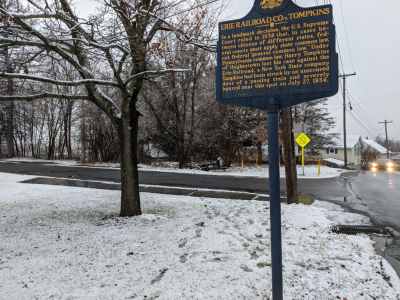
The site of the Erie incident, just a mile away from Mahon’s home.

Here’s an unusual, and kind of interesting one, from a U.S. District Court (Hawaii) in an eminent domain case brought by the County of Maui against the owner of Maui property which is needed for a solid waste disposal site for debris from the recent Maui wildfire.

First unusual point: the owner, a citizen of a state other than Hawaii, removed the case to federal court, asserting diversity jurisdiction. A state eminent domain action in federal court? Don’t see that every day, do you? (The County has not challenged federal court jurisdiction.)

Second unusual point: when the County deposited its estimate of just compensation and sought immediate possession under Hawaii’s eminent domain procedures (Hawaii does not have a true “quick take” procedure, but merely immediate possession where title does not transfer to the condemnor

Continue Reading Federal Court In Removed Eminent Domain Case: Quick-Take/Immediate Possession Is Erie Procedural, So Does Not Apply