2012-02-06_11-19-51_574 (Small)

Here’s the latest in a case (and issue) we’ve been following closely.

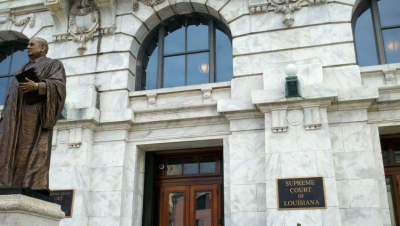
In Watson Memorial Spiritual Temple of Christ v. Korban, No. 24-0055 (June 28, 2024), the Louisiana Supreme Court unanimously affirmed the Court of Appeal, concluding the duty to actually pay just compensation for a taking is ministerial. 

That may not seem like an earth-shattering conclusion. After all, since at least 1987, the U.S. Supreme Court has labeled the Just Compensation Clause as “self-executing” which means that if there’s been a taking, there must be compensation. Must means must. At least that’s what it means to us.

But as readers of this blog know, you can get a final judgment for inverse condemnation from a Louisiana court, but the defendant/taker retains the discretion whether to actually pay it, and the usual judgment-enforcement procedures are not available. That comes from this provision
Continue Reading “A judgment for inverse condemnation, left unsatisfied, does not constitute the payment of just compensation.” Government Has A Ministerial Duty To Pay (And You Know What That Means)

This one isn’t so much a property or property rights opinion, but more “property adjacent” as they say.

Even so, we’re not going to comment much about the Massachusetts Appellate Court’s opinion in Lyman v. Lanser, No. 23-P-73 (Mar. 7, 2024), and not just because it seems faintly ridiculous.

The entire court vacated a single justice’s order vacating a preliminary injunction entered by the trial court which ordered the parties who were apparently locked in deadly combat about a jointly-owned dog named “Teddy Bear Lanser-Lyman.” The trial judge had ordered the parties to share custody of Teddy Bear, as if it were a child or something. Well, you clowns named the dog like a child and probably treat it like a child, so why not fight over it as if it were a child? “Pet parenting” gone too far. 

Read the darn thing. Maybe you will laugh, maybe you

Continue Reading Mass App: You Can Share Custody Of A Dog (Named Teddy Bear)

Euclid_front

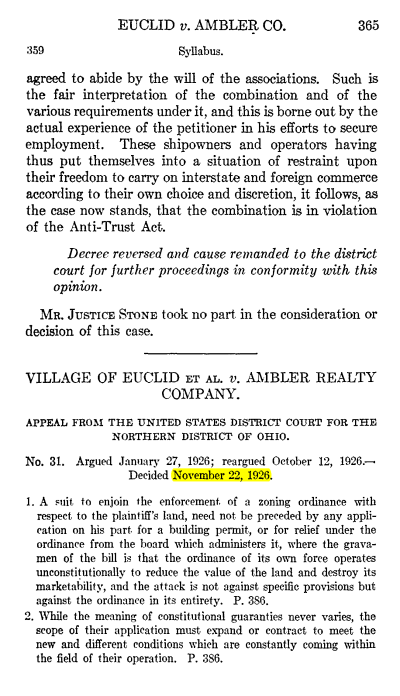
On this day in 1926, the United States Supreme Court issued its landmark opinion in Village of Euclid v. Ambler Realty Co., 272 U.S. 365 (Nov. 22, 1926).

You know this one (shame on you if you don’t!) – it is the case in which the Supreme Court first upheld — against a facial due process challenge — the validity of this thing we call “zoning.” While in the intervening century, zoning has become a catch-all term for regulatory restrictions on the uses of real property, land users know that “zoning” — ackshually — refers only to the regulation and separation of uses, and restrictions on density, and height regulation.

While “Euclid” and “Euclidean zoning” have become part of the land use lexicon and landscape, the decision might have been seen at the time as somewhat surprising. After all, the Supreme Court was in

Continue Reading (Un)Happy 97th Birthday, Euclid!

We don’t often post trial court orders — especially state trial court orders — but read on and you will understand why we made an exception here. Our thanks to an Oregon colleague for sending it our way.

Today’s case involves a pretty typical situation — a condemnor (or, “condemner” — for it is in Oregon that our scene lies) is contemplating taking property from someone, and wants and needs to figure out whether the property it is contemplating is suitable. It needs to get on site and check it out. Do things like surveys, examinations, tests, and sample-taking. Often, the owner of the property doesn’t mind: pay me a bit for my trouble, indemnify me in the event someone gets injured, and you can have limited access to do your business and then go on your way, condemner. 

But sometimes, an owner — as is her right — says

Continue Reading Some Precondemnation Entries Are Takings Requiring An Up-Front Condemnation And Compensation

The topic of the “self-executing” nature of Just Compensation is in the news these days, with the Supreme Court’s agreeing to review Devillier v. Texas.

But we’ve been on that issue for quite a while, and in a recent episode of Clint Schumacher’s Eminent Domain Podcast (if you are not already subscribed, why not?), our Pacific Legal Foundation colleague Deborah La Fetra joins Clint to discuss the issue, including a recent case we did together involving the intersection of property rights and the federal government’s bankruptcy power.

As the program notes note:

Deborah La Fetra of the Pacific Legal Foundation joins us to talk about the case of Financial Oversight and Management Board for Puerto Rico v. Cooperativa de Ahorro y Credito Abraham Rosa, a unique case where the boundaries of just compensation and governmental restructuring collide. Deborah and PLF served as counsel for several of the unpaid

Continue Reading Deb La Fetra Guests On Clint Schumacher’s Eminent Domain Podcast On Self-Executing Just Compensation

We don’t regularly cover unpublished opinions, but the U.S. Court of Appeals for the Fourth Circuit’s Columbia Gas Transmission, LLC v. 0.12 Acres of Land, No. 23-1069 (Oct. 11, 2023) got our attention because it involves a slight twist on the the Supreme Court’s ruling a couple of years ago in PennEast Pipeline Co. v. New Jersey, 131 S.Ct. 2244 (2021).

There, the Court held that a private actor exercising the delegated federal power of eminent domain may take property from a state in a federal court action, notwithstanding the state’s usual Eleventh Amendment immunity. Employing a historical analysis, the Court held that when the states entered the Union they consented to the federal government’s eminent domain power. And the later-adopted Eleventh Amendment didn’t change that.

The caption of the latest case should tell you a couple of things. First, this is also a federal taking (plaintiff vs.

Continue Reading CA4 (unpub): We’re Not Going To Adopt Justice Gorsuch’s Dissent In PennEast And Prohibit A State From Having Its Property Taken In Federal Court

We’re not going to ask you to read the entire 24 pages of the Washington Supreme Court’s 5-4 opinion in Gonzales v. Inslee, No. 1000992-5 (Sep. 28, 2023), in which the court seriatim rejects every challenge to the Governor’s Co-19 emergency eviction moratorium for tenants, which allowed tenants who did not pay rent to remain in occupation for the up to 15 months the moratorium was in place.

Instead, we’re going to focus only on the takings challenge under the Washington Constitution. The plaintiffs asserted a physical takings claim, based on their right to exclude nonpaying tenants. Rejecting the argument (as several other courts have done), the Washington court concluded that the moratorium on evictions was merely regulation of the “voluntary relationship” between an owner and tenant.

Hang on, you say, what do you mean “voluntary relationship?” If I am an owner, yes, I voluntarily handed over the keys

Continue Reading PruneYard Revisited: Washington SCT Says No Physical Occupation Taking In State’s Eviction Ban – You Invited Tenants In, So Forcing Owners To House Them For Free Is Merely Regulating That Voluntary Relationship

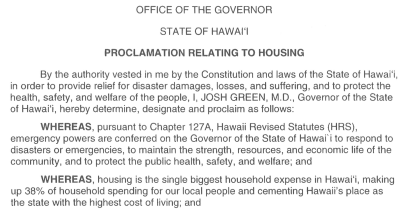
ExecOrder

The two-plus years under the declared Co-19 emergency surely have given Hawaii’s executive-branch officials a clear vision of how much easier they could get their agendas accomplished without all that pesky democracy.

Hawaii’s Sweeping Emergency Management Act: Governor is the “Sole Judge”

Hawaii’s Emergency Management Act gives state and county executives broad and nearly unreviewable authority to suspend a wide spectrum of the usual laws, regulations, and rules. As we wrote in Hoist The Yellow Flag and Spam® Up: The Separation of Powers Limitation on Hawaii’s Emergency Authority, 43 U. Hawaii L. Rev. 71 (2020), Hawaii’s Act confers among the nation’s most muscular and sweeping powers. For example, the governor is the “sole judge of the existence of the danger, threat, or circumstances giving rise to a declaration of a state of emergency.” The Act’s one limitation — the 60-day time limit on how long an

Continue Reading What If The Hawaii Governor’s Cutting Of The Gordian Land Use/Environmental Knot Actually Works?

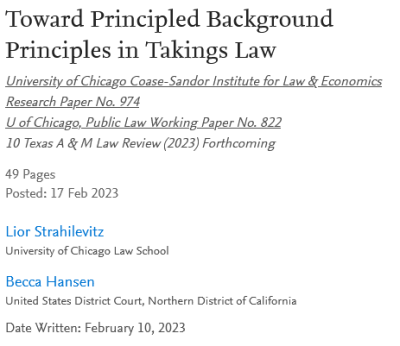
Screenshot 2023-02-23 at 11-13-54 Toward Principled Background Principles in Takings Law

Check this out, a new article co-authored by a federal judge’s law clerk and lawprof Lior Strahilevitz (Chicago). With the title, “Toward Principled Background Principles in Takings Law” are we going to read it? You bet. (Unlike a lot of new scholarship that we post here, we read this one immediately.)

Here’s the Abstract:

Blunders made by lawyers, judges, and scholars have caused the Supreme Court’s recent opinion in Cedar Point Nursery v. Hassid to be deeply misunderstood. In Cedar Point, the Court re-wrote takings law by treating temporary and part-time entries onto private property as per se takings. Prior to Cedar Point these sorts of government-authorized physical entries would have been evaluated under a balancing framework that almost invariably enabled the government to prevail. As it happens, there were two well-established rules of black letter law that California’s lawyers and amici mistakenly failed to invoke in defending

Continue Reading New Article: “Toward Principled Background Principles in Takings Law” (Strahilevitz & Hansen)

Many Honolulu residents don’t like short-term (less than 30 day) rentals. Whether fueled by NIMBY-ism, a genuine belief that tourists should stay out of residents’ neighborhoods and be limited to accommodations built for transients, or the belief that long-term rentals to locals somehow promote more affordable housing, the anti-transient renter vibe is most definitely there.

The no-less-than-thirty-days restriction wasn’t enough, however, and recently the City and County of Honolulu made it illegal to rent for less than three months (90 days). The ordinance stated the reasons:

Short-term rentals are disruptive to the character and fabric of our residential neighborhoods; they are inconsistent with the land uses that are intended for our residential zoned areas and increase the price of housing for O‘ahu’s resident population by removing housing stock from the for-sale and long-term rental markets. The City Council finds that any economic benefits of opening up our residential areas

Continue Reading Federal Court: Honolulu’s 3-Month Minimum Rental Term Preempted By State Law (And Would Be A Taking Of Vested Rights)