


The complete agenda and faculty list has now been posted on the ALI-CLE website, and early registration is open! Go now and reserve your spot. 

We paid a visit to Charleston recently, the venue for our January 2018 conference, to scout it out. We can report that we’re going to have a great time, for sure. When we polled you last year, you selected Charleston as your first choice (a new city for the Conference), and it is shaping up to be a very good selection. In addition to the usual lineup of CLE programming, there are a ton of things to see and do in the area. We recorded a short video down at the “four corners of law” (the intersection of Meeting Street and Broad Street), to give you a preview (the weather was much better than in our 2016 preview video, too).

As an added

Continue Reading 2018 ALI-CLE Eminent Domain Conference – Agenda And Faculty Now Posted
This just in: the Hawaii Supreme Court has rendered a unanimous opinion in Leone v. County of Maui, No. SCAP-15-599 (Oct. 16, 2017), a case we’ve naturally been following because it involves regulatory takings (and we were involved in a similar case on a neighboring property). 

We haven’t had a chance to review the 48-page opinion in detail (once we do so, we will post a more detailed review), but the issue the court was presented with was, as we noted here, whether leaving land in its vacant state court be considered an economically beneficial use. Short story is that the court held yes, it could, thus seeming to create a lower court split (hello, cert petition) with at least one other court, the Federal Circuit in Lost Tree, concluding that economically beneficial use means more than someone might buy it down the road. 

There’s

Continue Reading Conflict Check: Hawaii Adds To Lower Court Regulatory Takings Split: Is Leaving Land Vacant On The Hope It Is Worth More In The Future “Economically Beneficial Use”?

ALI-CLE2018

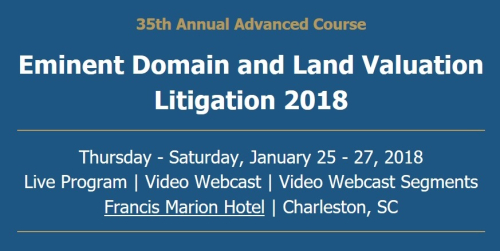
It’s not too early to reserve your spot at the 35th Annual ALI-CLE Eminent Domain and Land Valuation Litigation Conference, to be held at the Francis Marion Hotel in historic downtown Charleston, South Carolina, January 25-27, 2018. 

We’re finalizing the Conference details, but can report that the program will, as usual, feature expert presenters from across the nation, and both an in-depth update on the subjects we love, and a “101” track for those new to the field or who would appreciate a refresher. Check out some of the topics:

  • Takings and Damaging by Flood: Case Selection Advice For Savvy Practitioners
  • Quarterbacking the Case: Blocking Defenses, Controlling the Witnesses, and Converting for Verdicts
  • We’ve Been Working on the Railroad: Utility Crossing Disputes
  • Protecting Your Record,and Anticipating Appeals
  • Lucas 25 Years Later: Property Rights in the Age of Global Warming
  • Building and Growing Your Eminent Domain Practice With


Continue Reading 2018 ALI-CLE Eminent Domain Conference: Early-Bird Registration Discount Now Posted

We get that chicken and egg vibe from the California Court of Appeal’s opinion in Surfrider Foundation v. Martins Beach 1, LLC, No. A144268 (Aug. 9, 2017), a case that has been in the hopper for a while, but due to this-and-that we haven’t gotten around to posting about until now.

Our procrastination has allowed our colleagues at the California Eminent Domain Report to beat us to the punch with trenchant analysis, and Brad Kuhn has posted “Court Holds Temporary Injunction on Martins Beach Access Dispute Does Not Constitute a Taking.”

We say “chicken and egg” because the question in the case

Surfrider Foundation v. Martins Beach 1, LLC, No. A144268 (Cal. App. Aug. 9, 2017) 

Continue Reading Cal App: Temporarily Forcing Public Access To Private Property Isn’t A Taking

We’ve been offline lately, hanging out at the ABA Annual Meeting in New York, so haven’t had time to post, even though there is a lot to post about.

Thankfully, our colleague Brad Kuhn at the California Eminent Domain Report is on the ball, and has written up his thoughts about the California Court of Appeal’s decision in the case involving a Silicon Valley billionaire, surfers, beach access, and … California. 

We will have some thoughts once we find the time to sit down and write them up, but in the meantime, please read Brad’s thoughts on the case at “Court Holds Temporary Injunction on Martins Beach Access Dispute Does Not Constitute a Taking.”

More shortly. Continue Reading Cal Eminent Domain Report On The Strange “Martins Beach” Decision

Here’s the Brief in Opposition in Nies v. Town of Emerald Isle, No. 16-1305 (Aug. 11, 2017), the case in which North Carolina property owners are asking the U.S. Supreme Court (cert petition here) to review a N.C. Court of Appeals decision which involves wet and dry sand beaches, the location of the public trust boundary, and other favorite topics.

The case arose because the N.C. Legislature by statute moved the public trust” shoreline landward, and allowed the public to use what had formerly been private beach.  We filed an amicus brief in the case, supporting the property owners. 

We’ll also post the reply brief when it is filed. Stay tuned. 

Brief in Opposition, Nies v. Town of Emerald Isle, No. 16-1305 (Aug. 11, 2017) 

Continue Reading Brief In Opposition In Public Trust Takings Case

Load this one up for your morning drive, or workout: the Federalist Society’s podcast on “Lucas v. South Carolina Coastal Council at 25.” Featuring Professor Eric Claeys, Professor Michael Wolf, and Pacific Legal Foundation’s James Burling. Well worth your time.

Here’s the description:

This spring marks the 25th anniversary of the U.S. Supreme Court’s decision in Lucas v. South Carolina Coastal Council. In Lucas, a 5-4 Court majority held that a state law can effect a “regulatory taking” and trigger inverse condemnation requirements if it deprives an owner of all viable uses of his land. Join our panel to hear a discussion of questions such as: Did Lucas mark a major change in Supreme Court regulatory takings doctrine? Was the decision about right, or did it go too far or not far enough? Is Lucas still relevant to regulatory takings law today, and what are the

Continue Reading A Quarter-Century Of Lucas: What’s Next?

Winter storms damaged a seawall which protected a blufftop, oceanfront home. The owners, not surprisingly, wanted to rebuild the wall to protect their home. The Coastal Commission, as is its wont, saw this as an opportunity to extract some goodies from the owners. So it granted a limited-term permit to rebuild the wall, conditioned on the owners not repairing a stairway leading from the top of the bluff to the private beach:

Ultimately, the Commission approved a coastal development permit allowing seawall demolition and reconstruction, with the addition of midbluff geogrid protection below Lynch‟s home. The permit was subject to several conditions, three of which are at issue here. Special condition No. 1(a) prohibits reconstruction of the lower stairway. Special condition No. 2 provides that the seawall permit will expire in 20 years and prohibits future blufftop redevelopment from relying on the seawall as a source of geologic stability or

Continue Reading California Supreme Court: Accept The Exaction, Or Let Your Home Fall Into The Sea – Your Choice

Here are links to the cases and materials we spoke about today during our portions of the APA’s 2017 Planning Law Review webinar:


Continue Reading Cases And Links From Today’s American Planning Association’s 2017 Planning Law Review

Here’s the amici curiae brief we filed today on behalf of Owners’ Counsel of America, NFIB Small Business Legal Center, Cato Institute, and Professor David Callies in support of a cert petition which we detailed here.

The case is a regulatory takings claim, and involves wet and dry sand beaches, public trust, and other favorite topics. The case arose because the N.C. Legislature by statute moved the “public trust” shoreline landward, and allowed the public to use what had formerly been private beach.  

Here’s the Summary of Argument from our brief:

The North Carolina Court of Appeals permitted the Town of Emerald Isle (Town) to impress into public service the portion of the Nies family’s property above the mean high water mark as a road and park. North Carolina law has never subjected this dry sand to public ownership, through the public trust doctrine or otherwise.

Continue Reading SCOTUS Amicus Brief: States May Be Able To Rewrite Property Law, But They Can’t Avoid Paying For The Change