
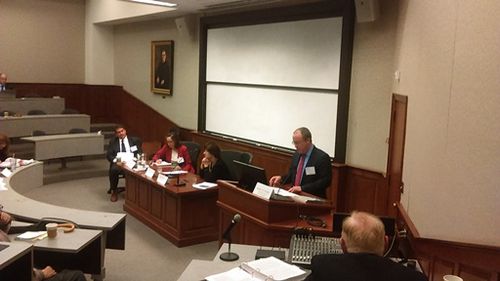
text above photo*
————–
*photo courtesy of Joe Sherman (thanks, Joe). Continue Reading Brigham-Kanner Property Rights Conference Wrap-Up


text above photo*
————–
*photo courtesy of Joe Sherman (thanks, Joe). Continue Reading Brigham-Kanner Property Rights Conference Wrap-Up
Followers of the blog understand that in addition to our usual fare of eminent domain, land use, regulatory takings and the like, we also cover another area, election law and voting rights. That’s a weird feature of our practice, so we post about it. Call it “editor’s prerogative” or something.
But there are actually some areas of crossover, or at least a few places where those who practice in one can learn from the other. Continue Reading “One-Person, One-Vote,” Regulatory Takings, And Why You Can’t Rely On The Supreme Court’s Words Alone
I’ve put off posting this for a while, but it now feels like the right time.
Back in May, Chuck Hurd — an old mentor and colleague — passed away. When I was fresh out of law school, Chuck (known as “CHH” to us in the firm) was one of the first experienced lawyers to take me under his wing and offer the guidance that was sorely needed as I flailed about in court and on paper. His mentoring and friendship was one of the primary reasons I joined my firm. He was at the time a “courtroom warrior,” but as his obituary notes, he evolved to “peacemaker,” and devoted his energies to resolving problems as a mediator.
Although eventually he departed the firm to set up his own shop, we kept in touch over the years. To my regret, not as formally as we should have, but when we’d see each
Every year at around this time, we note the anniversary of the blog. Our first post was back in August 2006, which means that we have nine years of this under our belt. In blog years, that’s apparently a lot.
It’s a gas to think about our favorite topics, and write up my thoughts about them. But the best part of this enterprise is the people whom I have met over the years as a result. So I’d like to recognize those who send in items, who make comments, and who gently prod with suggestions.
I’d also like to hail my fellow law bloggers who, like me, make the time to share thoughts about the legal issues of the day. Although you’re not quite “Real Men [and Women] of Genius,” today we salute you, Mr. Law Blog Blogging Guy (and Gals):
We reported on the California Supreme Court’s unanimous opinion in California Building Industry Ass’n v. City of San Jose, No. S212072 (Cal. June 15, 2015) on the day it was issued, and we also spoke about the case at a recent session sponsored by the International Municipal Lawyers Association.
But we’ve never done a more in-depth write up of the case, or gone into any detail about why the court ruled the way it did. Continue Reading California Supreme Court Knows The Way To San Jose, But Does It Know The Way To Sacramento?
From time-to-time, we cover non-land use, non-takings stuff that interests us, like election law. The biggest case the Supreme Court has considered in perhaps decades in that area is now being briefed, and the appellants have filed their brief on the merits.
Brief for Appellants, Evenwel v. Abbott, No. 14-940 (July 31, 2015)
Continue Reading First Brief In “Who Gets Counted” SCOTUS Case
Hawaii Business magazine has a new report about Honolulu rail whose headline asks, “How Much Will it Cost?”Continue Reading “How Much Will Rail Cost Us In the End?” Asks Hawaii Business Magazine. Our Answer: As Much As It Takes
Nobody’s perfect, as much as we may want them to be. Least of all fictional characters. But Atticus Finch, the Alabama lawyer portrayed in the novel “To Kill a Mockingbird” and the celebrated film, seemed above reproach.
The first year we sponsored the Law in Film festival, we had to feature “To Kill a Mockingbird,” because, as our colleague Mark Murakami wrote in his review of the film, “[s]tanding alone against a lynch mob armed only with words and his abiding morality, Atticus represents what author Scott Turow calls the ‘paragon’ of lawyer morality: a champion willing to make a stand even if his client, as an African-American accused of raping a white woman, is the most reviled man in their rural Deep South community.”
The book is loved equally, if not more than the film.
Well, get ready. The New York Times reports in its