On February 25, 2010, from 1:30 – 3:30 p.m. Eastern (12:30 CT, 11:30 a.m. MT, 10:30 PT, and 8:30 HST), my colleague and law partner Mark Murakami will be moderating a teleconference sponsored by the ABA Section of State and Local Government Law and the ABA Center for Continuing Legal Education: Beyond Gun Control: McDonald v. City of Chicago and Incorporation of the Bill of Rights.

In March 2010, the U.S. Supreme Court is scheduled to hear arguments in McDonald v. City of Chicago,a case asking whether the Fourteenth Amendment’s Privileges orImmunities Clause or the Due Process Clause makes the Second Amendmentapplicable to the states and local governments. It is shaping up to beone of the most important cases of the court’s term and it could usherin a new era in constitutional jurisprudence.

Thecase is a challenge to a Chicago ordinance prohibiting possession ofhandguns in the home, but the

Continue Reading Mark Your Calendars 2/25/2010: ABA CLE On McDonald Case

Yet another year has comeand gone — our blog’s fourth — so it’s time for ourannual summary of the past year’s highlights in land use law and other topics we cover.

Like 2008, it was mostly a year of infill and incrementaldoctrinal shifts, with a couple of sea changes thrown in forexcitement: the Ninth Circuit finally ditched Armendariz andrecognized the validity of substantive due process in land use cases;the Hawaii Supreme Court came out strongly in favor of property owner’srights in eminent domain proceedings, holding that courts should notsimply take the government’s word that a taking is for public use, andrequiring the government to bear the economic burden when its attemptsto take property fail; the Hawaii intermediate appellate court heldthat there is no private right of action under the state land use laws.

It was also a year in which certain issues kept coming back: Williamson Countyripeness (the trending

Continue Reading 2009 Land Use In Review

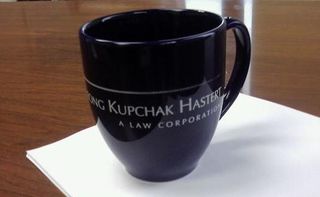
Forthose of you stuck in the office today, our annual Christmas Eve contest: I’ll send to thefirst three people who email me today their very own “limited edition”of my firm’s extra-large, cobalt blue coffee mug, shownbelow.

(Don’t forget to include your name and postal address in your email.)

A happy and safe holiday to all.

12190814351219081435a

Continue Reading Office Swag Contest Part III

Trying to stop a taking of your property? You may have options in addition to a “public use” challenge, as was recently noted here. In this video, Albany Law School’s Amy Lavine details a potential problem with the bonds for the Atlantic Yards project in Brooklyn, which is the subject of a multi-jurisdictional eminent domain brawl between property owners and neighborhood residents on one side, and a private developers and the redevelopment authority on the other. The New York Court of Appeals recently ruled against the property owners on their claim their properties are not blighted, but this latest question may put the kibosh on the project. Don’t win on public use? Go for the financing.

More on the issue here, from Atlantic Yards Report. For a broad critique of “economic development” takings, including Kelo and Atlantic Yards, see Eminent Domain Abuse: The Gifts That Keep On Giving

Continue Reading Yet Another Way To Battle Eminent Domain…

This is the live blog of the Hawaii Supreme Court oral arguments in Unite Here! Local 5 v. City and County of Honolulu, the case in which the IntermediateCourt of Appeals held that unless the project changes, a supplementalEIS is not required under the Hawaii Environmental Policy Act, Haw.Rev. Stat. ch. 343.

The recording of the oral argument is available here. Or stream it below and follow along with the live blog archive:

More about the issues here, and our summary of the arguments in the briefs here.
Continue Reading Live Blog Of Turtle Bay/Kuilima EIS Case: Is A Change In “Context,” But Not The Project, Enough To Trigger Supplemental EIS?

Givings

Yesterday’s Tom Toles web only sketch from the Washington Post certainly captures one of the arguments made by Florida in Stop the Beach Renourishment, Inc. v. Florida Dep’t of Environmental Protection,No. 08-11 (cert. granted. June 15, 2009, the appeal heard last week by the U.S. Supreme Court.

The argument overlooks the fact that the littoral owners never wanted the “renourishment” and argued it wasn’t really necessary, and that in oral argument, most of the Justices indicated that any benefit to the littoral property should be taken into account in determining compensation and not liability. But the sketch brought a smile to our faces, nonetheless.Continue Reading The Fifth Amendment’s Givings Clause?

Tuckitaway Since the U.S. Supreme Court’s decision in Kelo v. City of New London, 545 U.S. 469 (2005), the focus in public use challenges to exercises of the eminent domain power has largely focused on state courts and state constitutional protections. 

The Kelo majority held that the Fifth Amendment was a “baseline,” and established a standard for reviewing takings below which no state law could go:

We emphasize that nothing in our opinion precludes any State fromplacing further restrictions on its exercise of the takings power.Indeed, many States already impose “public use” requirements that arestricter than the federal baseline. Some of these requirements havebeen established as a matter of state constitutional law, whileothers are expressed in state eminent domain statutes that carefullylimit the grounds upon which takings may be exercised. As thesubmissions of the parties and their amici make clear, the necessityand wisdom of using eminent domain to promote economic

Continue Reading Kelo, Pretext, And Blight In Eminent Domain: NY Appellate Division Unravels The Skein

In “Beach ownership is still in question,” the Honolulu Star-Bulletin reports on Maunalua Bay Beach Ohana 28 v. State of Hawaii, No. 28175, the appeal currently pending in the Hawaii Intermediate Court of Appeals about whether Hawaii’s “Act 73” effected a taking of property. Thanks to Charley Foster at Planet Kauai for the heads-up on the report.

[Disclosure: we filed an amicus brief supporting the property owners, available here.]

The issue in the case is whether the state, or littoral landowners, are entitled toownership of certain accreted lands. In Act 73, (codifed here and here)the legislature declared that shoreline land naturally accreted belongsto the State of Hawaii and is public property.

The act overturned theage-old rule of shorelineaccretion and erosion, which held that beachfront owners lose ownershipof land when it erodes, but gain it when it accretes. Instead of thesebalanced rules, Act 73 made the

Continue Reading Hawaii Beach Takings Case In The News

Here are the latest blogs we’ve added to our list:

  • California Appellate Report – Focuses on California state courts of appeals decisions and those from the Ninth Circuit. Always an entertaining and informative read.

Continue Reading Latest Additions To The Blogroll