


Well, it’s alright, even if you’re old and grey.
Well, it’s alright, you still got something to say.
Well, it’s alright, remember to live and let live.
Well, it’s alright, the best you can do is forgive.Continue Reading We’re Going To End Of The Line
No, I Am Your Father (Christmas)
An inversecondemnation.com holiday tradition, updated.
Happy Holidays, everyone.Continue Reading No, I Am Your Father (Christmas)
Utah Clarifies When A Taking Claim Accrues
John Pinder was a bad dude. He “was convicted on eleven felony counts in connection with the murders” of two people. State v. Pinder, 114 P.3d 551 (Utah 2005). His mom and dad were not accused, but their property was seized by the state as part of its investigation of their son, and although some of it was used as evidence against him, some of it wasn’t.
But either way, that property was never returned:
Over the years, government officials gave several reasons for not returning the property. For example, they said that: (1) they needed the seized property for John Pinder‘s ―ongoing criminal case‖; (2) the seized property belonged to John—not to Robert and Virginia; (3) prosecutors needed the seized property in case ―additional charges [were] brought against John Pinder, based upon investigations . . . on cold cases; and (4) prosecutors needed it in case John Pinder
The Real “Prime Directive” – Happy Constitution Day
[Barista’s note: is it any coincidence that Constitution Day is just one day — a single day! — before National Cheeseburger Day? Two awesome days in a row a coincidence? We think not.]
On the day we celebrate Constitution Day (or should we say Khaaaaan-stitution Day?) we have to admit that pretty much nothing beats One Named Kirk’s reading of the Preamble.
KIRK: This was not written for chiefs.Hear me! Hear this! Among my people, we carry many such words as this from many lands, many worlds. Many are equally good and are as well respected, but wherever we have gone, no words have said this thing of importance in quite this way. Look at these three words written larger than the rest, with a special pride never written before or since. Tall words proudly saying We the People. That which you call “Ee’d Plebnista” was
Continue Reading The Real “Prime Directive” – Happy Constitution Day
Two Takings Cases On SCOTUS’s Sept 29 Conference

Australian (Torrens) Title, “Dunny Lanes,” And Adverse Possession
Today’s case, Hardy v. Sidoti, [2020] NSWSC 1057 (Aug. 12, 2020) is — like yesterday’s — from a foreign jurisdiction, but this one (unlike yesterday’s) is not an eminent domain case. It’s just plain old property law. Adverse possession to be precise.
But because the court’s official summary puts it this way, we could not resist posting it here. It’s just so… Australian:
These proceedings concern two very Australian phenomena: the “dunny” and dedication to home improvement. At issue is the ownership of a 3.35 square metre remnant of a “dunny lane” in Redfern, a suburb of historic significance for First Australians and in the development of Sydney as a city.
Slip op. at 1. All that’s missing is a Hills Hoist clothesline out back.
First, some terminology. A “dunny” is what we in the U.S. would call an outhouse. A “dunny lane” is a path where
Continue Reading Australian (Torrens) Title, “Dunny Lanes,” And Adverse Possession
Gibson v. The Steamer Madras, 5 Haw. 109 (1884)
Supreme Court of the Kingdom of Hawai‘i
M. GIBSON, PRESIDENT BOARD OF HEALTH,
v.
THE STEAMER MADRAS.
JANUARY TERM, 1884.
February 26, 1884.
APPEAL FROM DECISION OF JUDD, C. J., IN ADMIRALTY.
JUDD, C. J., MCCULLY and AUSTIN, JJ.
OPINION OF THE CHIEF JUSTICE.
The decision of the Chief Justice, appealed from, was as follows:
This is a libel in admiralty by the President of the Board of Health of the Hawaiian Kingdom against the steamer Madras, whereof W. H. Bradley is master, filed on the 12th of June. Attachment was made on the same day. On the filing of a bond, deemed sufficient by the libellant, the vessel was released from attachment.
The libel recites, in substance, that the steamship Madras arrived at the port of Honolulu on the 8th of April, 1883, upon a voyage from Hongkong, in China, with 745 Chinese passengers, of whom 600, more
Continue Reading Gibson v. The Steamer Madras, 5 Haw. 109 (1884)
Aloha, Bill Wade Ph.D.
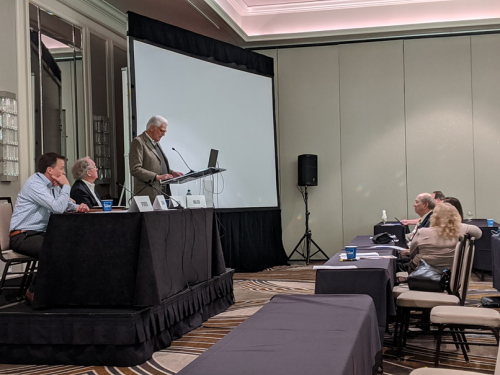
This is a post I wish I didn’t have to write. But I’ve just been informed that our friend and colleague, William W. Wade, Ph.D., died earlier this week.
I know many of you, like me, have known Bill for a long time. He was an economist, and not a lawyer, but he spoke our language (often in more clear terms than we do). A frequent speaker (that’s Bill above, speaking recently to the ALI-CLE Eminent Domain Conference in Nashville in January), thinker, author (here’s a recent guest post by Bill), and expert witness in takings cases, Bill knew his stuff.
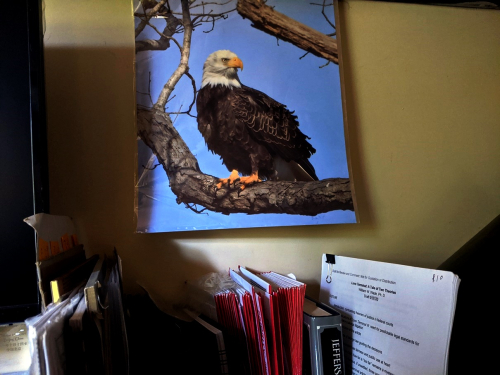
But to me, Bill was more than just a colleague and frequent correspondent, but also a friend and kindred spirit. Of course I treasured our conversations about our work in the law and economics, but more importantly, he always struck me as a kind soul.
Think Tech Hawaii (Jay Fidell)’s Interview With HAWSCT Chief Justice
This is mostly for our 808 sisters and brothers, but the rest of you might also find it interesting as well, because it is a Chief Justice of a state supreme court talking directly (to a lawyer-interviewer) about the measures which the third branch of state government is undertaking during lockdown.
Chief Justice Mark Rectenwald interviewed by Jay Fidell on Think Tech Hawaii. Continue Reading Think Tech Hawaii (Jay Fidell)’s Interview With HAWSCT Chief Justice
New Book: Stringfellow Acid Pits – The Toxic and Legal Legacy
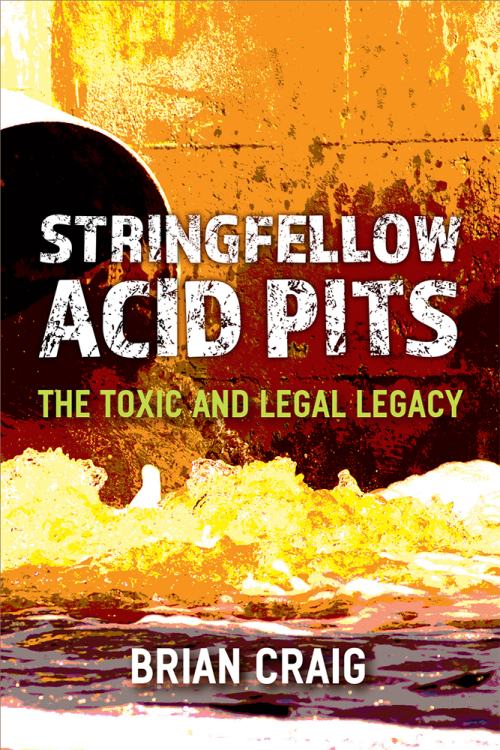
More information, including how to get your copy here.
Here’s the description:
Stringfellow Acid Pits tells the story of one of the most toxic places in the United States, and of an epic legal battle waged to clean up the site and hold those responsible accountable. In 1955, California officials approached rock quarry owner James Stringfellow about using his land in Riverside County, east of Los Angeles, as a hazardous dump site. Officials claimed it was a natural waste disposal site because of the impermeable rocks that underlay the surface. They were gravely mistaken. Over 33 million gallons of industrial chemicals from more than a dozen of the nation’s most prominent companies poured into the site’s unlined ponds. In the 1960s and 1970s, heavy rains forced surges of chemical-laden water into Pyrite Creek and the nearby town of Glen Avon. Children played in the froth, making fake beards with
Continue Reading New Book: Stringfellow Acid Pits – The Toxic and Legal Legacy