


Page

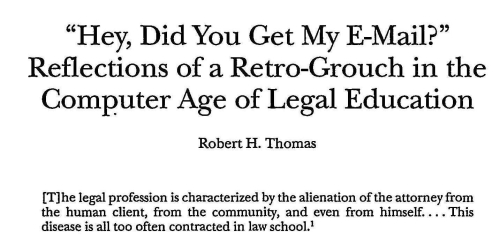
All the law schools moving from in-person to “remote” instruction got us to remembering that way back in the day, in the early days of the internet and email (1995, so really way back*), we wrote an essay in the Journal of Legal Education about the potential effects — good and bad — that might come from teaching-by-technology.

Thinking it would be interesting to see how antiquated it might now appear, we dusted off our copy. 

So here it is. We’ll leave it to you to determine for yourself whether it holds up.  

——————–

*The article is so old, it had to define “e-mail” for the reader. 

“Hey, Did You Get My E-Mail?” Reflections of a Retro-Grouch in the Computer Age of Legal Education, 44 J. L… 

Continue Reading Dusting Off An Old(er) Law Teaching And Tech Article
Here’s the latest in a case we’ve been following.

No. 52 Maryland Reclamation Associates, Inc. v. Harford County, Maryland

Issues – Constitutional Law – 1) Does a takings claim under the Maryland Constitution accrue at the time of a stayed administrative decision or at the time of a final judicial decision affirming that result? 2) May a regulatory taking become permanent and stabilized before a court of proper jurisdiction determines the validity of the regulation effecting the taking? 3) Should Petitioner’s takings claim be dismissed based on Petitioner’s failure to raise this constitutional issue in any administrative proceeding? 4) Did the decision of the Harford County Board of Appeals prohibiting a proposed use of Petitioner’s land to protect the public constitute a taking for which compensation is due? 5) Does the jury’s damages award as compensation for an unconstitutional taking contravene Maryland law when the damages are not the fair

Continue Reading Upcoming Arguments In Maryland Takings Case – 10am ET, Tuesday, March 10, 2020

A group of property owners acquired several parcels in the Windsor, Ontario (Canada) area over the years, “with the aim of developing the lots for residential purposes.”

The city had other ideas: it wanted the area for a “natural heritage area known as the Spring Garden Complex.” The property owners believed they were entitled to more for the parcels than the city offered, so the city instituted expropriation actions. After some up-and-down in the appeal chain, 

applying the concept which we further south call the “project rule,” the Appeal Tribunal concluded that its task was to determine the value of the expropriated property in the absence of the expropriation. See slip op. at 5 (“The Tribunals’ responsiblity in this case is to assess what impact, if any, the requirements of the PPS would have on the market value of Claimants’ lands if the impacts of the scheme are screened

Continue Reading Highest And Best Use And The Project Rule, Canadian Style

We’re not 100% certain of what the issues are in Landowners United Advocacy v. Cordova, No. 19-1126, a case argued in the U.S. Court of Appeals for the Tenth Circuit yesterday. 

But from what we can gather from listening between the lines to the OA recording (and reviewing some of the District Court documents here), the case is a federal court takings challenge to something the State of Colorado did, and whether the U.S. Supreme Court’s decision in Knick v. Township of Scott, 139 S. Ct. 2162 (2019) limited the impact of the federal Tax Anti-Injunction Act, and whether that statute means the plaintiffs here cannot challenge Colorado in federal court, but must proceed in state court. A similar issue was addressed by the Fifth Circuit recently, in the context of the Eleventh Amendment.

Was the majority in Knick telling us that the self-executing nature

Continue Reading CA10 Oral Argument: “I am a takings law nerd, and I’m going to do my best today to not geek out as I did when the Knick decision came down.”

On the day we celebrate Constitution Day (or should we say Khaaaaan-stitution Day?) we have to admit that pretty much nothing beats One Named Kirk’s reading of the Preamble

He might be from Iowa, but that guy who plays him is from north of the border, so our kudos to a Canadian for the best dramatic rendition of our founding document.

“This was not written for chiefs!” 

Beam me down, Scotty!

Continue Reading “This Was Not Written For Chiefs!” Happy Constitution Day

Every year at this time, it seems, we’re realizing again that as you get older, you forget birthdays. Thus, it only occurred to us only over this past weekend that that this blog’s “birthday” passed without notice.

It hardly seems like thirteen years ago that we posted here for the first time. In law blog years, that’s quite a while.

Because doing this in a vacuum would not be worthwhile, we’d like to recognize those who send us items, who make comments, who gently prod with suggestions.

We’d also like to hail our fellow law bloggers who, like us, make the time to share thoughts about the legal issues of the day. Although you’re not quite “Real Men [and Women] of Genius,” today we salute you, Mr. and Ms. Law Blog Blogging Bloggers:


Continue Reading Entering Our Fourteenth Year