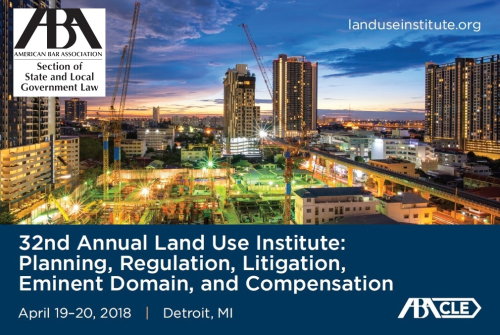
Space is filling up, but there’s still time to join us later this month in Detroit for the 32nd Annual Land Use Institute (April-19-20). 

We’ll let program Planning Chair Frank Schnidman explain all the reasons why, and we’ll add only these points: (1) it’s a very good program that won’t take much of your time (fly in for the Thursday afternoon program, stay a night, fly home on Friday evening); (2) Detroit is the place to be these days; and (3) it’s one of the best deals in CLE credits, with tuition as low as $400.

2018 Land Use Institute Brochure Detroit 5 2018

Continue Reading There’s Still Time To Join Us In Detroit: 32d Annual Land Use Institute
ZPLR front page

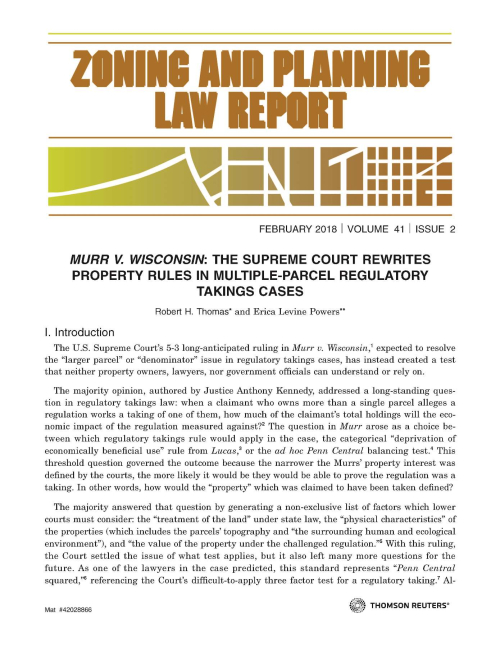
Here’s an article (“Murr v. Wisconsin: The Supreme Court Rewrites Property Rules in Multiple-Parcel Regulatory Takings Cases“), which we authored along with a colleague, published in February 2018’s Zoning and Planning Law Report, about the U.S. Supreme Court’s decision in Murr v. Wisconsin, the case about the “larger parcel” in regulatory takings.

As you might predict, we concluded that the Murr majority’s analysis was vague, unsatisfying, and generally not helpful. Strong letter to follow!

Here’s a passage from the Introduction:

The U.S. Supreme Court’s 5-3 long-anticipated ruling in Murr v. Wisconsin, expected to resolve the “larger parcel” or “denominator” issue in regulatory takings cases, has instead created a test that neither property owners, lawyers, nor government officials can understand or rely on.

The majority opinion, authored by Justice Anthony Kennedy, addressed a long-standing question in regulatory takings law: when a claimant who owns more

Continue Reading New Article: Murr And Other “Blurred Lines”

2018 LUI header Detroit-1

Mark your calendars, plan to come: Detroit, April 19-20, 2018. For what is perhaps the best deal in CLE (tuition as low as $400), the 32d Annual Land Use Institute, sponsored by our section of the ABA, the Section of State and Local Government Law.

The venue is the Detroit Mercy School of Law, and the conference hotel is the historic Westin Book Cadillac in downtown Detroit. The Land Use Institute is being held in conjunction with the Section’s Spring State and Local Law Conference. Register for one conference, and you are free to move between sessions (no additional registration fees).

Planning Chairs Frank Schnidman and Dean Patrica Salkin have assembled an excellent faculty and program for the two days. Topics include: “Nuts and Bolts of Land Use Practice: Vested Rights and Regulatory Takings,” “Public-Private Partnerships,” “Climate Change and Resilient Development,” “Client

Continue Reading 32nd Annual Land Use Institute: Detroit, April 19-20, 2018

Update: thanks to Daniel Lehmann for keying us in to this case, now being reviewed by the Supreme Court, involving the foundational question of whether title to Equal Footing Doctrine submerged lands is a question of state or federal law. Scheduled for the Court’s 2/16/2018 conference.

* * * *

In our experience, rationality often takes a second chair when delving into the question of who may own various parts of beaches. It’s certainly true in our home jurisdiction, where any claims to private rights anywhere near a beach can be met with howls of protest, regardless of what the law might actually provide in any given circumstance. Trying to unwrap these cases can be an exercise in frustration, and if you don’t understand the background and politics — the “real story” — you can’t really say you understand a decision.

That is what we’re wondering about the

Continue Reading Indiana: Equal Footing Doctrine Means Public Owns Up To The Ordinary High Water Mark

20170814_152652_Richtone(HDR)

At first, you might not pay much attention to it. After all, it doesn’t really stick out — elevated rail lines aren’t that unusual in a big city. Street-level trains and pedestrians don’t mix well, and in the early 20th Century, New York State adopted a law which moved some of the lines above the street. Indeed, some portions of New York’s subway are still above grade, especially once you are out in the boroughs.

These elevated routes, like many rail lines, were not constructed on land the railroad owned in fee. Instead, the owners of the land granted an easement to the rail lines to use the land “for railroad purposes.” Which meant that the grant of easement remained only as long as the easement holder used the land for a railroad or related purposes. Again, nothing out of the ordinary there.

But then you remember that Manhattan’s

Continue Reading New York City Uncompensated Takings Pilgrimage, High Line Edition

20170918_171435_Richtone(HDR)

If case you were thinking you might have missed a big property case that made its way to the Supreme Court, fear not. All of the above issues were raised in the course of yesterday’s arguments in a patent case.

As the transcript in Oil States Energy Services, LLC v. Greene’s Energy Group, LLC, reveals, the issue in that case is whether the Patent and Trademark Office’s Patent Trial and Appeal Board is unconstitutional because it can deprive a patent holder of its rights without the benefit of adjudication in an Article III court. A patent is property (yes, it is a creature of statute, and not a common law right, but it is property), and the owners of patents can’t be deprived of their property except in an Article III court. Or so the Petitioner’s argument goes.

If that issue sounds familiar, it is. In Brott v. United

Continue Reading Supremes Consider Unconstitutional Conditions, Vested Rights, And Property … In A Patent Case

The complete agenda and faculty list has now been posted on the ALI-CLE website, and early registration is open! Go now and reserve your spot. 

We paid a visit to Charleston recently, the venue for our January 2018 conference, to scout it out. We can report that we’re going to have a great time, for sure. When we polled you last year, you selected Charleston as your first choice (a new city for the Conference), and it is shaping up to be a very good selection. In addition to the usual lineup of CLE programming, there are a ton of things to see and do in the area. We recorded a short video down at the “four corners of law” (the intersection of Meeting Street and Broad Street), to give you a preview (the weather was much better than in our 2016 preview video, too).

As an added

Continue Reading 2018 ALI-CLE Eminent Domain Conference – Agenda And Faculty Now Posted

Chair Reception SLG 8-11-2017 invitation

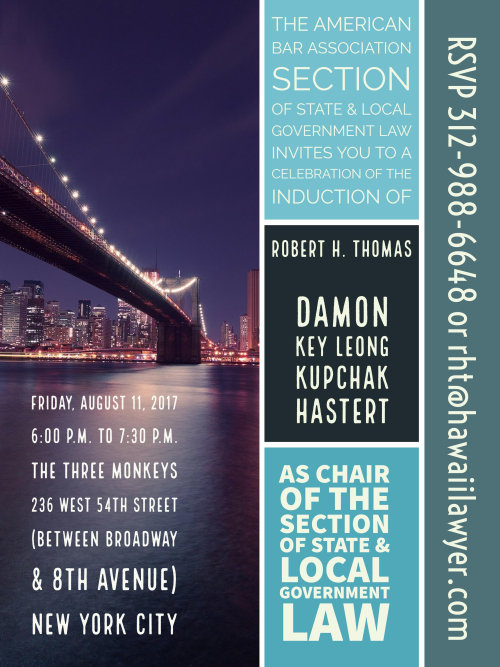
If you are scheduled to be in or near New York City on Friday, August 11, 2017, please consider attending one or both of the following events:

  • 10-11:30am, Midtown Hilton, Concourse E, Concourse level:Murr and Beyond: Implications for Regulatory Takings.” Yes, Murr is the case that keeps on giving, and has already given CLE providers numerous opportunities to add to their coffers. The ABA is sponsoring this program, which includes the lawyers for the two main parties, and two (me included) lawyers who do this kind of thing. Come,  join your colleagues for a roundtable discussion of the case, and more importantly, what comes next. With John M. Groen, Principal Attorney, Pacific Legal Foundation, Sacramento,CA; Robert Thomas, Damon Key Leong Kupchak Hastert, Honolulu, HI; Hon. Misha Tseytlin, Solictor General , WI Dept. of Justice, Madison,WI; and Nancy Stroud, Land Use Attorney, Lewis Stroud & Deutsch, Boca Raton, FL. Our


Continue Reading ABA CLE, NYC: “Murr and Beyond: Implications for Regulatory Takings” – Aug 11, 2017

Escaping gas isn’t enough, it has to be captured.

Yes, a clickbaity title, but this one is about just compensation, so please. You can create your own puns for this case, Northern Natural Gas Co. v. L.D. Drilling Defendants, No. 15-3272 (July 11, 2017), in which the U.S. Court of Appeals for the Tenth Circuit considered things like natural gas injections and escapes, companies that can’t control their gas, and the difference between “migrating,” “injected,” and “native” gas. Yeah, baby.  

Northern owned a mostly-depleted underground natural gas field, and when the gas in place ran out, it used the area as a gas storage area. Over time, it noticed that it was pulling out less gas than it was putting in, leading to the conclusion that some of its stored gas was leaking out into nearby fields, owned by others. So it exercised its delegated power of

Continue Reading Condemnor Didn’t Have To Pay For Escaped Gas

Here are links to the cases and materials we spoke about today during our portions of the APA’s 2017 Planning Law Review webinar:


Continue Reading Cases And Links From Today’s American Planning Association’s 2017 Planning Law Review