6a00d83451707369e2022ad3b86fce200d-800wi

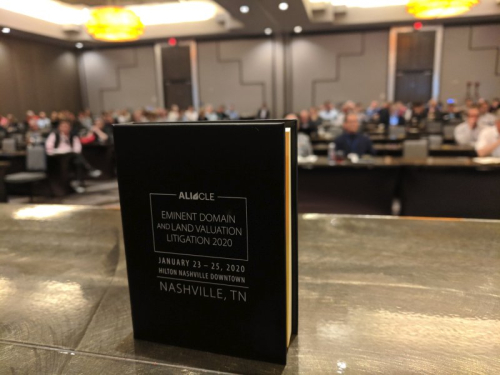
You overwhelmingly asked for Nashville, and we’re bringing it to you!

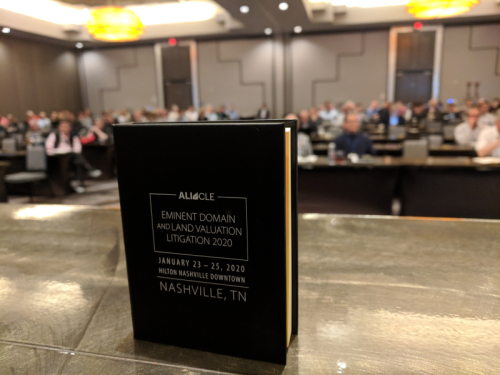
Get ready, and hold your place now: here’s the list of programs and speakers for the 36th Annual ALI-CLE Eminent Domain and Land Valuation Litigation Conference, to be held at the Downtown Nashville Hilton, January 23,- 25, 2020. Two-and-a-half days with top-notch national faculty (lawyers from both sides, judges, legal scholars, appraisers, relocation experts, and others).  

Early registration and group rates are available now

Here are just some of the programs:

  • Featured Presentation: Property Rights as Civil Rights: Seeking Justice Though the Fourth and Fifth Amendments. Hon. Jonathan Apgar, Jamila Johnson, Alan Ackerman. Moderator: Leslie Fields.
  • Making Sense of the New Rules After Knick v. Township of Scott: Where Do I Go, What Do I Do? David Breemer, Smitha Chintamaneni, Professor Bethany Berger. Moderator: Professor Steven Eagle.
  • When A River Runs Thought It: Water Rights and

Continue Reading Here’s The Agenda And Faculty For The 2020 ALI-CLE Eminent Domain And Land Valuation Litigation Conference, Nashville, Jan 23-25, 2020

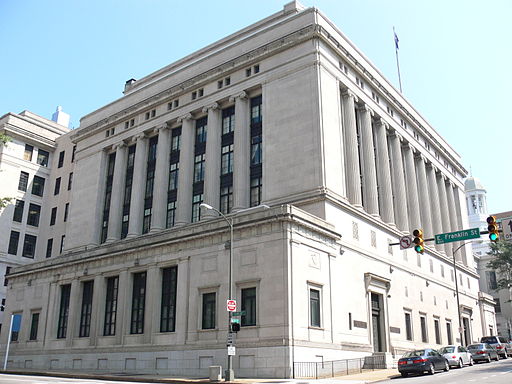
SupremeCourtofVirginiaBuilding

We sometimes assume that everyone gets that the point of an eminent domain valuation trial is to try to establish the price the real-world market of buyers and sellers would have arrived on for the property being taken had the transaction been voluntary. We know it is all hypothetical because this market didn’t actually exist, and the taking itself isn’t a market transaction. In fact, a taking is pretty much the opposite of a market transaction. In other words, you’re trying to recreate a market that did not in fact exist. 

To do so, you try to step into the shoes of a potential buyer of the property. What would they look at when trying to come up with a price? Would they limit themselves to the property’s present use? Maybe. But depending on the circumstances, they also might think its worth paying more than the present use for the

Continue Reading Virginia SCT: Reasonable Probability Of Rezoning Is Something The Jury Should Consider

ALI Nashville 2020

The final agenda and faculty list will soon be officially published, but we wanted to give you a preview of what is in store at the ALI-CLE Eminent Domain and Land Valuation Litigation Conference, January 23-25, 2020, at the Nashville Hilton (downtown, just a few steps away from everything that Nashville has to offer). 

Don’t miss out: in recent years, we’ve been at-or-near capacity, and the conference hotel has even sold out a couple of times. Visit the ALI-CLE website to register and hold your space

Here are some of the things we’ll be discussing: 

  • Making Sense of the New Rules After Knick v. Township of Scott: Where Do I Go, What Do I Do?
  • The Missing Link in Valuing Fixtures
  • When a River Runs Through it: Water Rights and Takings
  • Responding to Project Changes: Valuation When Government Action is Ongoing
  • Property Rights as Civil Rights: Seeking Justice Through


Continue Reading Get Ready: The 2020 ALI-CLE Eminent Domain And Land Valuation Litigation Conference Agenda Coming Soon

Here’s a case that’s pending in the New York Court of Appeals that has been briefed and is awaiting argument. 

In Natural Fuel Gas Supply Corp. v. Schueckler, No. 17-02021 (Nov. 9, 2018), the Appellate Division answered this question:

This appeal therefore presents a novel question of condemnation law: can a corporation involuntarily expropriate privately-owned land when the underlying public project cannot be lawfully constructed?

Slip op. at 1. 

The court stated it clearly: “We answer that question firmly in the negative.”

Like many projects, in order to be built this natural gas pipeline had a long and complex checklist. It needed approvals of FERC — a certificate of public convenience — under the Natural Gas Act. And certain approvals under the federal Clean Water Act. Which in turn meant it needed state enviro checkoffs, here a water quality certificate from a New York agency. It also needed to

Continue Reading NY Court of Appeals Considering Whether A Pipeline Can Take Property For A Project That Can’t Legally Be Built

In Cranston Police Retirees Action Committee v. City of Cranston, No. 2017-36 (June 3, 2019), the Rhode Island Supreme Court concluded that a municipal ordinance “the promulgated a ten-year suspension of the cost-of-living-adjustment (COLA) benefit for retirees of the Cranston Police Department and Cranston Fire Department who were enrolled in the City of Cranston’s pension plan” was not a taking of the pension plans’ members property.

Takings mavens should skip to page 27 of the opinion for the good stuff. First, the court assumed that the plan members possessed “property.” A COLA benefit, once vested, is property, and the parties did not challenge the trial court’s conclusion on that issue. Second, the court rejected the contention that the suspension of COLA benefits was a physical invasion or a Lucas economic wipeout. Slip op. at 30-31. This was a regulatory taking, analyzed under Penn Central‘s three-part ad hoc test.

Continue Reading RI: Ten-Year Suspension Of Pension’s COLA Adjustment Not A Penn Central Taking

20180717_135234_HDR

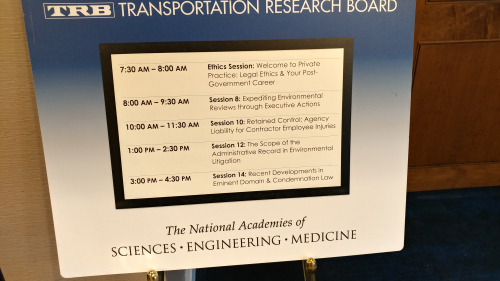
Here are the cases and other items I either spoke about or mentioned at today’s Transportation Research Board‘s 57th Annual Workshop on Transportation Law in Cambridge, Massachusetts:


Continue Reading Links And Materials From Today’s Transportation Research Board Session

20180504_091644_HDR
Surge pricing applies!

You really have to feel for taxi operators who invested what could be huge amounts of money to obtain a taxi medallion getting whacked by the competition from ridesharing outfits like Lyft and Uber. These services look and feel an awful lot like taxis, don’t they? As we wrote in a recent article:

These services—at least from the consumer’s standpoint—operate a heck of a lot like taxis do. You hail a ride (not with your arm and a sharp whistle, but with your fingers and your smartphone), you get in, you go, you get where you are going, you pay the driver (again, with the app, not by handing the driver cash or your credit card). Is that enough of a difference to say that ridesharing isn’t taxicabbing? On that, I am mostly with the taxicab operators. Having used Uber and Lyft more than a few

Continue Reading New York City Allowing Ridesharing Isn’t A Taking Of Taxi Medallions

Untitled Extract Pages

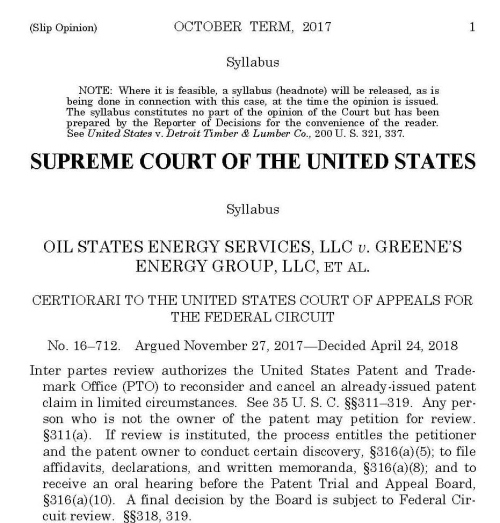
Here’s one we’ve been waiting to drop, but when it did, we were tied up so couldn’t get to it quickly. 

Yes, it’s a patent case. But as we explained here, a case that property mavens should be following because it deals with what is “property,” and where an owner goes to resolve disputes about that property. 

In Oil States Energy Services, LLC v. Greene’s Energy Group, LLC, No. 16-713 (Apr. 24, 2018), the Court’s majority held that patents are a form of “public property” (more like a government-created entitlement), and thus Congress can withhold the usual Article III tribunal and a jury when the validity of that property is challenged. In an opinion by Justice Thomas (joined by everyone but the Chief Justice and Justice Gorsuch), the Court held that “inter partes review,” under which the Patent and Trademark Office administratively reconsiders (and may cancel) previously-issued

Continue Reading Property Lawyers, Read The Supreme Court’s Latest Patent Case

IMG_2947
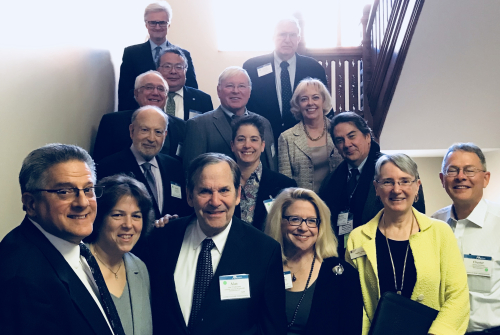
Some of the Land Use Institute faculty, including (front row left), Planning Chair Frank Schnidman and Planning Co-Chair Patty Salkin

Last Friday at the 32nd Annual Land Use Institute in Detroit, I was honored to moderate a freewheeling discussion by a panel of takings experts, Professor Steven Eagle, Minnesota lawyer Howard Roston, and Michigan’s own Alan Ackerman on “Takings, Eminent Domain, and Vested Rights.”

Here are the cases and other materials we discussed, as well as a few others which we did not have time to cover (but wish we could have):


Continue Reading Cases And Materials From The Takings And Eminent Domain Session At The Land Use Institute

20180419_150416_HDR

We’re in Detroit the rest of the week at the Mercy Law School for the venerable Land Use Institute, now in its 32nd iteration.

Planning Chair Frank Schnidman has assembled a great faculty including out Detroit colleague Alan Ackerman (above, talking about takings liability for flooding), and we’ll be spending the time talking inverse condemnation, public trust, planning law, homelessness, autonomous vehicles, affordable housing, RULIPA, and similar topics. We’ll be presenting on “Eminent Domain, Vested Rights, and Regulatory Takings,” “Client Representation: Developer, Government, and Citizens Groups,” and “Federal Laws Affecting Local Land Use Decision Making.” 

If you are here with us in Detroit, stop by and say hello. If you aren’t here, shame on you! This is one of the best and most affordable tuition deals in CLE.

But all kidding aside, if you are not in Detroit now, be sure to calendar these

Continue Reading Land Use Institute – Detroit