
ALI2017 - Copy
ALI2017

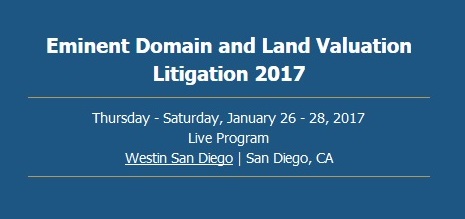
We’ve teased some of the details on the 2017 ALI-CLE Eminent Domain and Land Valuation Litigation and Condemnation 101 Conference, to be held at the Westin San Diego, January 26-28, 2017, but here are the details you’ve been waiting for.

This is the “big one,” our annual 3-day festival of all things eminent domain, property, takings, inverse condemnation, and just compensation. Truly national in scope, this is the 34th annual edition, and the one conference you must attend. Our 2016 conference in Austin was one of the best in years, and we’re on the way to replicating it in 2017, with a great venue in an exciting city. 

Look for the web and printed brochures to show up in your mailboxes, but in the meantime, here are some of the highlights (we’ll post more in the next few days):

  • Relocation, relocation, relocation: we are featuring two sessions on this


Continue Reading Details: ALI-CLE Eminent Domain And Land Valuation Conference – San Diego, January 26-28, 2017

One for you land users. We’re not going to analyze the Hawaii Intermediate Court of Appeals’ published opinion in Robert D. Ferris Trust v. Planning Comm’n of the County of Kauai, No. CAAP-15-0000581 (Aug. 9, 2016) in too much detail, because our Damon Key colleagues Greg Kugle and Chris Leong represent the prevailing appellant. But here’s a short summary, after which you can read the opinion itself.

The narrow issue in the case involves the definition of the term “applicant” in two different sections in the County’s zoning ordinance. The underlying issue is one that’s hot right now across Hawaii and elsewhere: short-term or transient vacation rentals, defined in the Kauai zoning ordinance as rental for less than 6 months.  

Here, the homeowner had a parcel in an agricultural district, with a single-family residence on the lot. It began renting the home to vacationers in 2003, prior to

Continue Reading HAWICA Rejects Planning Department’s Formalistic Definition Of “Applicant” In Vacation Rental Case

A land use diversion, to take you into the weekend. As land users know, the vested rights and zoning estoppel doctrines are all about timing. When did the government gave the green light” (however that is defined in your jurisdiction), what did the property owner do after that, and when did the government decide “hey, wait a minute, we’ve changed our mind” about that earlier green light? For more, see this law review article we co-authored a few years ago that highlights these dynamics. Even the title reflects that it is all about timing: “Arrow of Time: Vested Rights, Zoning Estoppel, and Development Agreements in Hawaii.”

As we wrote, “These closely-related principles permit the government to retain flexibility in land use planning only if a property owner has not proceeded sufficiently along the development path that it would unconstitutional or unfair to prevent it from completion.” 

Well, here’s an opinion from

Continue Reading Cal App: Vested Rights Are All About Timing

There’s a lot of procedural history to digest in the Michigan Court of Appeals’ opinion in AFT Michigan v. Michigan, No. 303702 (June 7, 2016), because it is merely the latest in a long string of opinions from that court, and the Michigan Supreme Court, interspersed with the Michigan legislature’s attempts to react. The opinion lays it all out, and we won’t repeat it here.

The short story is that the legislature adopted a statute which required public school employees to contribute 3% of their salaries to the retirement and health care system. Adding insult to injury, the withholding was labeled as an employer contribution.

The employees sued, alleging a taking among other claims. The court of appeals agreed it was a taking, but while the case languished in the Michigan Supreme Court awaiting discretionary review, the legislature revised the offending parts of the statute. In a different case

Continue Reading Mich App: Forced Employee Contributions To Retirement Fund – Still A Taking

Frisco

The plaintiffs in FLCT, Ltd. v. City of Frisco, No. 02-14-00335-CV (May 26, 2016), owned two adjoining parcels in the Dallas-Ft Worth area at the southeast corner what could be a very busy (and therefore profitable) intersection of two parkways. After checking with the city that the restriction in the Commercial zoning which prohibited the sale of beer and wine within 300 feet of a school wasn’t going to prohibit such sales if they sold the southern portion of the parcels for a school, the owners did so. The owners and their new southern neighbor the school district executed a development agreement that acknowledged that the sale of alcohol on the remaining parcels was okay. Building permit issued. 

A Racetrac gas/convenience store was what they had in mind. But the City amended the zoning code. And that was enough, apparently, to make the planning department change its mind about

Continue Reading Tex App: How To State A Penn Central Regulatory Takings Claim

First, the good part of the recent opinion issued by the New York Supreme Court Appellate Division, First Department (dun dun) in American Economy Ins. Co. v. New York, No. 16095 (Apr. 14, 2016):

Plaintiffs also established that the amendment, as applied retroactively, violates the Contract Clause of the US Constitution because it retroactively impairs an existing contractual obligation to provide insurance coverage “[w]here *** the insurer does not have the right to terminate the policy or change the premium rate” (Health Ins. Assn. of Am. v Harnett, 44 NY2d 302, 313 [1978] [internal quotation marks omitted] [asterisks in original]; see US Const, art I, § 10, cl 1). Defendants failed to show that the impairment is “reasonable and necessary to serve” “a significant and legitimate public purpose *** such as the remedying of a broad and general social or economic problem” (19th St.

Continue Reading New York Appellate Division: Applying New Workers Comp Provisions Retroactively Is A Taking

Earlier this week, we posted our visit to the site of the U.S. Supreme Court’s decision in Hadacheck v. Sebastian, 239 U.S. 394 (1915). It’s been over 100 years since that case was decided by the Court, but to Hinga Mbogo, the Dallas auto mechanic profiled in the above video from the Institute for Justice, 2016 sure must seem like 1915.

The more things change…

Continue Reading Hadacheck Revisited: The More Things Stay The Same Dep’t…

20160114_125445

As we noted here (“Latest On The Latest Hawaii Takings Case: Unconstitutional Conditions, Statutes Of Limitations, And Vested Rights“) the U.S. District Court for the District of Hawaii is considering a regulatory takings case (removed by the defendant State of Hawaii from Hawaii courts) involving a stalled development on the Big Island.

At the hearing last month, District Judge Mollway stated she was inclined to grant a part of the State’s motion for summary judgment and deny the rest, and that she would issue a formal ruling by the end of the month. In this order, filed on the last day of an extended February, the court as promised issued its decision. 

Bottom line: the plaintiff’s takings claims (Lucas and Penn Central) are going to trial, the balance of the remaining claims (vested rights, etc.) are gone.

This case came about after a property owner

Continue Reading Hawaii Federal Court: Get Ready For Trial On Lucas And Penn Central Takings Claims

Here are some upcoming events in which you may be interested, in chronological order:


Continue Reading Upcoming Events And CLE’s – Appellate, RLUIPA, Sharing Economy, And More

We’ve been remiss in updating for the past few days, caught up in the whirlwind that is the ABA Annual Meeting. But that’s now over and we can finally return to our usual blogging routine. 

First up, News of the World:


Continue Reading Takings International – Canada, Philippines … And More