We bring you the latest guest post by colleague Paul Schwind, who has been tracking the issues and arguments that recently led the Hawaii Supreme Court to conclude, in DW Aina Lea Development, LLC v. Bridge Aina Lea, LLC, No. SCAP-13-0000091 (Nov. 25, 2014), that the Hawaii Land Use Commission wrongfully rescinded an earlier reclassification of land (read: “rezoning” to all you non-Hawaii land users).

The oral argument recording is posted above.

We’ll post up our thoughts on the decision in a separate post. 

—————————————————————-

Hawaii Supreme Court In Aina Lea: The Rationales Behind The Opinion

by Paul J. Schwind*

Robert has asked me to summarize the rationales behind the holdings in the Hawaii Supreme Court’s recent opinion in DW Aina Lea Development, LLC v. Bridge Aina Lea, LLC, No. SCAP-13-0000091 (Nov. 25, 2014), which he summarized the following day, outlining the litigation history of the

Continue Reading Guest Post – Hawaii SCT In Aina Lea Case: The Rationales Behind The Opinion

2015 Hawaii Land Use Law Conference Banner - Credits

Registration is now open for the 2015 Hawaii Land Use Law Conference, to be held in downtown Honolulu on Thursday-Friday, January 15-16, 2015.

This is the bi-annual conference, co-chaired by U. Hawaii lawprof David Callies and land use lawyer Ben Kudo, that brings together the big names in our area of law. In other words, the one conference you don’t want to miss if you are a Hawaii land use or property lawyer, in-house counsel, a planner, an appraiser, a property owner or manager, or a law student interested in these topics. 

Download the full brochure here, or view it below. 

The keynote speaker this year is lawprof Richard Epstein, addressing “Stealth Takings: Exactions, Impact Fees and More.” Immediately following his talk, I will be moderating a panel on “Impact Fees and Exactions After Koontz,” with colleagues Bruce Voss and David Brittin. The rest

Continue Reading Registration Open: 2015 Hawaii Land Use Law Conference, Jan. 15-16, 2015

The Hawaii Supreme Court has issued a lengthy opinion in a case we’ve been following, DW Aina Lea Development, LLC v. Bridge Aina Lea, LLC, No. SCAP-13-0000091 (Nov. 25, 2014). 

The litigation is a series of two lawsuits that originated in state court in the Third Circuit (Big Island), one an original jurisdiction civil rights lawsuit, the other an administrative appeal, the latter being the case in which the Supreme Court just ruled.

The essence of the plaintiff’s allegations is that the State Land Use Commission wrongfully amended the land use boundaries from “urban” back to to “agriculture.” Many years earlier, the LUC had amended the boundary to urban on the condition that the owner provide a certain number of affordable units by 2006. In 2008, the developer had not fully done so and the LUC ordered it to show cause why the land classification should not revert to

Continue Reading HAWSCT: Land Use Comm’n Can’t Rescind A Re-zoning Via Truncated Procedures

Here is the recording of last month’s Hawaii Supreme Court oral arguments in Bridge Aina Lea Dev., LLC v. Bridge Aina Lea, No. CAAP-13-0000091.

This is the state court half of the case. The federal court half is pending in the Ninth Circuit, which, after oral arguments earlier in June, decided to hold off on deciding the appeal until after the Hawaii Supreme Court issued its decision in this case. 

Both cases started off in state court in the Third Circuit (Big Island), one an original jurisdiction civil rights lawsuit, the other an administrative appeal from a decision of the State Land Use Commission. The essence of the plaintiff’s allegations is that the LUC wrongfully amended the land use boundaries from urban to agriculture. Many years earlier, the LUC had amended the boundary to urban on the condition that the owner provide a certain number of affordable

Continue Reading HAWSCT Oral Arguments In In Bridge Aina Lea: LUC Reclassifications And Orders To Show Cause

Professor Richard Epstein shares his insight about the U.S. Supreme Court’s recent 8-1 decision in Marvin M. Brandt Revocable Trust v. United States, No. 12-1173 (Mar. 10, 2014).

The issue in the case was whether the federal government retained an “implied reversionary interest” when it issued railroad patents to private landowners, or whether these grants were subject only to a railroad easement. The Court concluded they were easements, which means that they were extinguished when the railroad ceased using them as railroads. 

Professor Epstein joined an amicus brief filed in support of the property owners in the case, which argued that a contrary ruling would violate “the special need for certainty and predictability where land titles are concerned.” 

Listen to the podcast here. Or go to this page and follow the link from there. 


Continue Reading Professor Epstein On SCOTUS Rails-To-Trails Decision

The Hawaii Supreme Court has been on a roll lately, giving us a series of decisions clarifying appellate procedure. So in the past couple of months, we’ve got cases about appealability, dismissing appeals for a brief not conforming to the rules, and what is a final appealable order. Good stuff for those of us who practice a lot in the appellate courts. 

Here’s the latest (and bonus for us, it’s a land use case). It addresses what remedy should be applied by a court of appeals when a case becomes moot while on appeal, and what a court should do with the appealed-from judgment: leave it in place even though it has been rendered academic, or vacate it and wipe it off the books as if it never existed at all? 

The court framed the issue and its conclusion in Goo v. Arakawa, No. SCWC-30142 (Feb.

Continue Reading How Do You Solve A Problem Like … Appellate Mootness? More Process!

Last month, we posted a decision about nonconforming uses, White v. City of Elk River, No. A12-0681 (Minn. Dec. 4, 2013), and want to follow up by posting a good summary of the issues, as well as the amicus brief that was filed in the case in support of the property owner.

Start here (“Can Government Revoke Your Right to Continue an Existing Business?“) by Luke Wake (also one of the counsel who filed this amici curiae brief). Luke’s piece discusses the Minnesota Supreme Court’s holding that the city could not revoke a campground’s nonconforming use as penalty for alleged violations of the conditions of the conditional use permit. The court also held that a nonconforming use is an independent property right, not a mere privilege as a product of a CUP ordinance. Luke writes:

The case raised a question of fundamental importance in Minnesota—one that might

Continue Reading Do You Have A Right To Continue A Business?

14.AGRHI

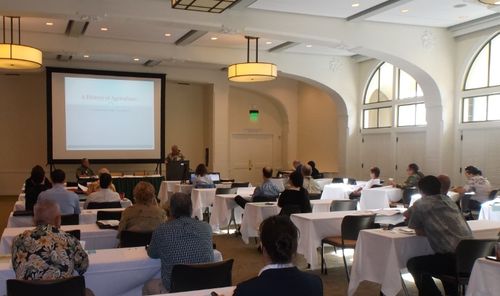
Here are links to some of the materials mentioned at our session today on the GMO issue at the Hawaii Agriculture Law Conference:

DSCF1529
My co-planning Chair, Dave Bateman (a lawyer and a coffee farmer), Continue Reading Links From Today’s Session On GMO Issues

A key win for property rights today in the Minnesota Supreme Court’s decision in White v. City of Elk River, No. A12-0681 (Dec. 4, 2013). In that case, the court concluded that a municipality could not revoke a campground’s nonconforming use as penalty for alleged violations of the conditions of the conditional use permit. The court also held that a nonconforming use is an independent property right, not a mere privilege as a product of a CUP ordinance. 

The campground had been operating since 1973, well before the city adopted zoning. Seven years later, the city adopted an ordinance which banned campgrounds. Three years later, the city amended the ordinance to allow campgrounds as a conditional use (which required a CUP). But later, the city amended the ordinance yet again, to bar campgrounds entirely. During the time that a CUP was required, the campground got one from the city

Continue Reading Minn S Ct: Zoning Requirement To Obtain CUP Does Not Affect Nonconforming Use Owner’s Property Rights

Here’s the amici brief of Pacific Legal Foundation and the Center for Constitutional Jurisprudence in Marvin M. Brandt Revocable Trust v. United States, No. 12-1173 (cert. granted Oct. 1, 2013). That’s the case in which the Court is considering the meaning of the term railroad “right of way” as used in an 1875 federal statute.

As we’ve explained, although this case is a quiet title action out of a Colorado U.S. District Court, it could have huge implications for rails-to-trails takings cases in the Court of Federal Claims and the Federal Circuit. The issue is whether the federal government retained an “implied reversionary interest” when it issued railroad patents, or whether these grants were subject only to a railroad easement. The difference is that easements may be extinguished, while reversionary interests cannot.

The Tenth Circuit, in contrast to other courts, held that the right of way is subject to an implied reversionary interest in favor of the United States, meaning that the property owner doesn’t have “property” that was taken when the railroad was abandoned and was turned into a recreational trail. The merits brief of the petitioners is posted here.

We filed an amicus brief in the case, available here

The PLF/CCJ brief argues:

This case raises important questions regarding the common law system of property ownership and the certainty of titles in property.

In the decision below, however, the Tenth Circuit repudiated the common law rules of property ownership in favor of a per se rule, holding that the United States—the original grantor of the railroad easement and the Brandts’ fee estate—will retain an “implied reversionary interest” in an 1875 Act right-of-way, even after the government patents the underlying land and conveys it to a private party without any express reservation of reversionary rights. … The decision below extended the Tenth Circuit’s rule, holding that all private landowners whose titles are traceable to a federal land patent will be subject to the government’s unexpressed reservation of a reversionary interest in a railroad right-of-way, regardless of the rights and expectations established by their titles.

If not reversed, the Tenth Circuit’s rule will unsettle the rights and expectations of tens of thousands of landowners across the nation. … Amici urge this Court to reverse the Tenth Circuit’s opinion in this case and to reaffirm the fundamental common law principle that ownership of land will be determined by title, not implication.

More background on the case in a piece in Jurist by PLF’s Brian T. Hodges, “Brandt v. US: Should the Common Law of Propert be Scrapped?”  

Amicus Curiae Brief of Pacific Legal Foundation and Center for Constitutional Jurisprudence in Support of P…


Continue Reading Amici Brief In Rails-To-Trails Case: Tenth Circuit Repudiated Common Law Rules Of Property