It’s Friday (and Valentine’s Day), so we’ll make this quick, even thought this is one of those cases with a fact pattern that you just can’t digest quickly: In Day v. Idaho DOT, No. 45552 (Feb. 14, 2020), the Supreme Court of Idaho held that only the property owners at the time of the taking may assert an inverse condemnation claim. That, standing alone (pun intended), is not surprising.

But skip forward to page 7 of the slip opinion where the court determined when the taking occurred (at the time the government action alleged to be a taking — here, an interchange — was “substantially completed,” not on the date the infrastructure project was actually completed):

This begs the following question: When did the taking in this case occur? The district court’s opinion states that “the parties stipulated that the taking occurred on December 5, 1997, when the Isaacs Canyon
Continue Reading Idaho: Only The Owners At The Time Of The Taking Have Standing To Pursue Inverse Claim (Because It Is A “Personal Claim” & Doesn’t Run With The Land)

EOGnEv8W4AAoKnI

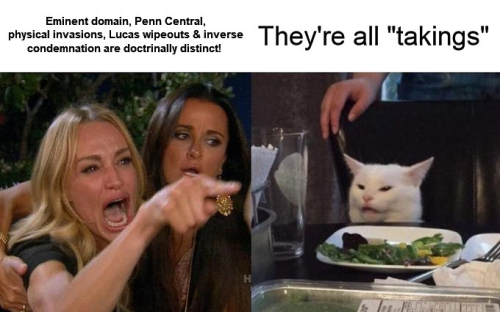
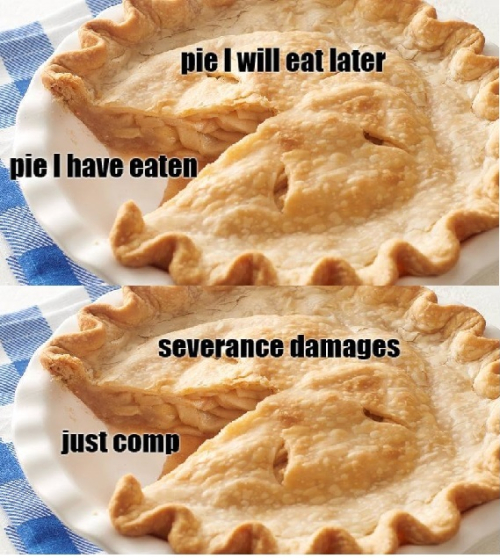
Picture 1: how normal people see pie.

Picture 2: how you see pie if you’re coming to the
ALI-CLE Eminent Domain Conference. 

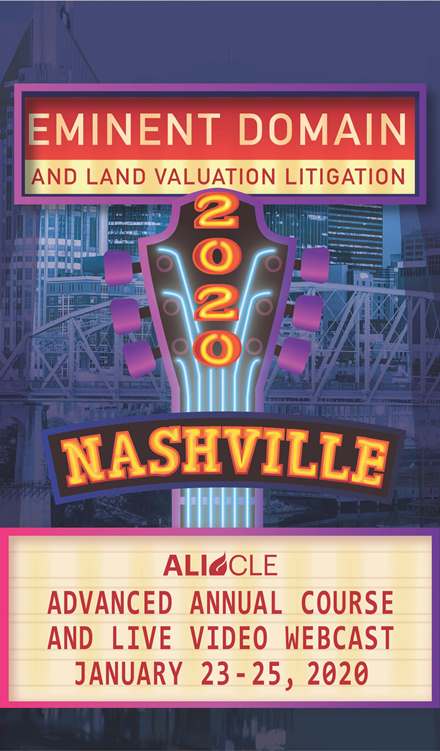
If you get the above, you probably are already set to join us next week for the 37th Annual ALI-CLE Eminent Domain and Land Valuation Litigation Conference in Nashville. (If not, shame on you!).

And having just reviewed the latest registration list, I can report that we have an all-time record attendance.  But there’s still room for those of you still not committed. Register here. Don’t miss out. There will be pie. Continue Reading Record Attendance (But There’s Still Time For You Last-Minute Filers) At Nashville ALI-CLE Eminent Domain Conference

ELHy3bhUYAAdM4B

If there’s one downside to the law school experience from the teacher’s side of the lectern, it’s grading. Especially at a law school like William and Mary that has a pretty strict mandatory curve.

In an upper-division course like “Eminent Domain and Property Rights Law,” where we’re dealing with some very high-level stuff and the quality of the students is uniformly excellent, that makes for some hard choices at this time of year. But we’ve wrapped up grading, and have submitted the official scores.

Although I cannot share with you all the papers themselves, I don’t think my students would mind if I give you a sampling of the topics and titles, just so you can see how the next generation of lawyers is thinking about this area of law: 

  • One Man’s Castle is Another Man’s Parking Lot: A Homeowner’s Theory of Eminent Domain
  • Native Title: Concept and


Continue Reading The Circle Is Now Complete: A Sampling Of Final Paper Topics From William and Mary Law’s Eminent Domain & Property Rights Course

One does not simply walk to nashville

You can also fly, drive, or bike to the upcoming 37th Annual ALI-CLE Eminent Domain & Land Valuation Litigation Conference. in Nashville. Limited space still available, so don’t delay further and register now. We’re on track to record attendance, so you don’t want to miss the best nationally-focused three-day program on our area of law.

Takings, Knick, compensation, appraisals … and a bit of fun thrown in. We have many new attendees, and many new speakers, too.  Continue Reading (Nearly) Last Chance To Join Us In Nashville For ALI-CLE’s Eminent Domain Conference

We’ve been meaning to post the Texas Court of Appeals’ opinion in Zaatari v. City of  Austin, No. 03-17-00812 (Nov. 27, 2019) for some time.  

The City of Austin adopted an ordinance that, among other things, prohibited short term rental of a residence that is not also owner-occupied, barred certain activities (such as weddings) on other properties, and permitted City officials to enter such properties to ensure compliance with the regulations. Property owners challenged the ordinance, and the State of Texas intervened as a plaintiff. The trial court granted the City summary judgment.

The court of appeals reversed:

The ordinance provision banning non-homestead short-term rentals significantly affects property owners’ substantial interests in well-recognized property rights while, on the record before us, serving a minimal, if any, public interest. Therefore, the provision is unconstitutionally retroactive, and we will reverse the district court’s judgment on this issue and render judgment declaring

Continue Reading Tex App: City Ordinance Prohibiting Short-Term Rentals Unconstitutional

Emoji_u1f4a9.svg

There’s nothing terribly novel in the Texas Court of Appeals’ opinion in City of Houston v. The Commons at Lake Houston, Ltd., No. 14-18-00664-CV (Oct. 15, 2019), but we highlight it here for a couple of reasons. 

First, the court’s holding that a regulatory takings claim was not ripe because the property owner had not sought a permit — and as a consequence, the city had not yet reached a “final decision” whether the regulations in question (which require that buildings in an area be built at least two feet above certain floodplains) — reminds us that the first prong of Williamson County ripeness is alive and well (even though this was a case purely under Texas law, so Williamson County did not govern). The court noted that the owner “had not any permit of plat applications, or requests for variances, denied as a result of the amended

Continue Reading City Engineer’s Email Was Not “Official Action” Triggering Vested Rights Even If You Responded With A Smiley Emoji

IMG_20191004_124327

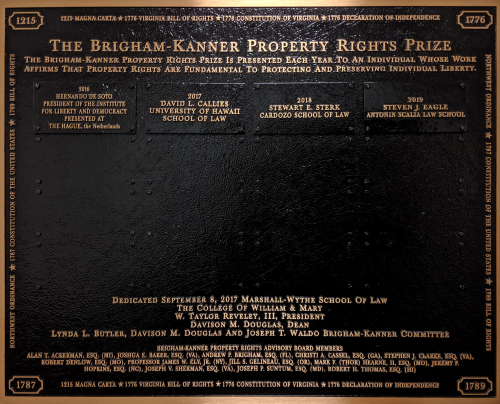
Here is a transcript of the remarks I delivered today at the 2019 Brigham-Kanner Property Rights Conference. I was honored to join lawprof Henry Smith and Florida Supreme Court Justice (ret.) Ken Bell (who authored the Florida court’s opinion in Stop the Beach Renourishment which was challenged in SCOTUS as a “judicial taking”) to speak about “Public Resources and Private Rights” (moderated by Professor Katherine Mims Crocker). After paying our respects to 2019 B-K Prize winner Professor Steven Eagle, we each addressed some part of the question.

—————————-

The New New Property

As always, I bring to you tidings of “aloha” from the state where the legislature thought it was a going to reduce the price of residential housing by taking fee simple interests from “A” and giving them to “B,” the leaseholders

Where now, the median price for a single-family, two bedroom, one bath

Continue Reading 2019 Brigham-Kanner Conference: The New New Property – Public Resources And Private Rights

Last week, along with Bob Grace, I (Robert (don’t-call-me-Bob) Thomas), was a guest on Clint Schumacher’s Eminent Domain Podcast. Stream it above, or download it here.

Clint and I had a wide-ranging discussion that centered on the recent trend of limiting short-term rentals, the legal pushback, and (of course) takings. We discussed the memorably-captioned Tiki Island case from Clint’s home state of Texas. Penn Central, naturally. Vested rights. Mrs. Murphy exceptions (although those deal with discrimination in rental housing). First Amendment stuff. The upcoming ALI-CLE Eminent Domain and Land Valuation Litigation Conference in Nashville (Jan 23-25, 2020), at which both Clint and Bob are speaking. And The Castle (which might not only be our favorite eminent domain movie, but our favorite movie period). 

Check it out.

Not only is Clint presenting at our Ethics program in Nashville in January, he will — as he did

Continue Reading Latest Ep, Eminent Domain Podcast: Short-Term Rentals, Tiki Island, The Castle, Penn Central